

AP Syllabus focus:
‘Ecosystems provide services such as food and materials, climate and water regulation, cultural benefits, and processes that support life.’
Ecosystems sustain human societies by generating natural “services” that support economies, health, and wellbeing. This page highlights concrete, test-ready examples of the services ecosystems provide and what ecological features produce them.
Ecosystem services: what they are
Ecosystem services are the beneficial outputs and functions of ecosystems that humans rely on, from tangible goods to life-supporting processes.
Ecosystem services: the benefits people obtain from ecosystems, including material goods, regulation of environmental conditions, nonmaterial benefits, and underlying ecological processes.
Provisioning services: food and materials
Provisioning services are the products harvested, consumed, or used as raw materials.
Food and freshwater
Food: fish and shellfish from coastal waters; game animals; crops supported by soil ecosystems; edible plants and fungi.
Freshwater supply: forested watersheds and intact soils promote infiltration and groundwater recharge, maintaining springs and baseflow to streams.
Materials and medicines
Timber and fibre: wood for construction/paper; plant fibres (e.g., cotton, hemp) supported by fertile soils and pollinators.
Fuel: fuelwood and biomass from forests and grasslands.
Biochemical and genetic resources: natural compounds used for pharmaceuticals; crop wild relatives that provide traits like drought tolerance for breeding.
Regulating services: climate and water regulation
Regulating services stabilize environmental conditions, often by controlling flows of energy, water, and chemicals.
Climate regulation
Carbon storage (sequestration): forests, grasslands, wetlands, and soils store carbon in biomass and organic matter, moderating atmospheric greenhouse gas concentrations.
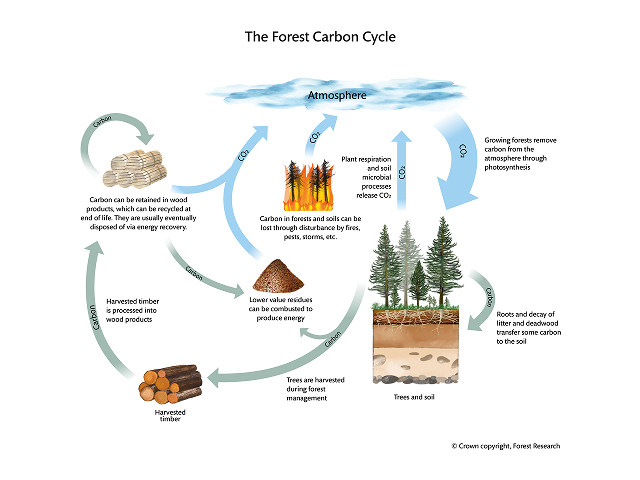
This diagram summarizes the forest carbon cycle, showing carbon uptake from atmospheric CO₂ through photosynthesis and carbon release back to the atmosphere through plant respiration and microbial decomposition. It also distinguishes major storage pools (tree biomass, dead organic matter, and soils) and shows how disturbances and harvested wood products can shift carbon among pools over time. Source
Local temperature regulation: tree canopy shade and evapotranspiration cool air; urban green spaces reduce heat-island intensity.
Water regulation and purification
Flood regulation: wetlands and floodplains slow runoff and store stormwater, reducing peak discharge.
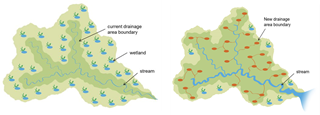
This comparison diagram shows how intact wetlands act like natural storage, spreading and temporarily holding runoff so water moves downstream more slowly. The drained-wetland scenario illustrates reduced storage and faster delivery of water to streams, which increases flood peaks and downstream flood risk. Source
Water purification: soils, riparian vegetation, and wetland microbes filter sediments, bind some pollutants, and transform nutrients through microbial processes, improving downstream water quality.
Other regulation examples students should recognise
Erosion control: plant roots anchor soil; ground cover reduces raindrop impact and surface runoff.
Pollination: wild insects (bees, butterflies, flies) pollinate many fruit, vegetable, and seed crops, increasing yield and quality.
Pest and disease regulation: predators and parasitoids reduce some agricultural pests; diverse communities can limit outbreaks by reducing host dominance.
Cultural services: nonmaterial benefits
Cultural services are intangible benefits that affect quality of life and social systems.
Recreation, aesthetics, and education
Recreation and ecotourism: parks, coral reefs, rivers, and mountains support hiking, diving, fishing, and wildlife viewing.
Aesthetic value: scenic landscapes and biodiversity contribute to art, inspiration, and place-based identity.
Scientific and educational value: ecosystems serve as living laboratories for research and field learning.
Spiritual and cultural identity
Spiritual significance: sacred groves, culturally important species, and traditional harvest areas support belief systems and heritage.
Mental health benefits: access to nature can reduce stress and improve wellbeing (a cultural service even when not monetised).
Supporting processes: “processes that support life”
Supporting services are the foundational ecological processes that make other services possible.
Core life-support functions
Primary productivity: photosynthesis forms the base of food webs, enabling biomass production.
Nutrient cycling: decomposers (fungi, bacteria, detritivores) recycle nitrogen, phosphorus, and carbon, maintaining soil fertility.
Soil formation: weathering plus organic matter accumulation builds soils that store water and nutrients.
Habitat provision: ecosystems provide breeding sites, shelter, and migration corridors that maintain populations and biodiversity.
Practice Questions
State three ecosystem services and give one example of each. (3 marks)
1 mark: correct service type stated (e.g., provisioning/regulating/cultural/supporting), up to 3
1 mark each: matching valid example (e.g., provisioning—timber/food; regulating—flood control/carbon storage; cultural—recreation; supporting—nutrient cycling), up to 3
Explain how wetlands can provide (i) water regulation and (ii) water purification services. Include specific mechanisms. (6 marks)
1 mark: wetlands store water and reduce peak flow (flood regulation)
1 mark: slowed water movement increases infiltration/temporary storage
1 mark: vegetation/roughness dissipates flow energy, reducing downstream flooding/erosion
1 mark: sediments are trapped/settle out in slow water
1 mark: soils/organic matter adsorb some pollutants/nutrients
1 mark: microbial processes transform nutrients (e.g., denitrification reduces nitrate)
FAQ
Common approaches include avoided cost (damage prevented), replacement cost (what it would cost to replace the service), and production functions linking ecosystem condition to yields.
To avoid double-counting: supporting processes (e.g., nutrient cycling) underpin other services already valued (e.g., crop production), so pricing both can overestimate totals.
They can also create disservices, such as allergenic pollen, disease vectors in some habitats, or crop damage by wildlife, depending on context and management.
Indicators can include wide riparian vegetation, intact wetlands, low turbidity after storms, stable banks, and high organic soils that support active microbial communities.
Higher diversity can add functional redundancy (multiple species performing similar roles), which can stabilise service delivery when conditions change or one species declines.
