

AP Syllabus focus:
‘Human activities can disrupt ecosystem services, leading to ecological damage and economic consequences for communities.’
Human actions can weaken or remove the benefits ecosystems provide to people. Understanding the main disruption pathways helps explain real-world ecological damage and why communities often face costly, long-lasting economic consequences.
What it means to disrupt ecosystem services
Ecosystem services: the benefits humans obtain from ecosystems, including material goods and the natural processes that maintain habitable conditions.
Disruption occurs when human activities reduce an ecosystem’s capacity to function (its structure and processes) so it can no longer deliver services reliably, at sufficient scale, or at acceptable quality.
Key idea for APES
Human-driven change often creates trade-offs: increasing a short-term benefit (e.g., crop yield) while degrading other services (e.g., water purification, flood control), producing ecological damage and later economic costs.
Major human activities that disrupt services
Land-use change and habitat conversion
Deforestation, wetland drainage, urbanisation, road building, and agricultural expansion
Disrupts services by:
Removing biomass and root networks that stabilise soil (erosion increases)
Reducing infiltration and groundwater recharge (more runoff and flooding)
Fragmenting habitat, lowering functional biodiversity that supports processes like pollination and pest control
Pollution and waste
Nutrient pollution (fertilisers, sewage) can trigger algal blooms that reduce oxygen, harming fisheries and water quality.
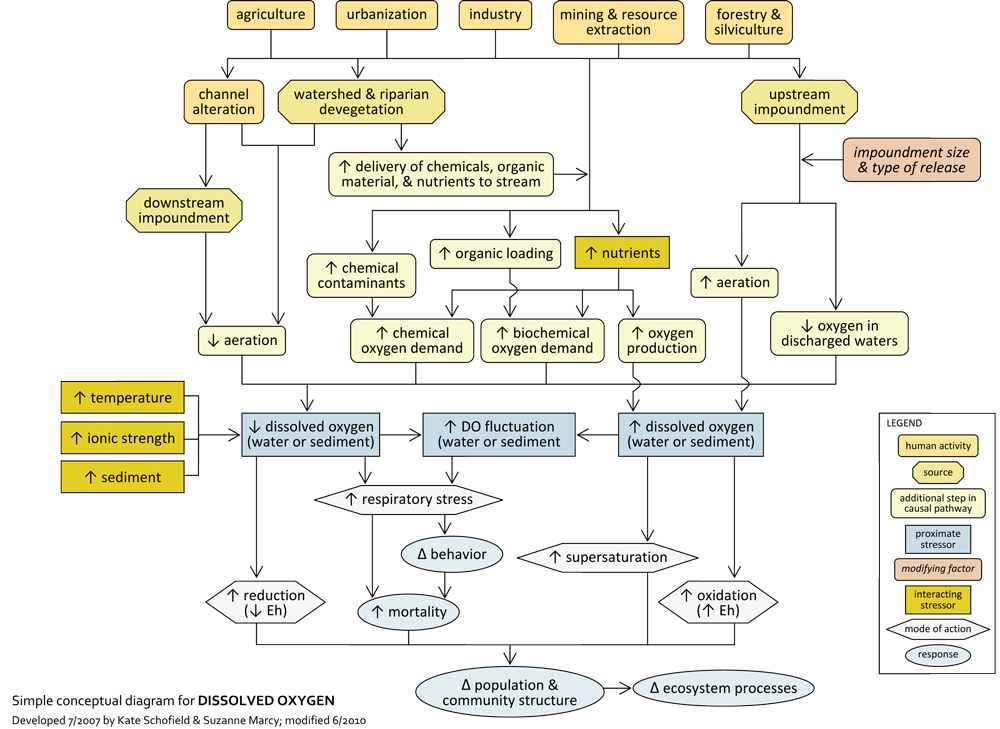
Conceptual model showing how human sources (e.g., wastewater discharges and runoff) can increase oxygen demand in waters, driving dissolved oxygen (DO) downward and leading to biological impairments. It visually connects “source → stressor → response,” reinforcing how pollution weakens ecosystem regulation services such as water quality maintenance. Source
Toxic contaminants (pesticides, heavy metals, industrial chemicals) can:
Bioaccumulate/biomagnify, impairing predators and reducing ecosystem regulation
Reduce decomposer activity, slowing nutrient cycling and soil formation
Air pollutants (ozone, particulates, acid deposition precursors) can damage vegetation and alter soil/water chemistry, weakening productivity and water-filtering capacity.
Overexploitation of organisms and resources
Overfishing, unsustainable hunting/harvesting, excessive groundwater withdrawal, and timber extraction
Disrupts services by:
Removing key functional groups (e.g., grazers, predators), causing trophic cascades
Shifting ecosystems to less desirable states (e.g., fishery collapse; algal-dominated waters)
Reducing resilience so recovery after stress is slower and less predictable
Climate change driven by greenhouse gas emissions
Warming, altered precipitation, sea-level rise, and more extreme events can:
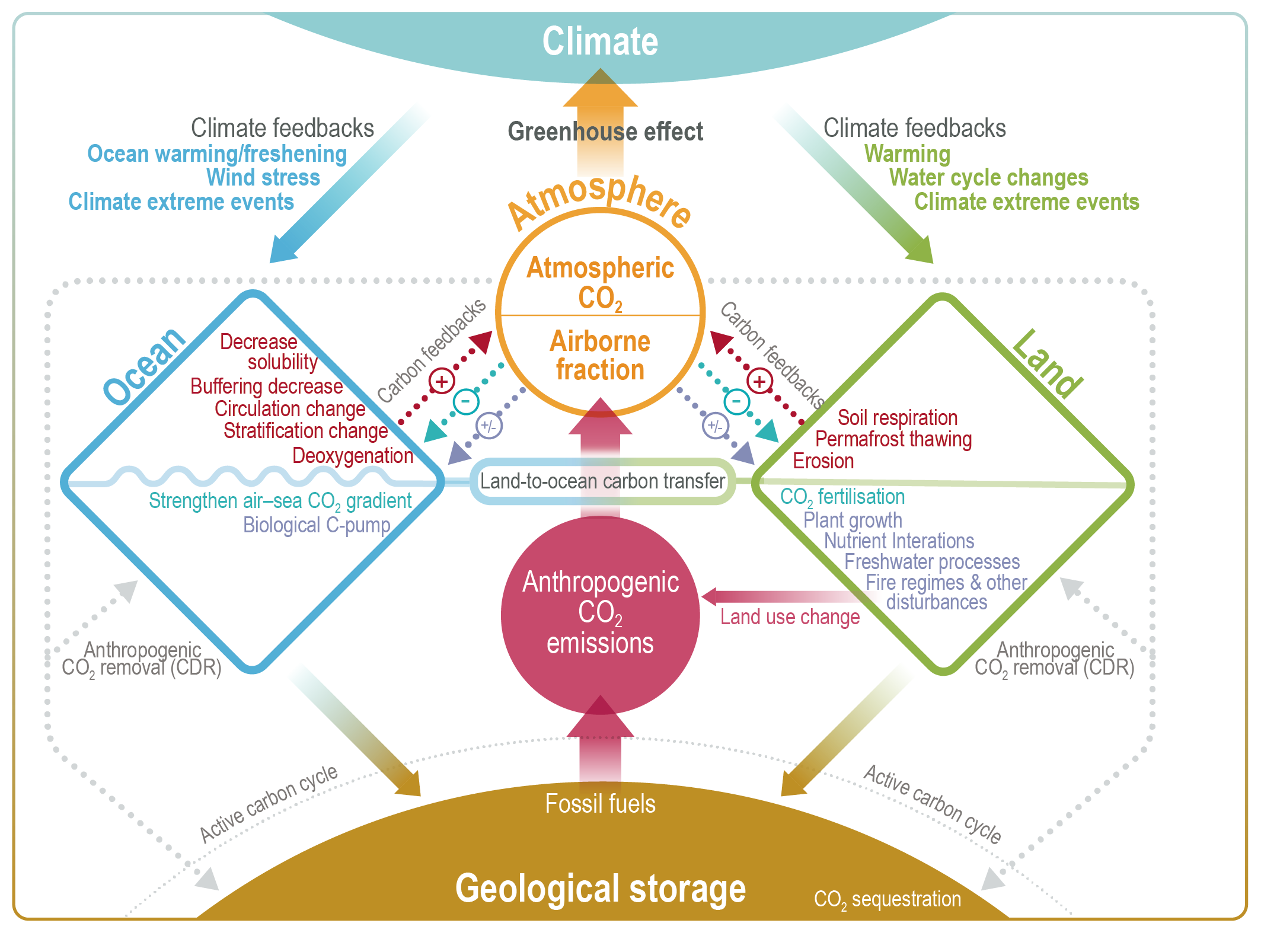
IPCC schematic of the coupled carbon–climate system, showing how anthropogenic CO emissions are divided among the atmosphere, ocean, and land, and how feedbacks can reinforce warming and associated impacts. This helps connect greenhouse gas emissions to downstream ecosystem-service disruptions, including reduced carbon storage and altered water-cycle regulation. Source
Exceed tolerance thresholds, reducing productivity and increasing mortality
Change timing of biological interactions (e.g., plants vs pollinators), reducing service reliability
Increase wildfire risk and pest outbreaks, degrading carbon storage and watershed protection
Species introductions and pathogen spread
Global trade and travel move organisms beyond natural barriers.
Invasive species can outcompete or prey on native species, altering community structure and reducing service-providing functions (e.g., stable fisheries, water clarity, culturally valued species).
How ecological damage translates into economic consequences
Direct costs (paid quickly and visibly)
Higher municipal costs for water treatment when natural filtration declines
Increased spending on flood control and disaster recovery when wetlands/forests are lost
Reduced income from fisheries, forestry, and agriculture when yields fall or become variable
Indirect costs (delayed, widespread, and uneven)
Health burdens from degraded air/water quality (medical costs, lost productivity)
Loss of tourism and recreation revenue when ecosystems degrade (beaches, reefs, parks)
Rising insurance and infrastructure costs as risk increases
Disproportionate impacts on low-income communities, where fewer alternatives exist and dependence on local ecosystem services is high
Why the costs persist
Many services are supported by slow processes (soil formation, groundwater recharge, species interactions), so damage can be long-lasting and sometimes irreversible on human time scales.
Reducing disruption (high-level approaches)
Prevent pollution at source (nutrient management, industrial controls)
Protect and restore high-service ecosystems (wetlands, riparian buffers, forests)
Set sustainable harvest limits and enforce them
Incorporate ecosystem service valuation into planning to reveal hidden costs and reduce harmful trade-offs
Practice Questions
Describe two ways human activities can disrupt ecosystem services and give one ecological impact for each. (3 marks)
1 mark: Correct disruption pathway (e.g., nutrient runoff, deforestation, overfishing, toxic pollution, invasive species).
1 mark: Matching ecological impact for first pathway (e.g., eutrophication/hypoxia, erosion, trophic cascade, biodiversity loss).
1 mark: Matching ecological impact for second pathway.
Explain how conversion of wetlands to urban land can lead to both ecological damage and economic consequences for nearby communities. (6 marks)
1 mark: Wetland loss reduces water storage/infiltration (less natural flood regulation).
1 mark: Increased runoff/peak discharge raises flood frequency or severity (ecological damage acceptable if clearly linked).
1 mark: Reduced filtration leads to poorer water quality (nutrients/sediments/contaminants).
1 mark: Ecological consequence such as habitat loss for aquatic species or reduced biodiversity/function.
1 mark: Economic consequence such as higher water treatment costs or flood damage to property/infrastructure.
1 mark: Economic consequence such as loss of fisheries/recreation/tourism revenue or increased insurance/health costs.
FAQ
Common approaches include avoided-cost (e.g., water treatment), replacement-cost (e.g., built flood defences), and willingness-to-pay surveys.
These methods can miss cultural values and long-term, non-linear ecosystem change.
Ecosystems can cross thresholds where feedbacks amplify change.
After a tipping point, recovery may require much larger reductions in pollution than the increase that triggered the shift.
Higher dependence on local natural resources, fewer financial buffers, limited infrastructure, and historical underinvestment increase vulnerability.
Governance and access to alternative livelihoods also matter.
Strategies include green infrastructure (rain gardens, permeable pavements), protecting riparian corridors, and zoning that avoids high-service areas.
Maintenance and correct placement are critical for performance.
Restoration may rebuild habitat structure without fully recovering functions like nutrient cycling or water purification.
Service recovery can lag due to lost species interactions, altered soils, or changed hydrology.
