

AP Syllabus focus:
‘Ecosystem services are commonly grouped into four categories: provisioning, regulating, cultural, and supporting services.’
Ecosystems sustain human societies in multiple ways, from producing usable goods to stabilising Earth systems.
AP Environmental Science groups these benefits into four categories to clarify how nature supports economies, health, and long-term environmental quality.
What are ecosystem services?
Ecosystem services: the benefits people obtain from ecosystems, including goods, life-support functions, and nonmaterial benefits.
A single ecosystem can provide several services at once, and the same service can occur across many ecosystem types. The four-category framework is a classification tool used to describe these benefits consistently.
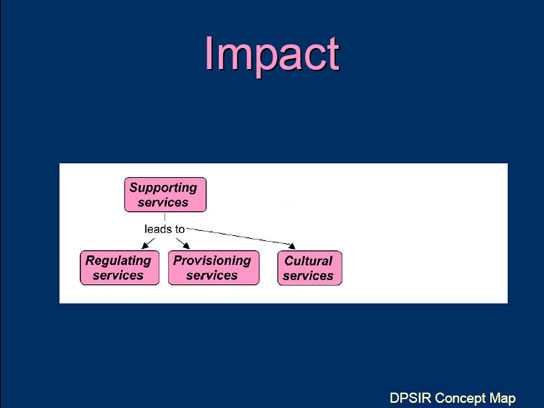
Concept map of the Millennium Ecosystem Assessment’s four ecosystem-service categories. The diagram highlights the hierarchical idea that supporting services (core ecological processes) underpin and enable provisioning, regulating, and cultural services. Source
Provisioning services (goods and materials)
Provisioning services are the ecosystem services that supply tangible products that humans directly harvest, extract, or use. They are often traded in markets, so they can appear in economic statistics more easily than other categories.
Key features of provisioning services:
Deliver physical goods that can be stored, transported, and consumed.
Depend on ecosystem productivity and the maintenance of living populations.
Are frequently managed through resource-use policies (e.g., harvest limits), although the category itself is broader than any one policy approach.
Provisioning services are typically the most intuitive because they resemble “resources,” but the classification emphasises that they originate from functioning ecosystems rather than being independent commodities.
Regulating services (control of environmental conditions)
Regulating services are benefits gained from the regulation of ecological processes that keep environmental conditions within ranges that support human life and economic activity. They often reduce risk, damage, or costs by moderating natural variability.
Core characteristics of regulating services:
Operate through system-level processes (often across large areas).
Can be preventative (reducing the likelihood of harm) rather than providing a product.
Are commonly evaluated through avoided costs (what society would pay to replace the service technologically), even when no direct market price exists.
This category focuses on the “control” functions of ecosystems—how they stabilize, buffer, filter, and moderate conditions that affect people and infrastructure.
Cultural services (nonmaterial benefits)
Cultural services are the nonmaterial ecosystem services that contribute to quality of life, identity, and well-being. They include the ways people value ecosystems beyond physical survival and economic production.
Typical traits of cultural services:
Provide psychological, social, educational, and spiritual benefits.
Are strongly influenced by context (culture, access, tradition, and individual experience).
Are harder to quantify, but still important for decision-making because they can shape public priorities and conservation outcomes.
Because cultural services are not primarily “used up” like goods, they are often discussed in terms of experience, meaning, and opportunities rather than extraction.
Supporting services (underpinning ecological function)
Supporting services describe the foundational ecological structures and processes that make the other three categories possible. They are sometimes considered “indirect” services because they maintain the conditions for ecosystem functioning.
Supporting services are often distinguished by their role in maintaining ecosystem integrity:
They occur over long time scales and can be diffuse across landscapes.
They are closely tied to ecosystem resilience and continued functioning.
They are frequently omitted from simple economic accounting to avoid “double counting” (because they contribute to provisioning, regulating, and cultural services).
Supporting services: ecosystem functions and processes that sustain ecosystems and enable other ecosystem services to exist.
In practice, recognising supporting services helps students connect human benefits to underlying ecological processes rather than treating benefits as isolated outputs.
Using the four categories as an organising framework
The four-category system is used to:
Identify the full range of benefits associated with an ecosystem (not only marketable goods).
Compare trade-offs among categories (e.g., increasing one category can reduce another).
Communicate ecosystem value to different audiences (scientific, economic, and civic) using shared terminology.
Structure inventories and assessments so benefits are not overlooked, especially cultural and supporting services.
Practice Questions
State the four categories of ecosystem services used in AP Environmental Science. (2 marks)
Provisioning (1)
Regulating, cultural, and supporting (1) (all three must be stated for the second mark)
Explain how provisioning, regulating, cultural, and supporting services differ from one another, and describe why supporting services are often treated differently in ecosystem service assessments. (6 marks)
Provisioning services described as tangible goods/materials directly obtained from ecosystems (1)
Regulating services described as benefits from regulation/moderation of environmental conditions or ecological processes (1)
Cultural services described as non-material benefits (e.g., well-being/educational/spiritual/recreational value) (1)
Supporting services described as underlying processes/functions that enable the other services (1)
Clear explanation that supporting services underpin other categories (1)
Reason supporting services treated differently: risk of double counting in valuation/assessment, or because they are indirect and long-term (1)
FAQ
They separate ecosystem functions from final benefits.
Common approaches include:
Counting supporting processes only insofar as they contribute to a final service (e.g., count the final benefit rather than every underlying step).
Using “intermediate” (supporting) versus “final” (direct) service frameworks.
This keeps totals from inflating when the same benefit is attributed to multiple categories.
Cultural value depends on history, beliefs, access, and social norms.
A place may have high cultural importance to one group and little to another. Assessment often requires:
Community consultation and qualitative evidence
Place-based indicators (participation, visitation patterns, heritage significance)
These differences make standardised scoring challenging.
Yes, depending on how it is defined and measured.
For instance, an ecosystem feature may create:
A direct good (provisioning)
A risk-reduction benefit (regulating)
A nonmaterial experience (cultural)
Good assessments define the “service” precisely to keep categories consistent.
Natural capital refers to the stock (ecosystems, species, soils, water) that generates flows of services.
The four service categories describe the flows. Natural capital accounting tries to track:
Condition/extent of the stock
Quantity/quality of service flows over time
This distinction supports long-term planning.
Analysts use indirect valuation methods when no market price exists, such as:
Avoided cost and replacement cost (common for regulating services)
Stated preference surveys and travel-cost methods (often for cultural services)
Each method has uncertainties, so results are typically reported with assumptions and limitations.
