

AP Syllabus focus:
‘Organisms adapt over time through incremental genetic changes that can occur on both short- and long-term time scales.’
Adaptations arise when heritable genetic variation changes in frequency across generations. In AP Environmental Science, this means linking environmental pressures to population genetics, over time scales ranging from a few generations to many thousands.
What an adaptation is (and is not)
Adaptations form at the population level, not because individual organisms “try” to change. Individuals can show short-term physiological or behavioural adjustments, but those are not genetic adaptations unless they alter inherited allele frequencies.
Adaptation: A heritable trait that increases survival and/or reproductive success in a particular environment, becoming more common in a population over generations.
A key implication is that adaptations depend on existing genetic variation and on environmental conditions that consistently favour some variants over others.
The genetic basis of incremental change
Adaptation requires heritable differences among individuals. The raw material for adaptive change comes from genetic processes that create or reshuffle variation:
Mutation: random changes in DNA that create new alleles (most neutral or harmful; some beneficial in a given environment).
Recombination during sexual reproduction: new allele combinations via crossing over and independent assortment.
Gene flow: movement of alleles among populations through migration and reproduction, which can introduce potentially beneficial alleles.
Because these inputs occur continually, populations can accumulate incremental genetic changes—small shifts in allele frequencies—rather than abrupt, directed transformations.
Natural selection as the main adaptive mechanism
When environmental conditions create consistent differences in survival or reproduction, natural selection can increase the frequency of advantageous alleles.
Natural selection: Differential survival and reproduction of individuals with heritable traits, causing advantageous alleles to become more common over generations.
For selection to produce adaptation, all three conditions must hold:
Variation: individuals differ in a trait.
Heritability: some of that variation is genetic and passed to offspring.
Differential fitness: differences in the trait affect fitness (reproductive success) in that environment.
Forms of selection that shape traits
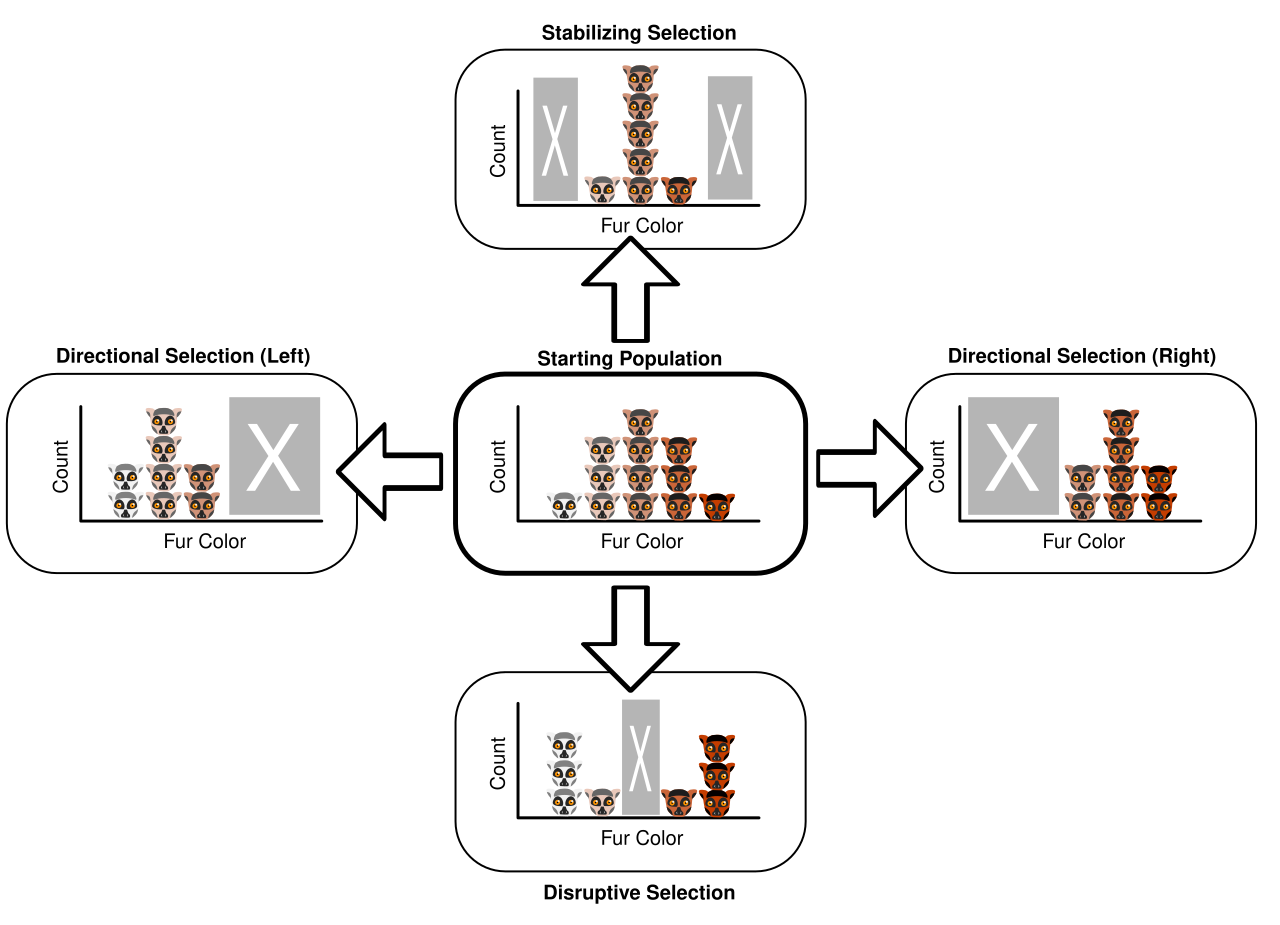
This diagram compares how directional, stabilizing, and disruptive selection change the distribution of phenotypes in a population. It highlights which phenotypes are selected against versus favored, and shows how the mean and/or variance can shift depending on the selection pattern. Source
Directional selection: one extreme phenotype is favoured (often during sustained environmental change).
Stabilising selection: intermediate phenotypes are favoured (often in stable environments).
Disruptive selection: both extremes are favoured (can maintain polymorphism and potentially contribute to divergence over longer periods).
Short- vs long-term time scales in adaptation
The syllabus emphasises that incremental genetic changes can occur on short and long time scales.
Short-term (ecological) time scales
Adaptive change can be observed over a few to tens of generations when:
selection pressure is strong (e.g., a new pollutant, pathogen, or predator),
populations are large enough to avoid losing beneficial alleles by chance,
there is substantial standing genetic variation already present.
Short-term adaptation often reflects shifts in frequencies of existing alleles rather than waiting for new mutations.
Long-term (evolutionary) time scales
Over hundreds to millions of generations, additional processes become important:
accumulation of many small-effect genetic changes (often across multiple genes),
emergence of new mutations that may become advantageous as environments change,
divergence among populations as selection differs across habitats.
Over long periods, incremental changes can yield complex suites of traits that match local conditions, especially when selective pressures persist.
Other evolutionary forces that affect adaptation
Not all genetic change is adaptive. These forces can speed, slow, or redirect adaptive outcomes:
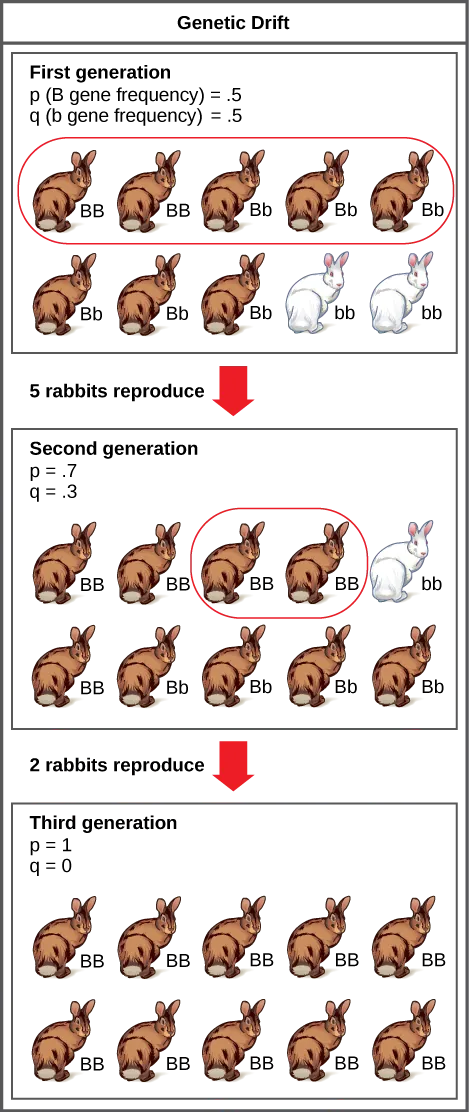
These figures illustrate two non-selection processes that change allele frequencies: genetic drift (random sampling can eliminate an allele, especially in small populations) and gene flow (migration moves alleles between populations). Together, they reinforce that populations can evolve through both chance events and movement of individuals, not only through natural selection. Source
Genetic drift: random allele frequency changes (strongest in small populations); can remove beneficial alleles before they spread.
Gene flow: can help by introducing beneficial alleles, or hinder by “swamping” local adaptation with alleles suited to different conditions.
Non-random mating/sexual selection: can increase traits that improve mating success, sometimes with survival trade-offs.
Constraints and trade-offs
Adaptations are limited by biology and history; selection works with what is available.
Trade-offs: a trait improving one function may reduce another (energy allocation, growth vs reproduction, defence vs competitiveness).
Environmental context: a trait beneficial under one set of conditions may be neutral or harmful under another.
Genetic constraints: limited variation, linked genes, or complex polygenic traits can slow adaptive change.
These constraints help explain why populations can be well-suited to their environments without being “perfectly” optimised.
Practice Questions
State two necessary conditions for natural selection to lead to adaptation in a population. (2 marks)
Any two of: heritable variation present; trait affects survival and/or reproductive success; differential reproduction leads to allele frequency change. (1 mark each)
Explain how adaptations can develop through incremental genetic changes on both short and long time scales. Include the role of genetic variation and at least one factor that can limit or counter adaptation. (6 marks)
Mentions mutations/recombination/gene flow as sources of heritable variation. (1)
Explains natural selection changes allele frequencies over generations (differential fitness). (1)
Describes short time scale as occurring over few generations, often from standing variation and strong selection. (1)
Describes long time scale as accumulation of many small genetic changes and/or new mutations over many generations. (1)
Includes a limiting/counter factor (genetic drift, gene flow swamping, constraints, trade-offs) with correct effect. (1)
Uses clear linkage between environment → fitness differences → allele frequency change → trait becomes common. (1)
FAQ
Adaptation is genetic and inherited across generations.
Acclimatisation is a reversible, within-lifetime adjustment and does not require allele frequency change.
Epigenetic marks can alter gene expression and sometimes persist across generations.
They are usually less stable than DNA sequence changes; whether they qualify depends on heritability and long-term persistence under selection.
Chance matters: in small populations, genetic drift can eliminate beneficial alleles.
Benefits can also depend on context (e.g., only helpful under specific conditions).
They test whether individuals with the trait leave more offspring (higher fitness).
Common approaches include field fitness comparisons, breeding studies of heritability, and tracking allele frequency changes over time.
Some traits are influenced by single genes, but many environmental tolerances are polygenic.
Polygenic adaptation can be gradual because selection acts on many small-effect alleles at once.

