

AP Syllabus focus:
‘Sudden or gradual environmental change can threaten survival, requiring individuals to change behavior, move to new areas, or perish.’
Environmental conditions are not constant. When temperature, precipitation, salinity, or disturbance patterns change, organisms face new constraints. Survival depends on how quickly individuals can respond and whether suitable habitat remains available.
Environmental change and biological response
Environmental change can be sudden (acute) or gradual (chronic). Either type can push organisms outside the conditions they can function in, reducing growth, reproduction, and survival.
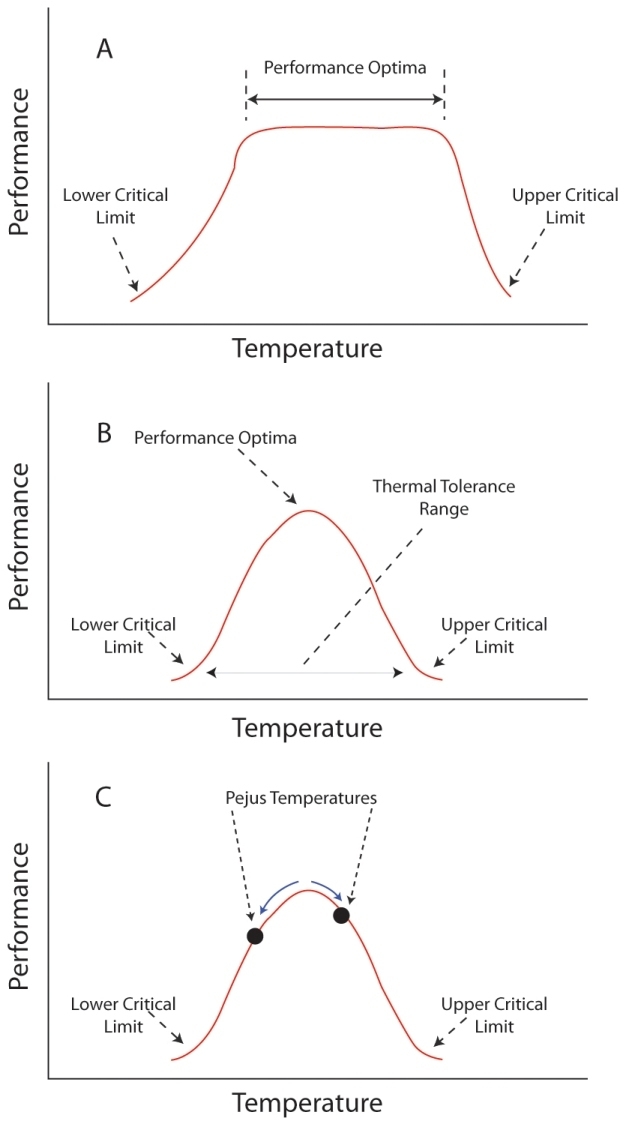
These thermal performance curves show how organism performance changes across a temperature gradient, including an optimal range and upper/lower critical limits. The figure illustrates why warming (or cooling) can reduce growth and reproduction well before outright death occurs—once temperatures move away from the performance optimum and toward critical thresholds. Source
A useful way to organize responses is by what happens to individuals in the short term:
They change behavior to reduce stress
They move to locations with more suitable conditions
They perish if they cannot cope or escape
Key terms for AP Environmental Science
Phenotypic plasticity: The ability of an individual organism to alter its traits (such as behavior, physiology, or timing of life events) in response to environmental change without genetic change.
Plasticity can buy time during change, but it has limits and may reduce fitness if conditions shift beyond what the organism can compensate for.
Response pathway 1: Change behavior
Behavioral responses can happen quickly (minutes to seasons) and often reduce exposure to stressors.
Microhabitat selection: seeking shade, burrows, deeper water, or wind-sheltered areas to moderate temperature and moisture
Activity shifts: becoming nocturnal/crepuscular to avoid heat; reducing activity during drought to conserve water
Diet shifts: switching prey/food sources when preferred resources decline
Reproductive timing changes: breeding earlier/later to match new seasonal cues (temperature, rainfall, snowmelt)
Behavioral change may maintain survival but still lower reproduction if food webs, pollinators, or seasonal resource peaks become mismatched.
Response pathway 2: Move to new areas
If local conditions become unsuitable, individuals (or populations over generations) may relocate to track suitable climate, water, or habitat conditions.
Range shift: A change in the geographic area where a species occurs, caused by individuals dispersing to and establishing in habitats with more suitable environmental conditions.
Common movement patterns include:
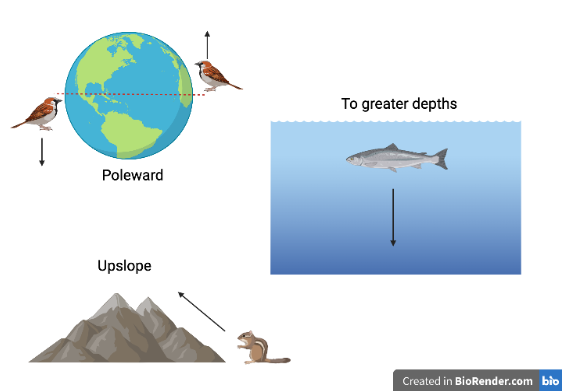
This diagram summarizes three common climate-linked range shifts: movement poleward (to higher latitudes), upslope (to higher elevations), and into deeper water (to cooler depths). It helps connect the abstract idea of “tracking suitable conditions” to concrete spatial directions that show up repeatedly in climate-change ecology. Source
Latitudinal shifts: moving poleward as temperatures warm
Elevational shifts: moving upslope to cooler conditions
Aquatic relocation: moving to deeper, cooler water; shifting among streams, wetlands, or coastal zones as salinity and flow change
Whether movement works depends on:
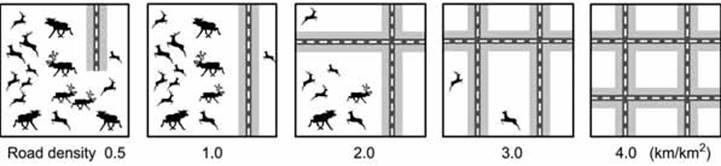
This schematic shows how increasing road density subdivides a landscape into smaller, more isolated habitat patches, which can restrict dispersal and increase fragmentation. It provides a visual basis for why roads function as barriers and why connectivity (corridors vs. fragmentation) strongly influences whether range shifts and relocations succeed. Source
Dispersal ability (seeds, larvae, migration capacity)
Landscape connectivity (corridors vs. fragmented habitat)
Availability of suitable habitat (space, resources, nesting sites)
Barriers (roads, dams, fences, urbanization)
Timing (change may occur faster than dispersal or reproduction)
Response pathway 3: Perish (mortality and local extinction)
When behavior and movement cannot prevent exposure to harmful conditions, individuals die, and populations can decline sharply.
Physiological failure: heat stress, dehydration, freezing injury, oxygen limitation, or salt imbalance
Resource collapse: food shortages or loss of key mutualisms (e.g., host plants, symbionts)
Increased disease and predation: stressed organisms may have weaker immune function or be forced into riskier habitats
Reproductive failure: adults survive but produce fewer viable offspring, leading to population decline over time
In extreme cases, a population may experience local extinction (extirpation) even if the species persists elsewhere, especially when suitable habitat patches are isolated.
Why outcomes differ among species and ecosystems
No single response fits all organisms. Important drivers include:
Rate and magnitude of change: rapid shifts favor immediate behavior/movement; slow shifts may still overwhelm long-lived species
Life history: short generation times can recover faster; long-lived species may accumulate stress before declines are obvious
Habitat specialization: specialists often have fewer behavioral and dietary options and fewer suitable destinations
Human-altered landscapes: fragmentation, water withdrawals, and built infrastructure can remove escape routes and intensify stress, increasing the chance organisms will perish rather than adapt behaviorally or relocate
Practice Questions
State two ways a population may respond when environmental conditions change. (2 marks)
Any two from: change behaviour; move to new areas/range shift; perish/die out (1 mark each).
A region experiences progressively hotter summers and more frequent drought over 20 years. Explain how an insect species might respond, and outline factors that could limit its chances of persistence. (6 marks)
Describes behavioural change that reduces stress (e.g., altered activity time, microhabitat use) (1)
Describes movement/range shift to more suitable areas (e.g., higher latitude/elevation, wetter habitats) (1)
Describes mortality/reduced survival or local extinction if it cannot cope or move (1)
Explains at least one limiting factor for behaviour (e.g., food/reproduction mismatch, insufficient refuge) (1)
Explains at least one limiting factor for movement (e.g., fragmentation, barriers, lack of suitable habitat) (1)
Links rate/severity of change or life history/dispersal ability to likelihood of persistence (1)
FAQ
Small-scale refuges (shade, north-facing slopes, deep pools, burrows) can stay cooler or wetter than the surrounding area.
They reduce exposure without requiring long-distance movement, but may be scarce or disappear during extreme events.
Assisted migration is the intentional relocation of a species to areas predicted to become suitable under future conditions.
Concerns include unintended invasiveness, disruption of recipient ecosystems, and moving pathogens, even if extinction risk is reduced.
Plasticity is within-lifetime adjustment in traits; evolution is heritable genetic change across generations.
Plasticity can provide immediate buffering, while evolution requires enough reproductive success and heritable variation over time.
An ecological trap occurs when organisms prefer cues (e.g., warm surfaces, artificial light, altered vegetation) that historically signalled good habitat but now reduce survival or reproduction.
Human-altered environments often create these misleading cues.
Common constraints include:
Low dispersal capacity
Physical barriers (dams, roads, intensive agriculture)
Lack of stepping-stone habitats
Competition or predation in newly suitable areas
