

AP Syllabus focus:
‘Wildlife may migrate over short or long time scales for various reasons, including responses to natural disruptions.’
Wildlife migration is a common way organisms persist when local conditions suddenly become harmful. Natural disruptions can trigger movements within days or over generations, reshaping populations, community interactions, and human–wildlife conflicts.
What “migration” means in AP Environmental Science
Migration: The movement of organisms from one area to another, often seasonally or in response to changing conditions, to improve survival and reproductive success.
In the context of disruptions, migration is best viewed as a risk-management strategy: individuals leave declining habitat to locate food, water, shelter, breeding sites, or safer microclimates.
Disruptions that trigger wildlife migration
Acute (rapid-onset) disruptions
These events can push organisms past tolerance limits quickly, causing immediate displacement:
Wildfires: loss of cover and forage; smoke reduces air quality and visibility.
Hurricanes, floods, storm surge: direct mortality risk; nest/den destruction.
Volcanic eruptions, landslides: habitat burial and fragmentation.
Heat waves or cold snaps: short-term spikes in physiological stress.
Drought: rapid drops in surface water and plant productivity.
Chronic (longer-term) disruptions
These alter habitat quality over longer periods and may shift migration routes or timing:
Repeated drought years reducing wetland hydroperiods.
Altered river flow regimes affecting fish access to spawning grounds.
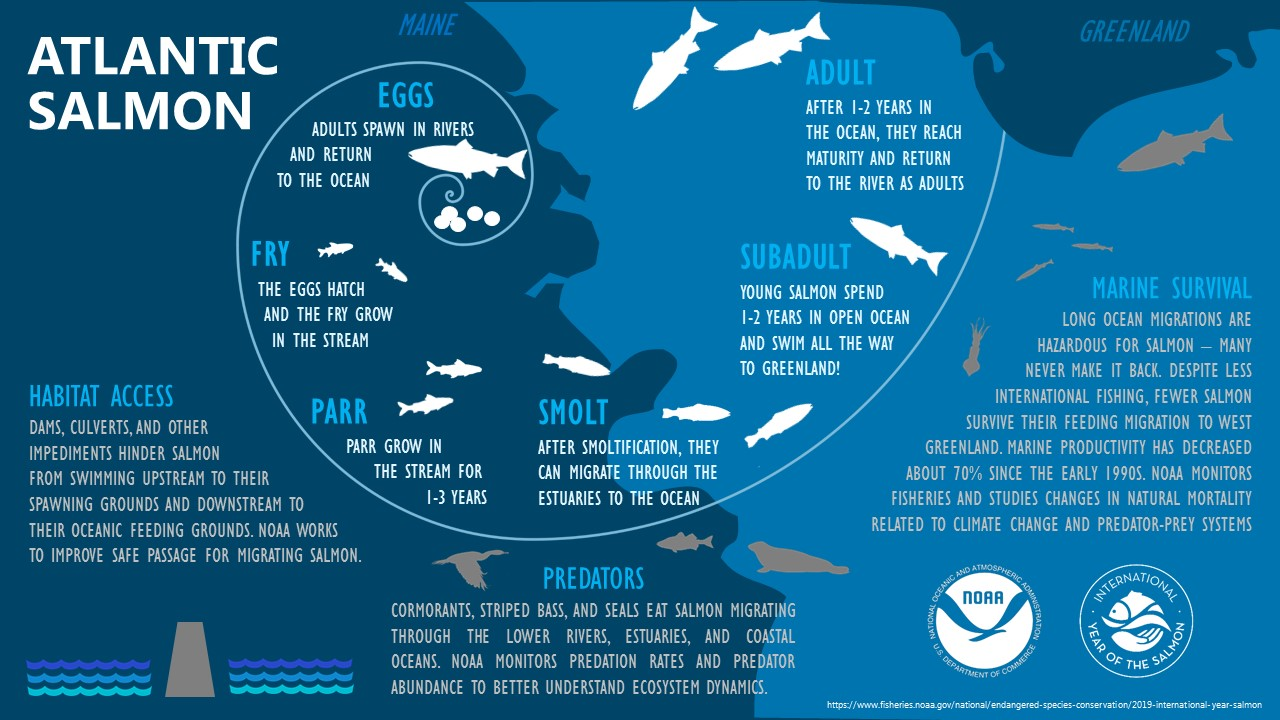
Life-cycle diagram of an anadromous fish (Atlantic salmon), showing movement from freshwater spawning and juvenile rearing to ocean growth and then return migration to natal rivers. The labeled stages (eggs, fry, parr, smolt, subadult, adult) help connect habitat needs to migration timing and to barriers that can block access to spawning grounds. Source
Gradual desertification changing vegetation structure and prey availability.
Time scales: short vs long migration responses
Short time scale (days to seasons)
Disruptions often cause temporary evacuation or seasonal rerouting:
Refuge seeking: moving to unburned patches, higher ground, or shaded riparian zones.
Stopover dependence: migratory birds may rely on intact wetlands as emergency fueling sites after storms.
Behavioural flexibility: generalists often shift diet and habitat use to exploit remaining resources.
Long time scale (years to generations)
Repeated or persistent disruptions can produce range shifts and new “normal” movement patterns:
Permanent relocation if recovery is slow (e.g., severe fires followed by erosion).
Colonisation of new habitat when corridors allow dispersal.
Population redistribution that changes local abundance and genetic mixing.
How migration affects ecosystems and people
Ecological consequences
Migration changes who interacts with whom and where energy and nutrients move:
Predator–prey reshuffling: prey moving into new areas may encounter unfamiliar predators (or escape existing ones).
Competition changes: migrants may compete with resident species for limited forage or nesting sites.
Trophic cascades: loss or arrival of a large herbivore can alter plant communities and habitat structure.
Disease and parasite dynamics: movement can introduce pathogens to naïve populations or concentrate animals at scarce water sources.
Human dimensions
Disruption-driven migration can create management challenges:
Crop raiding and livestock predation when wildlife enters agricultural landscapes.
Road mortality as animals cross highways during displacement.
Fisheries impacts if fish relocate away from traditional harvest areas.
What determines whether migration is possible
Landscape connectivity
Successful movement depends on connected habitat:
Wildlife corridors (riparian strips, hedgerows, underpasses) reduce mortality and guide dispersal.
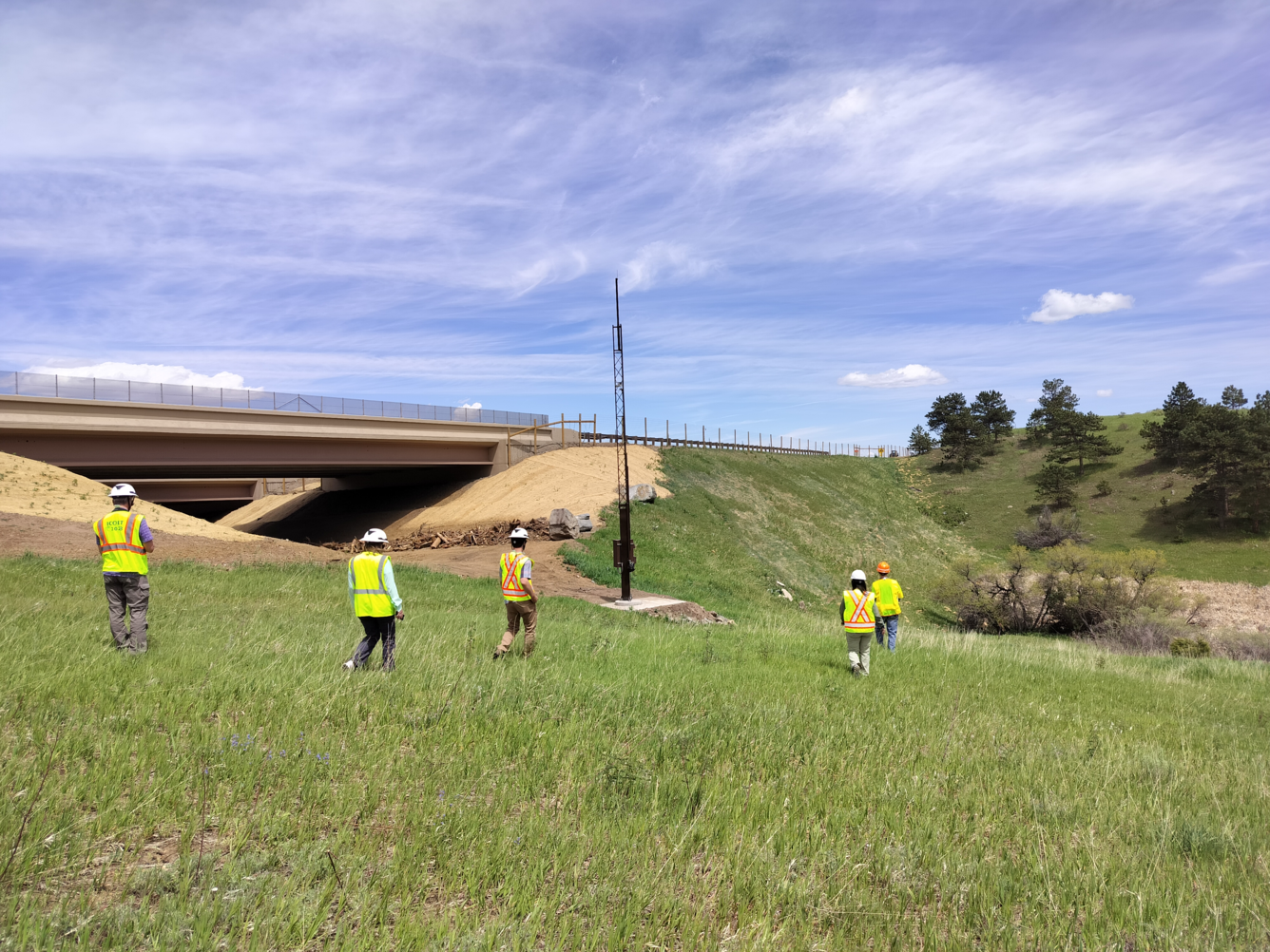
Photograph of a completed wildlife underpass designed to help animals cross beneath a highway. This kind of connectivity infrastructure reduces collision risk and helps maintain functional movement corridors when landscapes are fragmented by roads. Source
Fragmentation (roads, fences, urban areas) can trap animals in degraded habitat or force risky crossings.
Species traits
Not all species can respond equally:
Mobility: birds and large mammals often move farther than amphibians or many invertebrates.
Specialisation: specialists tied to specific hosts or microhabitats may fail to find suitable destinations.
Life stage: juveniles dispersing may be more likely to relocate than breeding adults with site fidelity.
Navigation and cues: disrupted cues (smoke, turbidity, altered flow) can interfere with orientation and timing.
Availability of “receiving” habitat
Migration only helps if destination habitat has capacity:
Food and water must be sufficient.
Shelter and breeding sites must exist.
Lower competition and predation pressure improves establishment.
Monitoring migration after disruptions (what students should recognise)
Ecologists document disruption responses using:
GPS collars and tags to map routes and mortality.
Mark–recapture to estimate movement and survival.
Remote sensing to track vegetation recovery and burned/unburned refuges that guide movement.
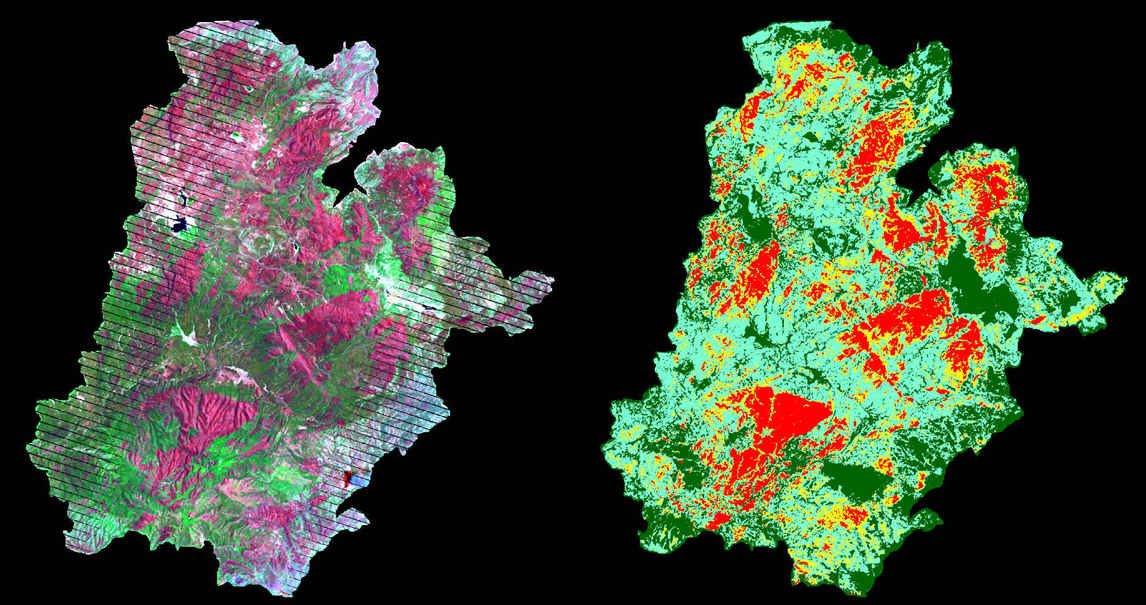
Paired satellite-derived maps of a wildfire showing post-fire surface conditions alongside a burn-severity product (dNBR). The color-coded pattern highlights the mosaic of unburned and severely burned areas that can act as refuges, barriers, or altered resource patches influencing where displaced animals can move and persist. Source
Practice Questions
Describe two reasons why a natural disruption might cause wildlife to migrate. (2 marks)
Any two valid reasons (1 mark each), e.g. loss of food resources; loss of shelter/breeding habitat; reduced water availability; avoidance of direct mortality risk (fire/flood); degraded air or water quality.
Explain how a severe wildfire could alter migration outcomes for a mammal population, referring to (i) time scale, (ii) landscape connectivity, and (iii) ecological effects in destination areas. (6 marks)
Time scale: short-term displacement to refuges or neighbouring habitat (1); longer-term range shift if repeated/slow recovery (1).
Connectivity: corridors/continuous habitat enabling safer movement (1); barriers such as roads/fences increasing mortality or preventing movement (1).
Ecological effects: altered competition with residents for food/shelter (1); changed predator–prey interactions or disease risk in destination areas (1).
FAQ
They look for directionality, repeatability, and drivers.
Evidence can include:
consistent movement towards intact habitat or water
similar timing across individuals
return movement after recovery (if seasonal or refuge-based)
Often a combination works.
Options include:
lightweight radio telemetry for short-range movements
passive integrated transponder (PIT) tags for recaptures at choke points
environmental DNA (eDNA) to confirm presence in new sites without capturing individuals
Yes, through differential survival and reproduction.
Mechanisms include:
selection for individuals with better navigation or stress tolerance
altered gene flow if previously isolated groups interbreed
founder effects if only a small subset colonises a new area
If it increases exposure to threats.
Examples:
corridors that funnel animals towards roads or poaching hotspots
connectivity that facilitates invasive predators or disease spread
routes that lead to low-quality “ecological traps” (attractive but unsafe habitat)
Assisted migration is the human-mediated relocation of a species to suitable habitat when natural movement is too slow or blocked.
It’s considered when:
barriers prevent access to refuges
repeated disruptions eliminate local recovery
careful risk assessment suggests low chance of creating new ecological harm
