

AP Syllabus focus:
‘There are two main types of ecological succession: primary succession and secondary succession.’
Ecological communities change predictably after disturbance as species colonise, compete, and modify habitat conditions. Understanding primary versus secondary succession clarifies how quickly ecosystems recover, what limits early growth, and why starting conditions matter.
Core idea: ecological succession
Ecological succession describes a directional change in community composition over time, often following disturbance, as species colonisation and environmental conditions shift together.
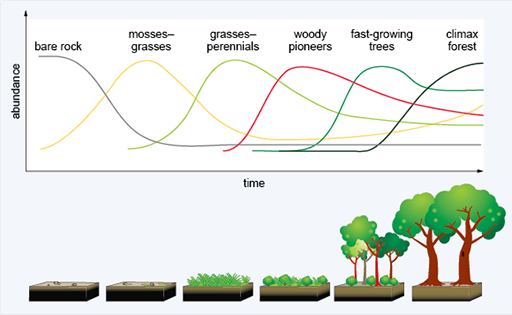
This diagram summarizes succession as a time-ordered sequence of community stages (from bare substrate to a mature forest) while simultaneously tracking increasing biomass, biodiversity, and soil development. It helps connect the visible vegetation changes to underlying ecosystem properties—especially the buildup of soil that constrains early stages. Source
Ecological succession: the process by which the species composition and structure of a community change over time, especially after a disturbance or the creation of new habitat.
Succession is not a single “path” to a perfect endpoint; it is a set of typical patterns driven by constraints like soil development, nutrient availability, and the types of organisms able to arrive and survive.
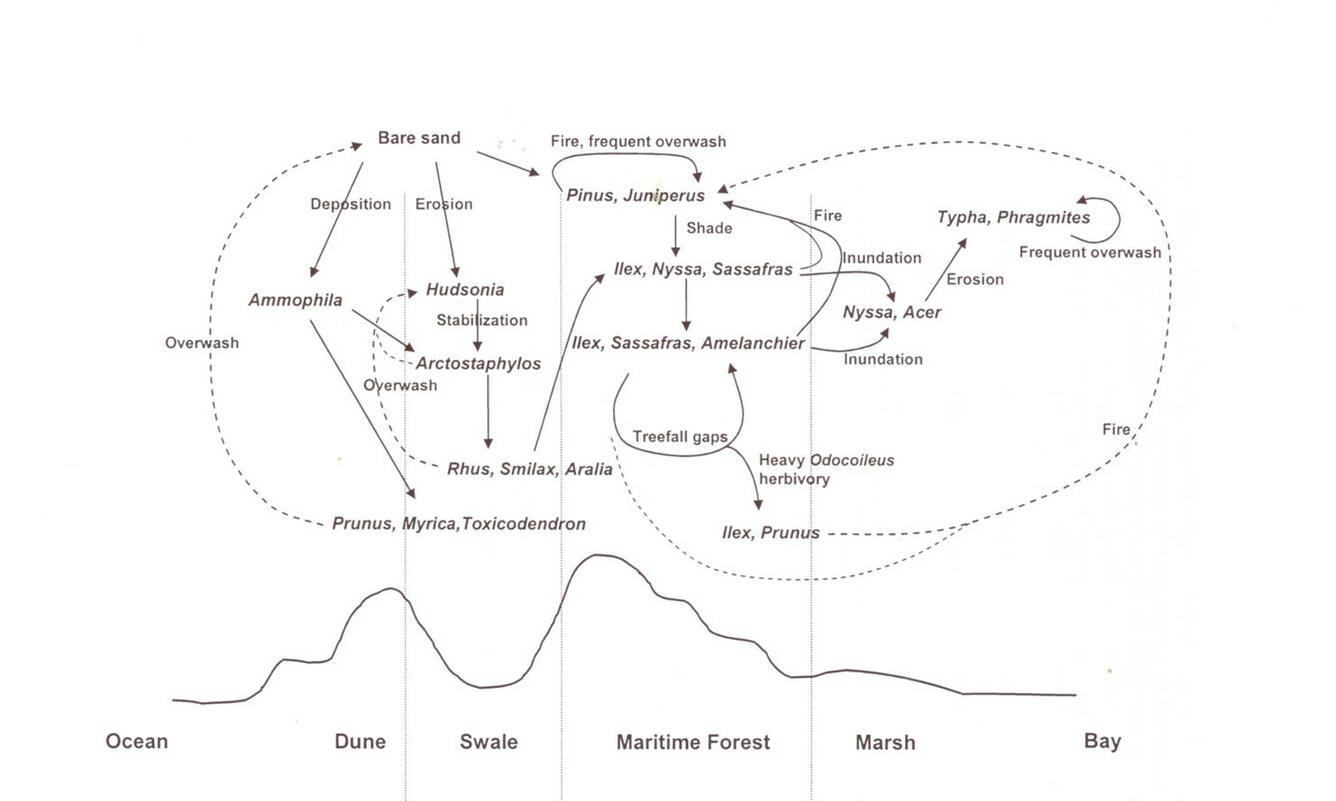
This diagram shows multiple successional pathways and feedbacks in a coastal system, emphasizing that communities can shift along different trajectories depending on disturbance and site conditions. Labeled arrows illustrate how processes such as fire, inundation, erosion, and deposition can redirect succession rather than producing one inevitable “climax” endpoint. Source
Primary succession
Primary succession begins where there is no biologically active soil and few or no surviving organisms to restart the community. The key limitation is often the absence of soil, which slows plant establishment and nutrient cycling.
Primary succession: succession that starts on newly exposed surfaces (or sterilised substrates) lacking soil, where a community must develop from very low initial biological input.
Typical settings and triggers
Fresh lava flows or volcanic ash
Newly exposed rock after glacial retreat
Newly formed sand or rock deposits where soil has not formed
Human-caused situations that remove soil down to bare substrate (e.g., severe erosion)
Early-stage characteristics
Pioneer species are typically those that can tolerate harsh, low-nutrient, high-exposure conditions and begin soil formation.
Soil development begins through:
Physical weathering of rock
Accumulation of organic matter from dead organisms
Increased water retention as fine particles and organic matter build up
Early communities often have low biomass and slow growth due to limited nutrients (especially nitrogen) and limited rooting medium.
Secondary succession
Secondary succession occurs after a disturbance that removes organisms but leaves soil (and often seeds, roots, and microbes) intact, allowing faster recovery than primary succession.
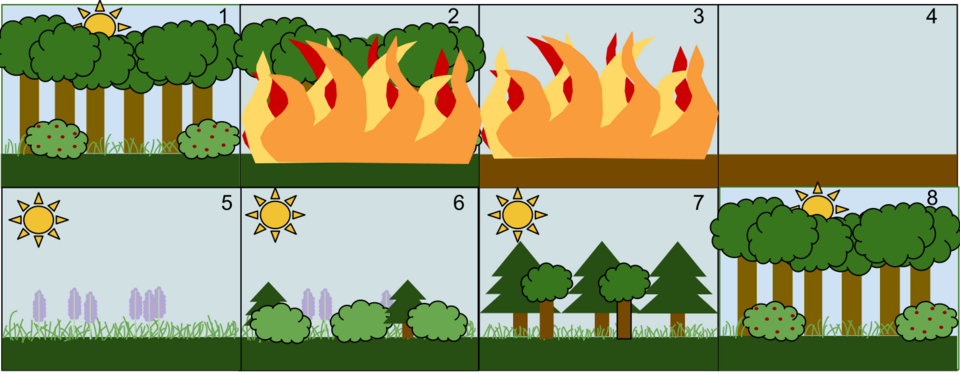
This figure illustrates secondary succession after a wildfire, moving from an intact forest through disturbance and into regrowth stages. The panels highlight the key APES idea that soil remains, allowing early herbaceous plants to re-establish quickly, followed by shrubs and trees as competition and shading increase over time. Source
Secondary succession: succession that follows a disturbance where soil remains, enabling regrowth from surviving organisms, seeds, and existing nutrient pools.
Typical settings and triggers
Wildfires (especially when soils are not severely burned)
Hurricanes and windstorms that remove vegetation
Floods that scour vegetation but leave some soil structure
Abandoned agricultural fields (old-field succession)
Logging or land clearing that does not remove topsoil
Why it is usually faster
Existing soil structure, nutrients, and decomposers support rapid plant establishment.
Surviving seed banks, roots, and nearby source populations speed recolonisation.
Early plant growth often increases quickly because nutrient cycling can resume without needing to build soil from scratch.
Comparing primary vs secondary succession (what to know for APES)
Key contrasts
Starting conditions:
Primary: no soil; very low organic matter
Secondary: soil present; organic matter and microbes remain
Biological “legacies”:
Primary: few or none
Secondary: seeds, roots, spores, and soil organisms often persist
Pace of change:
Primary: typically slower due to soil formation needs
Secondary: typically faster due to existing soil resources
Shared features in both types
Community changes over time as:
New species arrive (dispersal) and establish
Species modify conditions (shade, litter, moisture), changing which species can persist
Competition and environmental filtering shift dominance patterns
Disturbance severity matters: even in secondary succession, extreme disturbance (e.g., intense heating that kills soil microbes) can make recovery more “primary-like” in speed and limitation.
Practice Questions
State one key difference between primary and secondary succession. (2 marks)
Primary succession begins without soil / on bare substrate (1)
Secondary succession begins with soil already present (1)
Explain why secondary succession generally proceeds more quickly than primary succession after a disturbance. (5 marks)
Soil remains in secondary succession (1)
Existing nutrients/organic matter support rapid plant growth (1)
Decomposers/microbes survive and restart nutrient cycling (1)
Seed bank/roots/surviving organisms enable faster recolonisation (1)
Primary succession requires soil formation or significant organic matter accumulation, slowing early stages (1)
FAQ
They look for evidence of pre-existing soil horizons and “biological legacies”.
Buried topsoil layers, intact soil structure, or charcoal within soil often indicate secondary succession.
Very thin, newly forming soils directly on rock, with minimal horizons, suggest primary succession.
Microbes jump-start nutrient cycling when plants are scarce.
Some bacteria and fungi colonise rock surfaces and newly forming soils, contributing to organic matter buildup and, in some cases, increasing nitrogen availability, which supports later plant establishment.
Yes. Recovery slows when soil function is damaged.
Examples include severe erosion removing topsoil, high-intensity burns that reduce soil microbes, compaction that limits roots and water infiltration, or contamination (e.g., salts or toxins) that restricts germination and growth.
Yes, through long-term habitat formation.
For instance, newly created ponds or recently exposed sediments can be colonised by microbes and algae first, followed by plants as sediments accumulate and conditions stabilise, though the “soil” analogue forms differently than on land.
Larger and more isolated sites tend to recover more slowly.
Greater distances from source populations reduce dispersal of seeds and animals. Small patches near intact habitat receive more colonists, increasing establishment rates and speeding community change.

