AP Syllabus focus: ‘Disequilibrium occurs when surpluses or shortages exist, causing pressure on prices to adjust toward equilibrium.’
Markets do not always sit at the equilibrium price. When price is set above or below equilibrium, predictable imbalances arise. Understanding surpluses and shortages helps explain why markets experience pressure for price change.
Disequilibrium and quantity imbalances
A market is in disequilibrium when quantity demanded (Qd) does not equal quantity supplied (Qs) at the current price.
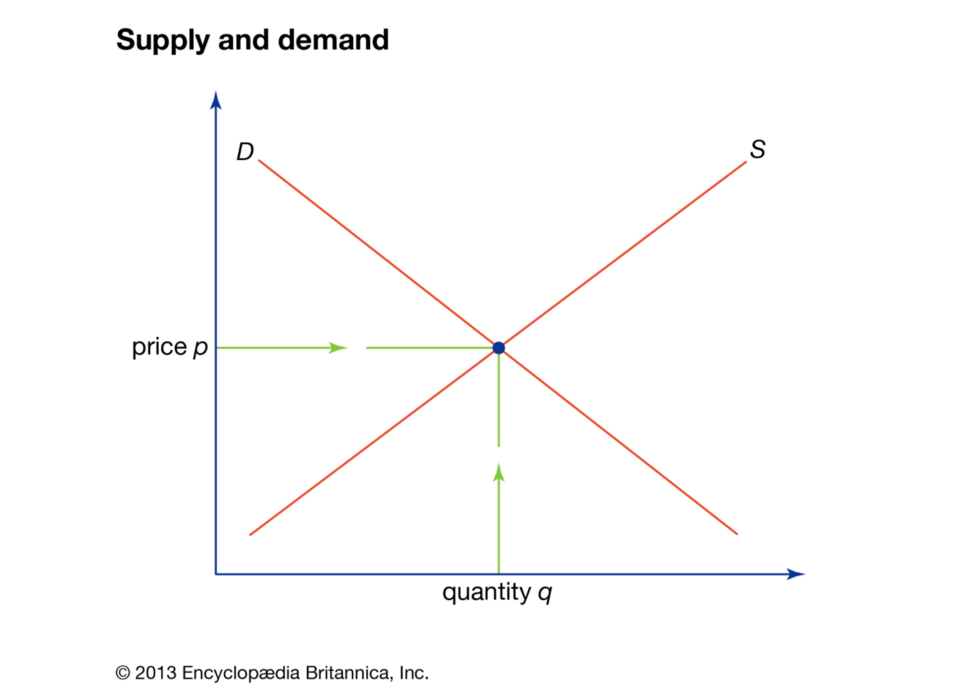
This supply-and-demand diagram shows equilibrium at the intersection of the demand curve (downward sloping) and the supply curve (upward sloping). The equilibrium price and equilibrium quantity occur where the market “clears,” meaning buyers’ and sellers’ plans are mutually consistent at that point. Any price set above or below this intersection implies , which is the core idea behind disequilibrium. Source
Disequilibrium appears as either a surplus or a shortage, each creating incentives for buyers and sellers to change behaviour.
Surplus (excess supply)
Surplus — a situation where quantity supplied exceeds quantity demanded at the current price.
A surplus occurs when the price is above equilibrium, leading producers to supply more while consumers buy less. The result is unsold output (inventory buildup) and frustrated sellers.
Key features of a surplus:
Qs > Qd at the current price
Producers experience inventory accumulation
Firms may reduce output, reduce prices, or increase promotions to clear stock
There is downward pressure on price because sellers compete for fewer buyers
A surplus is not merely “a lot of production”; it is specifically an imbalance at a given price.
Shortage (excess demand)
Shortage — a situation where quantity demanded exceeds quantity supplied at the current price.
A shortage occurs when the price is below equilibrium, so consumers want to buy more while producers supply less. The result is unmet demand, lines, backorders, or rapid sell-outs.
Key features of a shortage:
Qd > Qs at the current price
Buyers compete for limited goods/services
Firms may sell out quickly and face pressure to restock
There is upward pressure on price because buyers bid against each other and sellers can raise prices
A shortage is not simply “scarcity” in the broad sense; it is an imbalance created by the market price being too low to clear the market.
Why surpluses and shortages create pressure on prices
Disequilibrium creates incentives that push market participants toward decisions consistent with equilibrium:
In a surplus, sellers have an incentive to lower price to attract more buyers and reduce unwanted inventories.
In a shortage, sellers have an incentive to raise price because goods are scarce relative to demand, and buyers are willing to pay more to obtain them.
This “pressure” is the key AP idea: when Qd and Qs are unequal, there are systematic forces that make the current price unstable.
Signals and incentives behind the pressure
Price communicates information:
High inventories signal that resources are being used to produce goods people are not buying at that price.
Empty shelves/unmet demand signal that consumers value the good more than the current price reflects.
Incentives respond accordingly:
Businesses seek to minimise losses from unsold stock (surplus).
Businesses seek to capture gains when demand exceeds supply (shortage).
Graph interpretation (no calculations required)
On a standard supply-and-demand graph:
A surplus is the horizontal distance between Qs and Qd at a price above equilibrium.
A shortage is the horizontal distance between Qd and Qs at a price below equilibrium.
Common AP pitfalls to avoid:
Confusing a shift in demand/supply with a movement along a curve; surpluses/shortages are defined at a given price.
Saying “equilibrium causes surplus/shortage”; equilibrium is where neither exists.
Mixing up directions: surplus → price tends to fall, shortage → price tends to rise.
Practice Questions
(2 marks) Define a shortage and state what it implies about and at the current price.
Correct definition of shortage (1)
States at the current price (1)
(6 marks) A market price is set above the equilibrium price. Explain why a surplus occurs and describe the resulting pressure on price.
Identifies price is above equilibrium (1)
Explains that at this price quantity supplied is higher and/or quantity demanded is lower (1)
States surplus occurs where (1)
Describes unsold output/inventory accumulation (1)
Explains sellers have incentive to reduce price to increase sales/clear inventory (1)
States price experiences downward pressure towards equilibrium (1)
FAQ
A surplus does not mean sales are zero. It means that at the current price:
consumers purchase less than firms produce
the difference becomes unsold inventory
The key is the mismatch between $Q_s$ and $Q_d$, not whether any transactions occur.
Yes. If the wage is above the market-clearing level, there can be a surplus of labour (more people willing to work than jobs offered). If the wage is below, a labour shortage can occur.
Prices may be slow to adjust due to:
contracts and posted prices
regulations or rules limiting price changes
firms choosing non-price rationing (queues, waiting lists)
These factors can keep $Q_d > Q_s$ for longer.
A shortage is the imbalance $Q_d > Q_s$ at a given price. Rationing is the method used to allocate the limited supply, such as queues, purchase limits, or priority rules.
They indicate misallocation at the current price:
surpluses suggest resources are tied up producing goods consumers value less at that price
shortages suggest too few resources are directed to a good consumers value highly
Price pressure signals producers to adjust output over time.