AP Syllabus focus: ‘Market forces adjust prices when imbalances occur, restoring equilibrium between quantity demanded and supplied.’
In competitive markets, prices act like signals and incentives. When buyers and sellers aren’t matched at the current price, the resulting pressure changes price, which changes behaviour and moves the market back toward equilibrium.
Core idea: how prices “clear” a market
The price adjustment mechanism is the process by which market forces push price up or down when the market is not in equilibrium, so that quantity demanded (QD) and quantity supplied (QS) become equal.
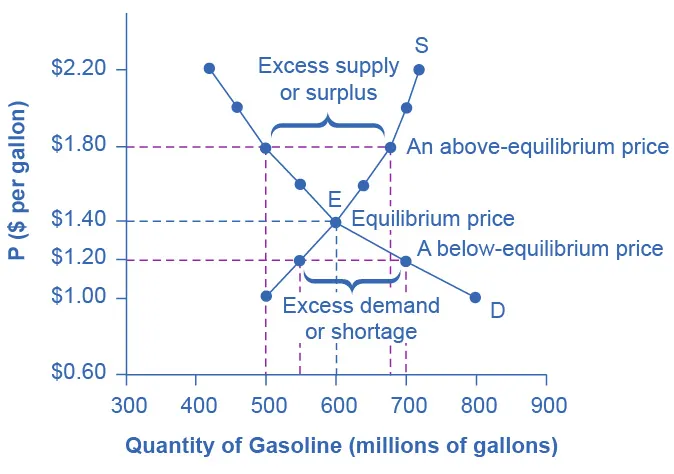
This figure shows a standard supply-and-demand diagram where the equilibrium (market-clearing) price and quantity occur at the intersection of the demand curve and supply curve. It visually connects the idea that equilibrium is the unique point where buyers’ and sellers’ plans are mutually consistent, i.e., where . Source
Price adjustment mechanism: The tendency for market prices to change in response to excess demand or excess supply, moving the market toward the equilibrium (market-clearing) price where .
This adjustment relies on two linked responses:
Buyers respond to price: higher prices discourage purchases; lower prices encourage purchases.
Sellers respond to price: higher prices encourage production/sales; lower prices discourage production/sales.
Disequilibrium and the direction of price change
When price is above equilibrium (excess supply)
If the market price is too high, then:
QS > QD
Firms cannot sell all they produce (inventory builds up or sales are slower than expected).
Sellers have an incentive to cut prices (to attract buyers and reduce unsold goods).
As price falls:
QD rises (buyers are willing to buy more at lower prices)
QS falls (some producers exit or reduce output at lower profitability)
The market moves toward the point where QD = QS.
When price is below equilibrium (excess demand)
If the market price is too low, then:
QD > QS
Buyers compete for limited supply (queues, stockouts, rapid sell-outs).
Sellers have an incentive to raise prices (because consumers are willing to pay more and the good is scarce).
As price rises:
QD falls (some buyers drop out)
QS rises (firms expand output or more sellers enter)
The market moves toward QD = QS.
= quantity demanded (units per period)
= quantity supplied (units per period)
= quantity supplied (units per period)
= quantity demanded (units per period)
A useful way to remember the mechanism:
ED (shortage) creates upward pressure on price.
ES (surplus) creates downward pressure on price.
What actually transmits “pressure” into a new price
Incentives and competition
Price changes are driven by incentives:
With excess supply, firms compete to make sales (discounts, promotions, improved terms), effectively lowering the market price.
With excess demand, buyers compete (bidding up, fewer discounts), allowing sellers to raise the market price.
Information and expectations
Adjustment depends on how quickly market participants learn that conditions have changed:
Faster information (posted prices, online listings) can speed adjustment.
If sellers expect the imbalance to be temporary, they may adjust quantities (inventories, waiting lists) before fully adjusting prices.
The equilibrium as a “resting point,” not a guarantee
In the AP model, the mechanism restores equilibrium between quantity demanded and supplied because price changes alter both QD and QS. The key is recognising direction:
Too high a price → unsold output → price falls.
Too low a price → unmet demand → price rises.
Practice Questions
(2 marks) Explain how excess demand affects market price in the price adjustment mechanism.
1 mark: States that excess demand (shortage) creates upward pressure on price / price rises.
1 mark: Explains that buyers compete for limited supply or sellers raise prices when QD > QS.
(5 marks) A market is initially in equilibrium. The current price is now above the equilibrium price. Using the price adjustment mechanism, explain the sequence of changes that restores equilibrium.
1 mark: Identifies that price above equilibrium causes excess supply (QS > QD).
1 mark: Explains unsold goods/inventories build up or sales fall.
1 mark: Explains sellers cut prices due to competitive pressure/incentives.
1 mark: Explains that as price falls, QD increases.
1 mark: Explains that as price falls, QS decreases, moving toward .
FAQ
No. It only predicts the direction of pressure. Speed depends on how frequently prices are updated, how costly it is to change prices, and how quickly buyers and sellers observe the imbalance.
Inventories buffer the imbalance.
Rising inventories signal overproduction.
Firms may try discounts first, then reduce output.
If storage is costly or goods are perishable, price cuts tend to be quicker and larger.
If prices are sticky, regulated, or firms fear losing customers, they may not raise prices immediately.
Non-price rationing can occur: queues, stockouts, waiting lists, limited purchase quantities.
They can delay adjustment. If firms expect a brief shock, they may hold prices steady and wait. If expectations are wrong, the imbalance persists longer, increasing eventual pressure for a price change.
More competitive markets typically pass imbalances into prices more directly.
Many sellers: stronger pressure to cut prices under excess supply.
Many buyers: stronger pressure to raise prices under excess demand.
Limited competition can soften or slow the price response.