AP Syllabus focus: ‘GDP does not include nonmarket transactions such as household production or volunteer work.’
GDP is widely used to track economic performance, but it omits many valuable activities. Understanding nonmarket transactions helps explain why GDP can underestimate production and misrepresent living standards across time and countries.
What counts in GDP (and what does not)
GDP is designed to measure the market value of final goods and services produced within a country during a time period, using observed prices from recorded transactions.
Because GDP relies on market prices and official records, many productive activities are excluded when they are not bought and sold.
Nonmarket transactions: the core idea
Nonmarket transactions: Productive activities that create goods or services but are not exchanged for money in formal markets and therefore have no directly observed market price.
Nonmarket transactions are excluded even when they clearly provide value and would be costly to replace through market purchases.
Key examples emphasised by the syllabus
Household production
Household production includes unpaid work that produces goods and services within the home, such as:
Childcare and elder care by family members
Cooking, cleaning, laundry, and home maintenance
Home gardening or food preparation that substitutes for purchased goods
If a household pays a childcare provider, that payment is part of GDP (a market service). If a parent provides identical care unpaid, it is excluded—despite producing a similar service.
Volunteer work
Volunteer work creates services that may be socially valuable but are typically unpaid, such as:
Volunteering at food banks, shelters, or community clinics
Coaching youth sports or tutoring
Community clean-ups and mutual-aid efforts
If a charity hires staff to perform the same tasks, wages are counted in GDP; if volunteers do it, GDP does not change.
Why GDP excludes these activities
No market price to add up
GDP accounting aggregates output using market prices. Nonmarket transactions lack an explicit price, so including them would require assigning a value without an actual transaction.
Measurement and verification problems
Including unpaid work would require large-scale estimates of:
Hours worked and type of activity
Quality of output (e.g., professional childcare vs informal care)
Consistency across households, regions, and time
Because estimates can vary by method and data quality, adding them can reduce comparability and raise concerns about reliability.
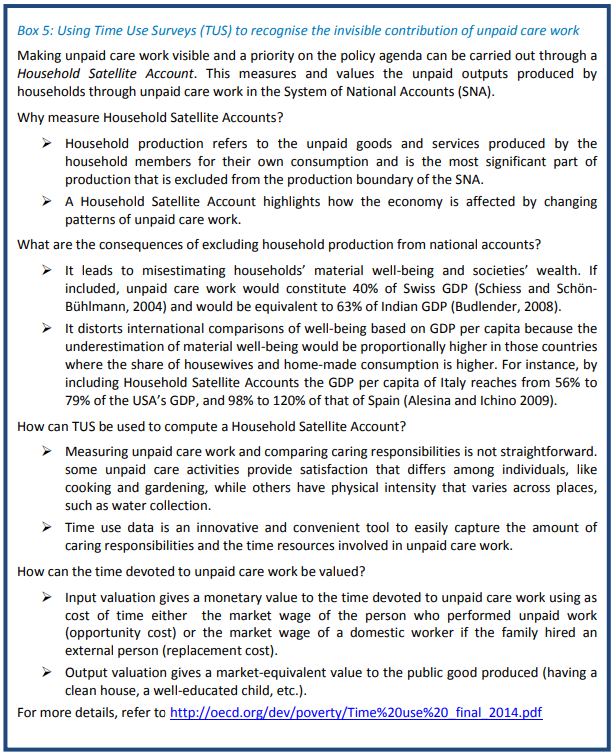
How unpaid work gets valued in practice: satellite accounts and time-use surveys. This OECD page (a boxed “how-to” section) explains how time-use surveys feed into a Household Satellite Account and outlines common valuation methods—replacement-cost and opportunity-cost approaches. It complements the notes by showing the exact step where GDP runs into trouble: translating unpaid hours into a defensible market-equivalent dollar value. Source
Avoiding double counting and boundary issues
Expanding GDP to include nonmarket activity creates difficult boundaries:
Is leisure-time cooking “production” or a hobby?
How should home repairs be valued if materials are purchased (counted) but labour is unpaid (not counted)?
How do statisticians separate household production from personal time in a consistent way?
Why the omission matters for interpreting GDP
GDP can understate actual production and consumption
When households produce more at home (for example, caring for children rather than paying for daycare), well-being may be unchanged or improved, yet measured GDP is lower than if the same services were purchased in markets.
GDP may misstate changes over time
Shifts between household production and market provision can change GDP even if the underlying service level is similar:
More two-earner households may increase paid childcare and prepared-food purchases, raising GDP even if total childcare and meals are comparable.
During downturns, households may substitute toward home cooking and DIY repairs; GDP can fall more than “true” consumption of services.
Cross-country comparisons can be distorted
Countries differ in social norms, labour-force participation, and availability of paid services. Two economies with similar living standards could show different GDP levels if one relies more on unpaid household work and the other relies more on paid market services.
Distributional and welfare implications
Nonmarket production often supports groups not well captured by income-based measures (e.g., children, older adults, and caregivers). Excluding unpaid care can understate the economic contribution of caregivers and hide pressures on time, stress, and household capacity.
How economists handle the limitation (conceptually)
Economists often complement GDP with additional indicators rather than altering GDP directly.
Common approaches include:
Satellite accounts or time-use studies that estimate unpaid household work separately
Quality-of-life and well-being measures that incorporate nonmarket dimensions
Comparing trends in paid services alongside demographic and labour-market changes to interpret GDP movements more carefully
Practice Questions
(6 marks) Using the concept of nonmarket transactions, analyse two ways GDP may give a misleading picture of economic well-being.
1 mark: Defines or clearly explains nonmarket transactions (unpaid production not sold in markets).
2 marks: First analysis channel (e.g., substitution between home production and paid services changes GDP without changing actual services).
2 marks: Second analysis channel (e.g., cross-country differences in unpaid care distort comparisons; downturns increase home production so GDP understates consumption).
1 mark: Links explicitly to “misleading picture of well-being” (living standards/actual consumption/services received).
(2 marks) Explain why unpaid household work is not included in GDP.
1 mark: Identifies that GDP counts market transactions with observable prices/recorded sales.
1 mark: States unpaid household work has no market price/does not involve payment, so it is excluded.
FAQ
They commonly use time-use surveys and then apply a wage rate to hours worked.
Methods include:
Opportunity cost (foregone wage)
Replacement cost (market cost of hiring someone)
Volunteer rates, reporting accuracy, and the types of volunteering differ widely.
Different valuation choices (local wages, national averages, task-specific pay) can change estimated totals substantially.
No. Nonmarket transactions are typically unpaid and legal.
The underground economy involves market-like exchanges that are unreported or illegal, even though money changes hands.
Yes. Economies with higher shares of unpaid caregivers (due to ageing populations or lower formal childcare availability) may have a larger gap between GDP and total productive activity.
Yes. Household technology (appliances, apps, online coordination) can raise the amount or efficiency of unpaid production, increasing real household output without increasing measured GDP.