AP Syllabus focus: ‘GDP may underestimate economic activity because it excludes informal and illegal economic transactions.’
GDP is widely used to gauge economic performance, but it can miss sizable production that occurs outside official markets. Understanding the underground economy clarifies why measured GDP can diverge from actual economic activity.
The Underground Economy and Measured GDP
What counts as “underground”
The underground economy includes economic activity that generates goods or services but is not fully reported to authorities, so it is largely absent from official statistics used to compute GDP.
Underground economy: Market-based production of goods and services that is concealed from official reporting (often to evade taxes, regulations, or legal scrutiny), causing it to be excluded from measured GDP.
Because GDP relies on recorded transactions (sales, income reports, tax data, business surveys), activity that is hidden or deliberately untracked is difficult to include consistently.
Why it causes GDP to be underestimated
The syllabus emphasis is that GDP may underestimate economic activity because it excludes informal and illegal economic transactions. This underestimation occurs when:
Output is produced and exchanged, but no official record is created (no invoice, payroll record, or registered sale).
Participants intentionally avoid reporting to reduce tax liabilities or comply with fewer regulations.
Transactions occur in cash or other hard-to-trace methods, limiting statistical capture.
Types of Underground Activity Relevant to GDP
Informal (legal) transactions that are hidden
These activities are legal in nature, but unreported:
“Off-the-books” work paid in cash (unreported wages)
Small-scale services (repairs, childcare, tutoring) with no formal accounts
Underreported sales by businesses to reduce tax or compliance costs
Even though the underlying goods and services may be legitimate, the lack of reporting means they are generally omitted from GDP estimates.
Illegal transactions
These transactions involve goods or services prohibited by law:
Production and distribution of illegal drugs
Illegal gambling operations
Prostitution where illegal
Sales of stolen goods
From a measurement perspective, illegal markets can still represent real production and income, but they are especially hard to measure because participants actively avoid detection.
Measurement Challenges and Data Limitations
Why statisticians struggle to include it
In principle, GDP aims to measure total final output produced domestically, but underground activity complicates this goal because:
There are no reliable administrative records (tax filings, business registrations).
Survey respondents may misreport or refuse to answer.
Prices and quantities are uncertain, especially in illegal markets.
Separating true production from pure transfers (e.g., theft) is complex; GDP should count production of goods/services, not mere redistribution.
What GDP still captures indirectly
Some underground activity can appear partially in official data:
Purchase of inputs (tools, supplies) may be recorded even if the final sale is hidden.
Some income may be spent in formal markets, influencing recorded consumption patterns. However, these indirect traces do not fully correct the missing value of unreported final output.
Why the Underground Economy Matters for AP Macroeconomics
Interpreting GDP comparisons
Differences in underground activity can distort comparisons:
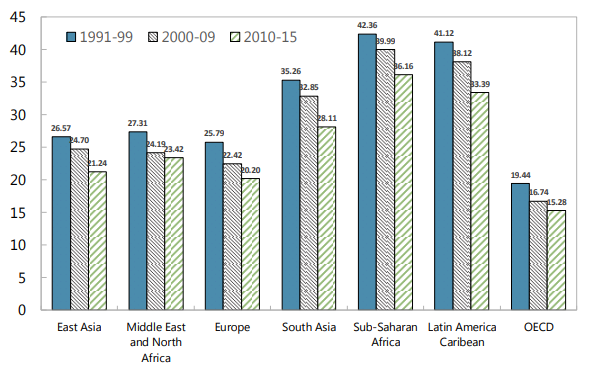
This IMF figure compares the estimated shadow economy (as a percent of GDP) across world regions over multiple time periods. It highlights systematic cross-region differences and shows that estimates can shift over time, which can affect how we interpret GDP levels and growth when informality is large. In AP Macro terms, it’s a reminder that “measured GDP” may not be equally comparable across countries if the underground share differs. Source
Across time: changes in enforcement, technology, or reporting norms can shift measured GDP without equivalent changes in real production.
Across countries: places with higher informality may show lower measured GDP relative to actual living standards and output.
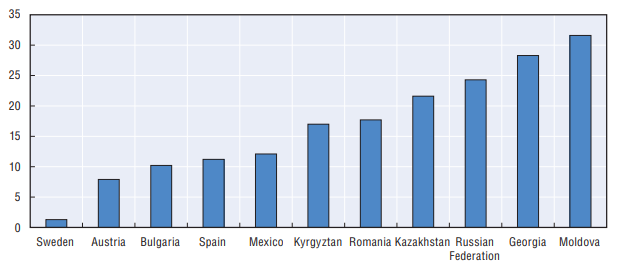
This bar chart reports estimated GDP adjustments for “non-observed activities” (hidden/underground production) for selected countries. It provides concrete evidence that statistical agencies sometimes add explicit adjustments to measured GDP to account for underreporting, and that the size of these adjustments varies widely across countries. This supports careful interpretation of international GDP comparisons when informality differs. Source
Policy and economic interpretation implications
An underestimated GDP can affect how policymakers and analysts view:
Tax capacity: hidden income narrows the tax base and can constrain public revenue.
Productivity and output: official productivity may be biased if output is undercounted.
Business cycle signals: measured slowdowns or accelerations may partly reflect changes in reporting rather than real activity.
These issues reinforce the core point: underground production is real economic activity, but it is often missing from GDP because it is informal, concealed, or illegal.
Practice Questions
Question 1 (1–3 marks) Explain why the existence of an underground economy can cause official GDP figures to underestimate economic activity.
1 mark: Identifies that underground/informal/illegal transactions are not recorded in official statistics.
1 mark: Links non-recording to GDP measurement (GDP relies on reported/observed market transactions).
1 mark: States the consequence: measured GDP is lower than actual production/output.
Question 2 (4–6 marks) Discuss two reasons why the underground economy is difficult to measure accurately, and explain one implication this has for interpreting GDP data.
Up to 2 marks: Reason 1 explained (e.g., cash/off-the-books payments leave limited records; underreporting due to tax/regulation evasion).
Up to 2 marks: Reason 2 explained (e.g., illegal activities are concealed; survey misreporting; uncertain prices/quantities).
Up to 2 marks: One implication explained (e.g., cross-country GDP comparisons may be misleading; apparent growth changes may reflect reporting/enforcement rather than real output).
FAQ
They may combine indirect indicators and modelling, such as discrepancies between income and expenditure measures, cash-demand approaches, and specialised surveys.
Methods vary by country and can produce wide-ranging estimates.
No. Cash is often used for legitimate, fully reported transactions.
Cash can, however, make concealment easier because it reduces the automatic paper trail created by electronic payments.
In rare cases, misclassification can occur if recorded transactions are mistakenly treated as final output when they reflect intermediate or duplicative reporting.
The dominant issue in AP Macro is undercounting due to non-reporting.
Digital payments can increase traceability and reduce some off-the-books activity.
Conversely, encrypted communication and certain online platforms can facilitate hidden transactions, shifting rather than eliminating underground activity.
Different assumptions about hidden prices, participation rates, and reporting behaviour lead to different model outputs.
Because participants actively conceal activity, validation is difficult, so uncertainty remains high.