AP Syllabus focus: ‘In a market economy, resource allocation is shaped by market incentives, institutions, and decentralized decisions about production and consumption.’
A market economy allocates scarce resources through voluntary exchange. Prices, profits, and losses coordinate millions of independent choices, while institutions such as property rights and contract enforcement make decentralized trade possible.
Core idea: decentralized coordination
In a market economy, no single agency answers the allocation questions. Instead, households and firms interact in markets, and the outcomes (what gets produced, how, and for whom) emerge from their combined decisions.
Market economy: An economic system in which most resource allocation and distribution decisions are made through decentralized market transactions guided by prices and incentives.
Decentralization matters because individuals typically have the best information about their own preferences, costs, and opportunities, and they respond to incentives they personally face.
How prices allocate resources
Prices act as signals and incentives simultaneously:
As signals, prices summarise information about relative scarcity and consumer willingness to pay.
As incentives, prices affect behaviour by changing the costs and benefits of choices.
When a good becomes relatively scarce, its price tends to rise:
Consumers reduce quantity demanded or switch to substitutes.
Firms increase quantity supplied, expand capacity, or attract resources (labour, land, capital) into that industry.
Price signal: Information conveyed by a price about the relative scarcity of a good or resource, guiding consumers and producers toward choices that better match market conditions.
The same logic applies to factor markets (labour, land, capital): higher wages or rents in a sector attract resources toward their most valued uses, as judged by buyers’ willingness to pay for outputs.
Market incentives: profit, loss, and self-interest
A central incentive in a market economy is the profit motive:
If consumers value a product enough to pay prices exceeding production costs, firms earn profits, encouraging expansion and entry.
If revenues do not cover costs, firms incur losses, encouraging contraction, exit, or cost-reducing innovation.
This continuous feedback helps align production with consumer preferences without requiring central planning. Importantly, incentives depend on expected profitability, so firms make forward-looking choices about output, prices, and investment.
Institutions that make markets work
The syllabus emphasis on institutions recognises that markets require rules and enforcement mechanisms. Key institutions include:
Property rights: clarify who can use, transfer, and benefit from resources, encouraging investment and exchange.
Contract enforcement: reduces risk in trade by ensuring agreements can be upheld.
Rule of law and stable governance: lowers uncertainty and supports long-term planning.
Financial institutions: channel savings into investment, influencing which industries expand.
When institutions are weak, transaction risks rise, trade shrinks, and resources may be allocated through non-market methods (e.g., personal networks) even within largely market-based systems.
Market equilibrium as a coordinating outcome
In competitive markets, price tends to adjust toward a level where buyers’ and sellers’ plans are mutually consistent.
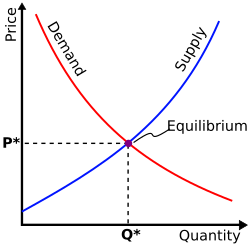
A standard supply-and-demand graph showing the market equilibrium at the intersection of the demand curve and the supply curve. The equilibrium point corresponds to the price–quantity pair where quantity demanded equals quantity supplied, aligning with the condition . Source
= Equilibrium price (currency per unit)
= Quantity demanded at (units per period)
= Quantity supplied at (units per period)
Equilibrium is not a moral ideal; it is a coordination point where there is no persistent tendency for price to rise (shortage) or fall (surplus), given current tastes, technology, and constraints.
What to produce, how to produce it, and who consumes it
Market allocation answers the three basic questions through decentralised decisions:
What to produce: determined by consumer demand expressed through willingness to pay; higher demand raises prices and draws resources into those products.
How to produce: firms choose production methods that minimise costs for a given output quality, because lower costs increase profitability under competitive pressure.
Who consumes: individuals with greater ability and willingness to pay obtain more goods and services; income, wealth, and prices jointly shape consumption bundles.
Because each market is linked (outputs use inputs; incomes come from supplying inputs), changes in one market can ripple through others, redirecting resources across the economy.
Practice Questions
(2 marks) Explain how higher prices in a product market can lead to changes in the allocation of labour.
1 mark: Higher product prices increase firms’ incentives to expand output (higher expected revenue/profit).
1 mark: Expanding firms demand more labour, bidding up wages and attracting workers from other uses/industries.
(6 marks) Using the concepts of incentives, institutions, and decentralised decision-making, explain how a market economy coordinates what gets produced and how resources move between industries.
1 mark: Incentives—prices/profits signal where demand is stronger or goods are scarcer.
1 mark: Firms respond by increasing supply/entering; losses cause exit/contraction.
1 mark: Consumers respond to price changes by adjusting quantity demanded/substituting.
1 mark: Resource mobility—higher wages/rents/returns pull labour/land/capital into expanding industries.
1 mark: Institutions—property rights and contract enforcement enable exchange and investment.
1 mark: Decentralisation—many individual choices aggregate into market outcomes without central direction.
FAQ
Clear, enforceable rights reduce theft/disputes, lowering transaction costs and risk premia.
With lower risk, more trade occurs at narrower bid–ask gaps, making prices more informative signals.
They reduce search and information costs, matching buyers and sellers more efficiently.
They can also standardise quality/terms, which strengthens price signals across locations.
If firms expect future prices/demand to rise, they may invest and hire now, shifting resources early.
If consumers expect future scarcity, they may buy sooner, increasing current demand.
Differences in transport costs, market access, taxes/fees, and local regulations can segment markets.
Institutional quality (contract enforcement, fraud risk) can also raise effective costs.
Posted prices emphasise convenience and stable terms; auctions emphasise rapid price discovery.
Both are decentralised: allocation still results from many voluntary bids, offers, and trades.