AP Syllabus focus: ‘Mixed economies combine market and government coordination, using institutional arrangements to allocate scarce resources and distribute output.’
Mixed economies are the most common real-world economic systems. They rely on both decentralized market signals and purposeful government action to coordinate decisions about production, consumption, and distribution under scarcity.
Mixed Economies: Core Idea
A mixed economy blends market coordination (individual choices, prices, profit incentives) with government coordination (rules, public provision, regulation, and redistribution). The mix varies by country, industry, and time.
Mixed economy: An economic system in which both private markets and government institutions play significant roles in allocating resources and distributing goods and services.
In AP Microeconomics, the key is understanding how the system answers allocation and distribution problems when markets alone may not deliver desired outcomes.
Coordination Mechanisms in a Mixed Economy
“Coordination mechanisms” are the tools and institutions that align individual decisions with economy-wide outcomes. Mixed economies use multiple mechanisms at once, including:
Prices and profits: Prices transmit scarcity and preferences; profits/losses guide entry and exit.
Government rules and enforcement: Laws, courts, and agencies set constraints and enable exchange.
Public finance: Taxes and government spending shift incentives and change who receives output.
Social and institutional norms: Informal rules (e.g., professional standards) can influence behaviour.
Coordination mechanism: The set of processes and institutions that organise economic activity by shaping incentives, information, and constraints for consumers and firms.
Institutional Arrangements That Make Coordination Possible
Mixed economies depend on institutions that support both markets and government actions:
Property rights: Define ownership and the ability to transfer or exclude others, enabling trade and investment.
Contract enforcement: Reduces risk in exchange, encouraging specialisation and long-run planning.
Regulatory institutions: Set standards (safety, truth-in-advertising) that can increase trust and reduce harmful practices.
Political and administrative systems: Determine how public choices are made and implemented.
Allocating Scarce Resources: Market + Government Together
The syllabus focus highlights that mixed economies “allocate scarce resources” using both approaches. In practice, allocation often works like this:
Market-led allocation
Consumers allocate income across goods based on preferences and prices.
Firms allocate inputs and choose outputs based on expected profitability.
Resources tend to flow toward higher-valued uses when prices adjust freely.
Government-guided allocation
Government can redirect resources through:
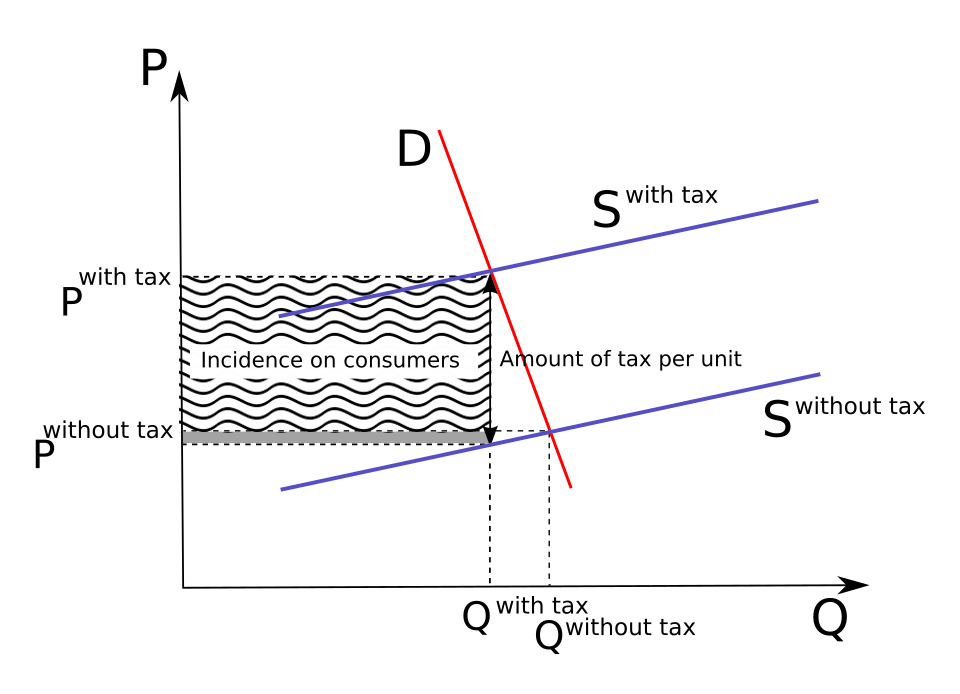
This tax-incidence diagram illustrates how a per-unit tax creates a wedge between the consumer price and the producer price, reducing the equilibrium quantity traded. With inelastic demand and elastic supply, the graph highlights that consumers bear most of the tax burden (a larger increase in the price they pay relative to the drop in the price sellers receive). It’s a visual bridge between “taxes change incentives” and “policy choices affect who gets what.” Source
Taxes/subsidies that change relative costs and benefits for producers/consumers.
Regulation that restricts or mandates certain actions (e.g., licensing, quality standards).
Direct provision of some goods and services (e.g., roads, national defence) and procurement from private firms.
Budget priorities that expand or contract activity in targeted areas.
The practical outcome is a system where many goods are produced and priced in markets, while the government shapes the “rules of the game” and sometimes the direction of production.
Distributing Output: Who Gets What in a Mixed Economy
The syllabus also emphasises that mixed economies “distribute output” via institutional arrangements. Distribution happens through:
Market incomes: Wages, rent, interest, and profit depend on ownership of resources and market conditions.
Taxes: Income, payroll, sales, and property taxes reduce private purchasing power and fund public activity.
Transfers and in-kind benefits: Cash payments (e.g., pensions) or goods/services (e.g., public schooling) shift consumption possibilities.
Public services: Even without direct cash transfers, government-provided services affect living standards and opportunity.
A key AP Microeconomics theme is that distribution is influenced not only by “ability to pay” in markets, but also by policy choices embedded in institutions.
Why Use a Mixed System?
Mixed economies reflect trade-offs between different goals:
Efficiency vs. equity: Markets can be highly responsive and innovative; government can pursue fairness or minimum standards.
Incentives vs. protections: Strong profit incentives may increase output; regulations may reduce harms and improve security.
Decentralised flexibility vs. coordinated planning: Markets adapt quickly; government can address broad priorities and constraints.
Understanding mixed economies means recognising that coordination is not “market or government,” but a layered combination of both operating simultaneously in most sectors.
Practice Questions
(2 marks) Define a mixed economy and identify one coordination mechanism used within it.
1 mark: Correct definition of mixed economy (market and government both play significant roles).
1 mark: Identifies one valid coordination mechanism (e.g., prices, taxes, regulation, public provision, property rights enforcement).
(6 marks) Explain how institutional arrangements in a mixed economy can affect (i) the allocation of scarce resources and (ii) the distribution of output.
Up to 3 marks (allocation):
1 mark: Institutions shape incentives/information/constraints (e.g., property rights, regulation).
1 mark: Link to resource allocation via market decisions (prices/profits) and/or government tools (taxes/subsidies/regulation).
1 mark: Clear explanation of how these change production/consumption choices.
Up to 3 marks (distribution):
1 mark: Identifies market income channels (wages/rent/interest/profit) and institutional role.
1 mark: Identifies government redistribution channels (taxes/transfers/public services).
1 mark: Explains how these mechanisms change who can consume output.
FAQ
The mix often varies by industry.
Network sectors (e.g., utilities) may have heavier regulation.
Retail markets may be mostly price-coordinated.
Healthcare/education often combine private provision with public finance.
Credibility usually depends on enforcement and predictability.
Clear legal rules, consistent court decisions, and stable agencies reduce uncertainty, making private contracts and long-term investment more likely.
Governments use administrative design to reduce conflict.
Tools include defined agency mandates, judicial review, cost–benefit requirements, and inter-agency coordination processes, though overlaps can still create inconsistent incentives.
Yes, if prices, entry/exit, and private ownership remain central.
High taxes mainly change incentives and fund redistribution/public services; they do not automatically replace market coordination unless the state also controls key production decisions.
Independent regulators can insulate technical decisions from day-to-day politics.
They often set rules (pricing, quality, safety) within a legal framework established by elected bodies, aiming for stability while still being accountable through oversight.