AP Syllabus focus: ‘Elasticity measures the percentage change in quantity resulting from a percentage change in price, income, or the price of related goods.’
Elasticity is the core tool for describing how strongly buyers and sellers respond when market conditions change. It turns “responsiveness” into a comparable, unit-free measure that applies across goods, markets, and time periods.
What elasticity measures
Elasticity captures how sensitive quantity is to a change in some determinant (such as price, income, or another good’s price). It is expressed in percentage terms, which helps comparisons across different units and scales (e.g., gallons vs. tickets).
Elasticity: A measure of responsiveness equal to the percentage change in quantity divided by the percentage change in a relevant determinant.
A key interpretation point is that elasticity is about relative change, not absolute change. A 10-unit drop in quantity could be “small” in a large market but “large” in a small one; percentages standardise that comparison.
The basic elasticity structure
Most elasticities used in demand and supply analysis share the same ratio form:
Elasticity\ (E) = \dfrac{%\Delta Q}{%\Delta X}
= elasticity (unit-free)
= percentage change in quantity (percent)
= percentage change in the determinant (percent)
Here, is the factor changing (commonly price, income, or the price of a related good). Because both numerator and denominator are percentages, elasticity is unit-free, enabling comparisons across products and contexts.
Interpreting sign and magnitude
Elasticity has two interpretive components: direction (sign) and strength (magnitude).
Direction (positive vs. negative)
For many demand relationships, the sign reflects the underlying relationship:
When a determinant rises and quantity rises, elasticity is positive.
When a determinant rises and quantity falls, elasticity is negative.
In practice, AP Microeconomics often emphasises the size of responsiveness for certain elasticities (especially for demand with respect to own price), while still recognising what the sign implies about the relationship being measured.
Strength (how responsive quantity is)
Magnitude tells how strongly quantity responds:
If the absolute value of elasticity is large, quantity is highly responsive to changes in the determinant.
If the absolute value is small, quantity is weakly responsive.
This responsiveness matters because it helps predict how shocks or policy changes transmit through markets (e.g., whether quantity changes a lot versus price changing more).
Elasticity beyond price: the syllabus scope
The syllabus focus includes three broad applications: price, income, and related goods’ prices. In each case, elasticity answers: “When this factor changes by 1%, by what percent does quantity change?”
Price responsiveness
Price elasticity summarises how much quantity changes when price changes. It is used to gauge how sensitive market participation is to price movements.
Income responsiveness
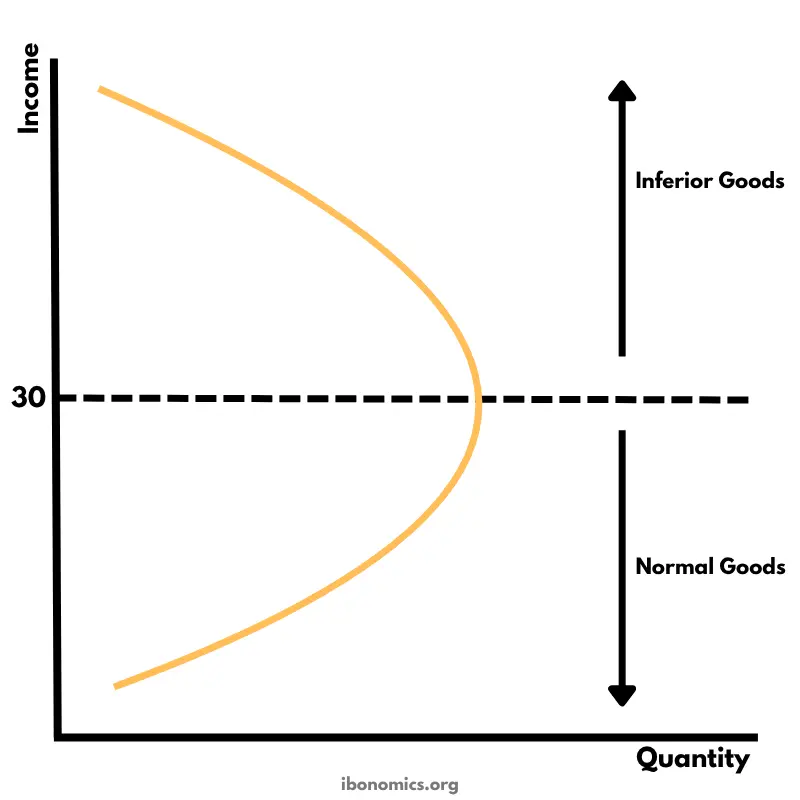
This Engel curve plots income (vertical axis) against quantity (horizontal axis) to show how purchases change as income changes. The upward-sloping region corresponds to a normal good (positive income elasticity), while the downward-sloping region illustrates an inferior good (negative income elasticity). Source
Income elasticity summarises how much quantity changes when income changes. It is used to assess how purchases track consumer purchasing power.
Responsiveness to related goods’ prices
Cross responsiveness summarises how demand for one good changes when the price of another good changes. It is used to capture interdependence across markets.
Why economists use elasticity
Elasticity is especially useful because it:
Supports comparisons across goods (necessities vs. discretionary items) without relying on units.
Helps predict the relative impact of changes in determinants on market outcomes (whether quantity reacts strongly or weakly).
Provides a compact way to describe responsiveness that can be applied consistently to different determinants (price, income, related goods’ prices).
Practice Questions
(2 marks) Explain what an elasticity value measures and why it is described as unit-free.
1 mark: States elasticity measures responsiveness as a ratio of percentage changes (e.g., relative to ).
1 mark: Explains it is unit-free because it uses percentages, so units cancel and comparisons across goods are possible.
(5 marks) A market analyst claims “Quantity is very responsive to changes in .” Using the concept of elasticity, explain how the analyst could support this claim and what additional information is needed to interpret the direction of the relationship.
1 mark: Defines elasticity as \dfrac{%\Delta Q}{%\Delta X} or an equivalent statement.
2 marks: Links “very responsive” to a large magnitude (large absolute value) of elasticity.
1 mark: Notes that interpretation requires knowing whether the elasticity is positive or negative (direction of relationship).
1 mark: Explains the sign depends on whether moves with (positive) or against (negative).
FAQ
Percentages allow comparisons across goods with different units and typical quantities.
They also reduce the risk of misreading “big” changes that are only big because the market level is large.
Point elasticity refers to responsiveness at a specific point; arc elasticity averages responsiveness over a range.
It matters when the change is large, because the measured responsiveness can depend on which base value is used.
Because the underlying relationship is typically negative, absolute value focuses attention on responsiveness strength.
This convention simplifies comparisons across goods without repeatedly restating the negative sign.
Yes. Small starting quantities or determinants can generate very large percentage changes, inflating elasticity.
In such cases, context and the underlying levels should be checked alongside the elasticity value.
In continuous terms, elasticity can be expressed as a derivative-based ratio (e.g., $E = \dfrac{dQ}{dX}\cdot\dfrac{X}{Q}$).
Log changes approximate percentage changes, which is why log-based methods are common in empirical work.