AP Syllabus focus: ‘Price elasticity of demand equals the percentage change in quantity demanded divided by the percentage change in price; slope is not elasticity.’
Price elasticity of demand is a precise way to quantify how strongly buyers react to price changes. This page focuses on computing it correctly, choosing percentage-change methods, and avoiding the common mistake of confusing elasticity with slope.
Core concept: responsiveness in percentage terms
Price elasticity of demand (PED) measures the percentage change in quantity demanded caused by a percentage change in the good’s own price (a unitless responsiveness measure).
Because PED is based on percent changes, it can be compared across goods with different units (e.g., movie tickets vs. gasoline).
What “slope is not elasticity” means
A demand curve’s slope is (or ), and it depends on the units used for price and quantity.
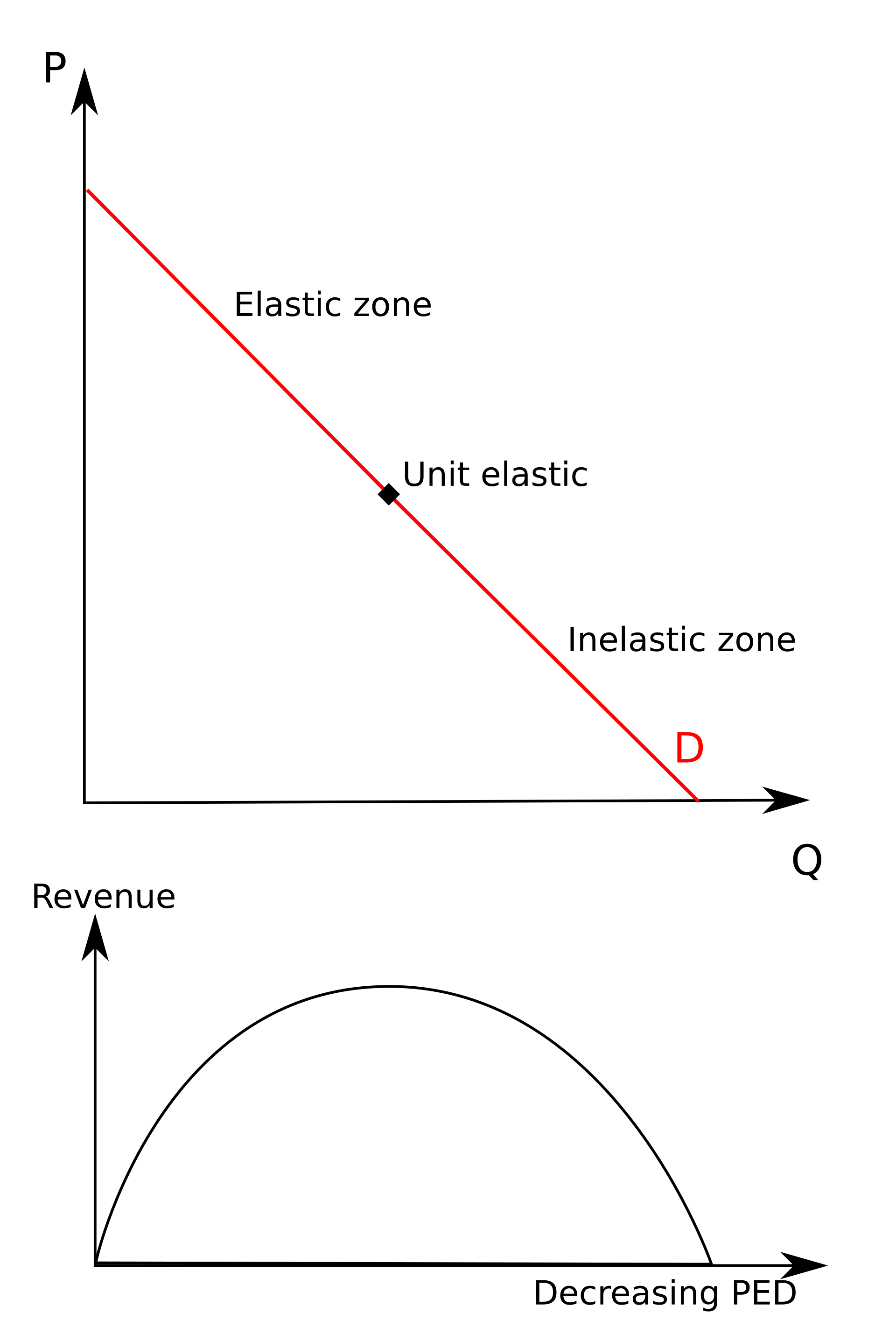
A straight-line demand curve is divided into regions where demand is elastic, unit elastic, and inelastic. The figure helps show why slope can be constant while elasticity changes: elasticity depends on percentage changes (which vary with the starting and ), not just the line’s steepness. Source
Elasticity instead uses percent changes, so it is unitless and varies along a linear demand curve even when slope is constant.
Computing PED: the required components
To calculate PED between two points, you need:
Two prices (, )
The corresponding quantities demanded (, )
A consistent method for percent change (simple base vs. midpoint)
Be clear about the direction of change:
If price rises, quantity demanded typically falls, making the raw ratio negative.
In AP Micro, PED is commonly reported in absolute value (as a positive number) unless a question explicitly asks for the sign.
Formulas (simple percent change and midpoint)
Price\ Elasticity\ of\ Demand\ (E_d) = \frac{%\Delta Q_d}{%\Delta P}
= price elasticity of demand (unitless)
= initial and new quantity demanded (units of the good)
= initial and new price (currency per unit)
= the variable you are percent-changing (use for or )
Use the midpoint method (also called arc elasticity) when calculating elasticity between two discrete points, because it avoids getting different answers depending on whether you treat the move as or .
Choosing the right method on AP-style tasks
When midpoint is preferred
Use midpoint percent change when:
You are given two prices and two quantities
You are asked for elasticity “between” two points
The prompt does not specify a base value for percent changes
When simple percent change may appear
Simple percent change (using the initial value as the base) may be used if:
The problem explicitly says “from the initial price of…” and “from the initial quantity of…”
The question expects a directional (start-to-end) framing
Common calculation and interpretation pitfalls
Forgetting to use percent change: Using gives slope, not elasticity.
Mixing bases: If you use midpoint for , you must also use midpoint for .
Sign confusion: The raw PED is usually negative; if the question asks whether demand is “more” or “less” responsive, report .
Rounding too early: Round PED at the end to avoid compounding error.
Using the wrong : Quantity demanded comes from the demand curve point at that price (not total market size unless specified).
Practice Questions
State the formula for price elasticity of demand and explain briefly why the slope of the demand curve is not the same as elasticity.
1 mark: Correct formula E_d=\frac{%\Delta Q_d}{%\Delta P}.
1 mark: Slope uses absolute changes/units (e.g., ), so it depends on units.
1 mark: Elasticity uses percentage changes, so it is unitless/comparable and can vary along a linear demand curve.
A product’s quantity demanded changes from 80 to 100 when its price changes from 8.
(a) Calculate PED using the midpoint method. (4 marks)
(b) State whether you would typically report the value as positive or negative in AP Microeconomics and why. (2 marks)
(a) 1 mark: Midpoint .
(a) 1 mark: Midpoint .
(a) 1 mark: Substitution into E_d=\frac{%\Delta Q}{%\Delta P}.
(a) 1 mark: Correct numerical PED (allow reasonable rounding).
(b) 1 mark: Raw PED is negative due to inverse price–quantity relationship.
(b) 1 mark: Typically report (positive) unless sign is explicitly requested.
FAQ
It uses the average of the two values as the base, so the percentage changes are symmetric in either direction.
Not necessarily. The negative sign usually reflects the law of demand; many answers conventionally report $|E_d|$ instead.
Yes, by selecting two points (arc elasticity) or using calculus-based point elasticity; which is appropriate depends on what the question provides.
Even with constant slope, the ratio of percent changes varies because the bases (price and quantity levels) change along the curve.
Keep intermediate results unrounded when possible, then round the final PED to the precision requested (or to two decimals if unspecified).