AP Syllabus focus: ‘Demand is elastic when elasticity is greater than 1, inelastic when it is less than 1, and unit elastic when it equals 1.’
Price elasticity of demand labels how strongly buyers react to price changes. This page explains the three key ranges—elastic, inelastic, and unit elastic—so you can interpret elasticity values clearly and consistently.
Price elasticity categories (what the number means)
Price elasticity of demand (PED) is a measure of how responsive quantity demanded is to a change in the good’s own price, expressed as a ratio of percentage changes.
Because price and quantity demanded typically move in opposite directions, PED is often reported in absolute value (as a positive number) to focus on responsiveness rather than direction.
E_d = \left|\frac{%\Delta Q_d}{%\Delta P}\right|
= price elasticity of demand (unitless)
= percent change in quantity demanded
= percent change in price
The key classification rule from the syllabus compares the size of the percentage quantity change to the percentage price change.
Elastic demand (PED greater than 1)
Elastic demand means quantity demanded changes by a larger percentage than price changes.
If price rises, quantity demanded falls a lot in percentage terms.
If price falls, quantity demanded rises a lot in percentage terms.
Interpretation: consumers are highly responsive to price changes for this good in this range.
Elastic does not mean “flat demand” or “luxury good” automatically; it is a statement about relative percentage responsiveness at the current price and quantity.
Inelastic demand (PED less than 1)
Inelastic demand means quantity demanded changes by a smaller percentage than price changes.
If price rises, quantity demanded falls only a little in percentage terms.
If price falls, quantity demanded rises only a little in percentage terms.
Interpretation: consumers are not very responsive to price changes for this good in this range.
Inelastic does not mean quantity demanded does not change at all; it means the percentage change in quantity is proportionally smaller than the percentage change in price.
Unit elastic demand (PED equals 1)
Unit elastic demand means quantity demanded changes by the same percentage as price changes.
A given percentage increase in price leads to an equal percentage decrease in quantity demanded.
A given percentage decrease in price leads to an equal percentage increase in quantity demanded.
Interpretation: consumers show proportional responsiveness in this range.
Unit elasticity is a boundary case that separates the elastic and inelastic ranges.
Visual and interpretive cues (without confusing slope and elasticity)
Even though a steeper or flatter curve can suggest responsiveness, slope is not the same as elasticity. Elasticity is based on percent changes, which depend on the starting price and quantity.
Common AP-relevant interpretation points:
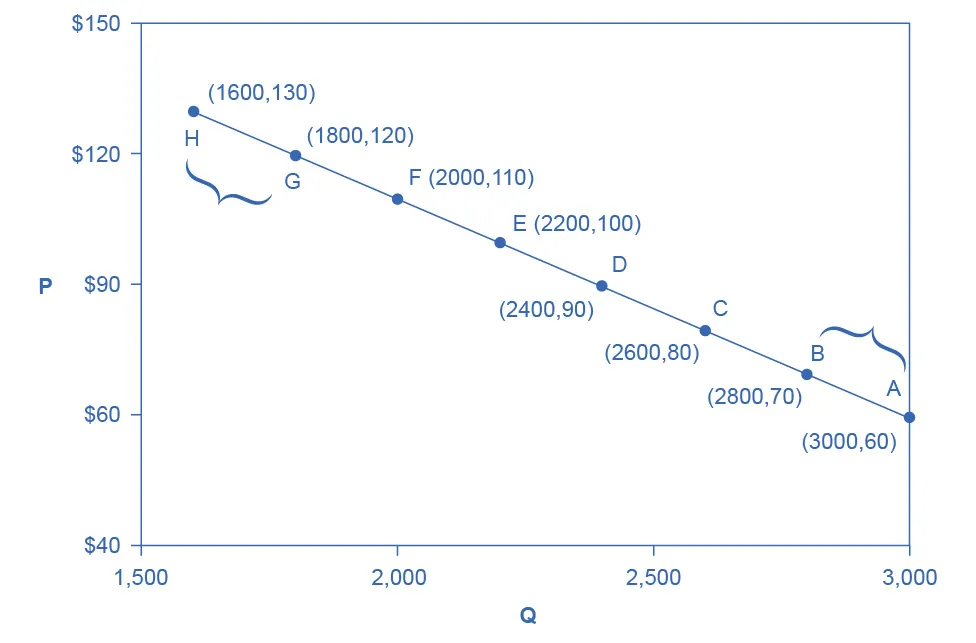
A linear demand curve with several labeled price–quantity points used to compute price elasticity over different segments. The diagram helps you see that the same straight-line demand curve can be relatively elastic in one region and relatively inelastic in another, depending on the starting price and quantity. Source
A straight-line demand curve can include elastic, unit elastic, and inelastic portions, depending on where you are on the curve.
Elasticity is about how buyers respond at a point or over a range, not a permanent label for the entire market in all circumstances.
Special cases often tested as classifications
You may also see extreme classifications:
Perfectly inelastic demand (PED equals 0): quantity demanded does not change when price changes (vertical demand).
Perfectly elastic demand (PED is infinite): buyers will purchase at one price but none at any higher price (horizontal demand).
These extreme cases reinforce the meaning of responsiveness: from none at all (0) to unlimited (infinite), with unit elastic (1) as the proportional middle.
Common pitfalls
Forgetting absolute value: the demand relationship is negative, but classification typically uses the magnitude.
Misreading the threshold: “greater than 1” is elastic; “less than 1” is inelastic; “equals 1” is unit elastic.
Overgeneralising: elastic/inelastic is a statement about responsiveness for the good in a specified situation, not a moral judgment or a guarantee about consumer motives.
Practice Questions
(2 marks) If the price elasticity of demand for good X is , classify demand as elastic, inelastic, or unit elastic. Briefly justify your choice.
1 mark: Correct classification (inelastic).
1 mark: Justification that means percentage change in quantity demanded is smaller than percentage change in price.
(6 marks) Define unit elastic demand and explain how it differs from elastic demand and inelastic demand. In your answer, refer to the relationship between percentage changes in price and quantity demanded.
2 marks: Correct definition of unit elastic demand (; equal percentage changes).
2 marks: Correct explanation of elastic demand (; quantity changes by a larger percentage than price).
2 marks: Correct explanation of inelastic demand (; quantity changes by a smaller percentage than price).
FAQ
Yes. Elasticity can vary along a demand curve because percentage changes depend on the starting price and quantity.
Because the price–quantity relationship is usually negative; using $|E_d|$ focuses on responsiveness magnitude for classification.
It implies quantity demanded is fixed regardless of price changes over the relevant range, so responsiveness is zero.
It is rare, but can approximate situations with many identical substitutes and buyers who can switch instantly at tiny price differences.
Over longer horizons, buyers often have more ways to adjust (switch products, change habits), so demand may appear more elastic than in the short run.