AP Syllabus focus: ‘The supply-and-demand model explains what influences prices and quantities and why they differ across markets or change over time.’
The supply-and-demand model is the core tool for explaining how competitive markets determine prices and quantities. It helps you compare markets, predict changes over time, and organise real-world shocks into clear economic logic.
What the Supply-and-Demand Model Does
The supply-and-demand model predicts the market price and quantity of a good using two relationships:
Demand: buyers’ willingness and ability to purchase at different prices
Supply: sellers’ willingness and ability to produce and sell at different prices
It is a comparative statics framework: you compare an initial outcome to a new outcome after some change (a “shock”) to market conditions, holding other factors constant (ceteris paribus).
Supply-and-demand model: A model that determines a market’s price and quantity by combining buyers’ demand and sellers’ supply and analysing how shifts in either side change market outcomes.
In AP Microeconomics, this model is typically used for perfectly competitive markets, where many buyers and sellers interact and no single participant controls price.
Building the Model: Demand and Supply
Demand: what shapes buyers’ behavior
A demand curve shows the relationship between price and quantity demanded, holding other determinants constant. When those other determinants change, demand shifts.
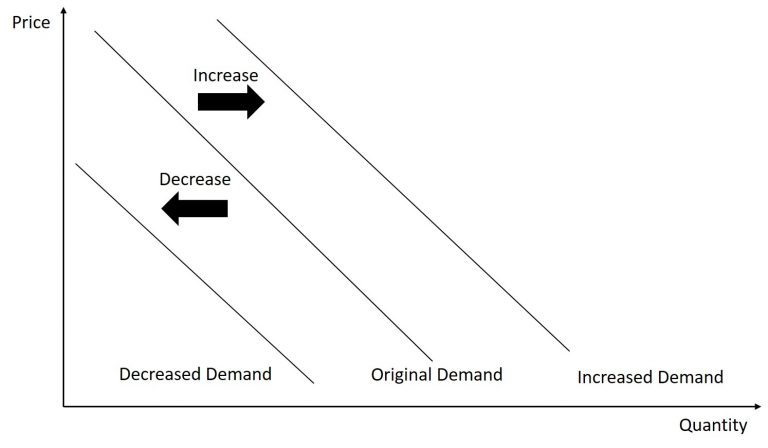
A demand-shift diagram showing three demand curves: decreased demand (left), original demand (middle), and increased demand (right). It emphasizes that a change in a demand determinant moves the entire demand relationship (a shift), rather than causing a movement along a single curve due to the good’s own price changing. Source
Common determinants of demand (causes of shifts) include:
Income (especially important for normal vs inferior goods)
Tastes and preferences
Prices of related goods (substitutes and complements)
Expectations about future prices or income
Number of buyers in the market
Using the model means separating:
A movement along the demand curve (caused by a change in the good’s own price)
A shift of the demand curve (caused by a change in a determinant other than the good’s own price)
Supply: what shapes sellers’ behavior
A supply curve shows the relationship between price and quantity supplied, holding other determinants constant. When those other determinants change, supply shifts.
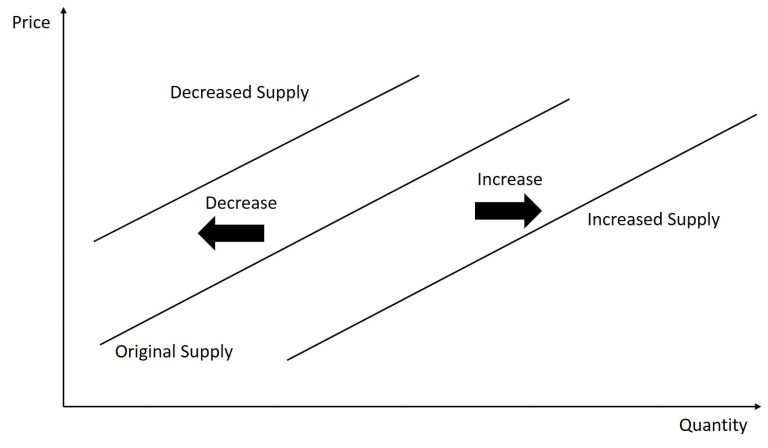
A supply-shift diagram showing decreased supply (left), original supply (middle), and increased supply (right) on Price–Quantity axes. This helps visualize how changes in production conditions (costs, technology, policy, number of sellers) shift the entire supply curve, changing the quantity supplied at every price. Source
Common determinants of supply include:
Input prices (costs of labour, raw materials, energy)
Technology and productivity
Taxes/subsidies and regulation that affect costs (treated as cost shifts)
Expectations about future prices or input costs
Number of sellers in the market
As with demand:
A movement along supply comes from a change in the good’s own price
A shift of supply comes from changes in costs or production conditions
Reading the Graph: Price, Quantity, and the Market Outcome
On the standard graph:
Vertical axis: Price (P)
Horizontal axis: Quantity (Q)
The intersection of supply and demand indicates the model’s predicted market outcome: the equilibrium price and quantity.
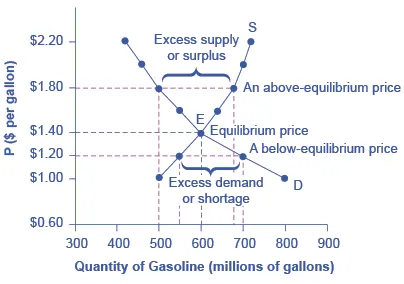
A standard supply-and-demand equilibrium graph: the demand curve (D) and supply curve (S) intersect at point , determining the equilibrium price and quantity. The diagram also shows that prices above equilibrium generate a surplus (excess supply), while prices below equilibrium generate a shortage (excess demand), illustrating how market pressures push price back toward equilibrium. Source
Even when you are not doing calculations, it is useful to express equilibrium as the condition that the quantity buyers want equals the quantity sellers want at that price.
= Quantity demanded (units per time period)
= Quantity supplied (units per time period)
= Market price (dollars per unit)
The key skill is translating a real-world change into “demand shifts right/left” or “supply shifts right/left,” then using the new intersection to infer how P and Q change.
Using the Model to Explain Differences Across Markets
The model explains why two markets can have very different prices and quantities for similar goods. Differences come from underlying demand and supply conditions, such as:
Demand differences: higher incomes, stronger preferences, larger populations, or fewer substitutes can push demand higher, raising the predicted price and quantity (depending on supply).
Supply differences: cheaper inputs, better technology, favourable climate/locations, or more sellers can push supply higher, lowering the predicted price and raising the predicted quantity (depending on demand).
Importantly, you cannot conclude “high price means high demand” without also considering supply. A high price could reflect strong demand, weak supply, or both.
Using the Model to Explain Changes Over Time (Comparative Statics)
To use the model cleanly, follow a consistent process:
Identify the market (be precise about the good and geographic/time boundaries).
Identify the shock (what changed in the world?).
Decide whether the shock changes demand or supply (or both).
Determine the direction of the shift:
Demand right = higher demand at every price; demand left = lower demand at every price
Supply right = greater supply at every price; supply left = lower supply at every price
Compare the old and new intersections to infer changes in:
Equilibrium price
Equilibrium quantity
When both curves shift at once, the model still works: it usually gives a clear direction for one variable (price or quantity) and an ambiguous direction for the other unless you know which shift is larger. This is one reason the supply-and-demand model is powerful for explaining real markets: multiple forces often operate simultaneously.
Practice Questions
Question 1 (1–3 marks) In the market for coffee, consumers’ incomes rise and coffee is a normal good. Using the supply-and-demand model, state the direction of the change in (i) demand and (ii) equilibrium price.
Demand shifts to the right/increases. (1)
Equilibrium price rises/increases. (1)
Question 2 (4–6 marks) A new production technology reduces firms’ costs in the market for bicycles, and at the same time a rise in the price of public transport increases consumers’ willingness to buy bicycles. Using the supply-and-demand model, explain the predicted changes in equilibrium price and equilibrium quantity.
Identifies that lower costs increase supply (supply shifts right). (1)
Identifies that higher public transport price increases demand for bicycles (demand shifts right). (1)
States equilibrium quantity increases (unambiguous). (1)
States equilibrium price is indeterminate/ambiguous without knowing relative shift sizes. (2)
Uses correct model language (shifts, not movements) and links to new intersection. (1)
FAQ
In many competitive settings, the demand curve can be interpreted as buyers’ marginal benefit and the supply curve as sellers’ marginal cost (including opportunity cost).
Equilibrium then corresponds to the point where marginal benefit equals marginal cost, which helps connect the model to efficiency analysis later.
It means you assume all other determinants stay fixed while you isolate one change.
Practically, you choose the most relevant shock and treat other potential influences as unchanged so the shift you draw has a clear cause.
A higher price can be caused by:
demand shifting right, or
supply shifting left, or
both happening together.
Without additional information about what changed (income, costs, etc.), price alone does not identify the shift.
Define the market by:
the specific product category (a particular service vs all streaming),
geography (national vs local), and
time period (short run vs long run).
A narrower market often shows stronger substitution effects and clearer determinants.
It can be less predictive when:
prices are not flexible (contracts, administered pricing),
product quality varies sharply and is hard to observe, or
market power or external effects dominate behaviour.
In such cases, the model may still organise thinking, but outcomes may not match simple intersection predictions.