AP Syllabus focus: ‘In a perfectly competitive market, equilibrium occurs when quantity supplied equals quantity demanded, so there is no shortage or surplus.’
Market equilibrium is the core prediction of the supply-and-demand model: the market price tends to settle where buyers’ and sellers’ plans are mutually consistent. Market clearing describes this outcome as the absence of shortages and surpluses.
Market equilibrium in a perfectly competitive market
What “equilibrium” means
In a perfectly competitive market, many buyers and sellers trade an identical (or very similar) product, and no single participant can control the market price. The price is determined by the market as a whole.
Market equilibrium: The price–quantity outcome where quantity demanded equals quantity supplied, so buyers and sellers’ plans are compatible.
The equilibrium outcome is typically described by two values:
Equilibrium price (): the market price at equilibrium
Equilibrium quantity (): the quantity bought and sold at equilibrium
Condition for equilibrium
= Quantity demanded (units of the good per time period)
= Quantity supplied (units of the good per time period)
= Equilibrium price (dollars per unit)
This condition can be found using:
A graph: the intersection of the demand curve and the supply curve
A schedule: the price at which the quantity demanded entry matches the quantity supplied entry
A function: the price that solves
Market clearing: no shortage or surplus
Market clearing as an outcome
The syllabus emphasises that in perfect competition, equilibrium is also a market-clearing situation: the market has no built-in tendency to accumulate unsold goods or leave willing buyers unable to purchase at the going price.
Market clearing: A market outcome in which, at the current price, there is no shortage and no surplus because .
At the market-clearing price:
Every unit producers want to sell at that price is purchased
Every unit consumers want to buy at that price is available
The “plans” of buyers and sellers match, so there is no pressure for price to change
Shortages and surpluses as signals
To understand why the equilibrium price clears the market, it helps to define the two forms of non-clearing outcomes.
Shortage: A situation where quantity demanded exceeds quantity supplied at the current price.
A shortage indicates the price is “too low” relative to equilibrium, meaning buyers’ desired purchases exceed what sellers bring to market.
Surplus: A situation where quantity supplied exceeds quantity demanded at the current price.
A surplus indicates the price is “too high” relative to equilibrium, meaning sellers’ desired sales exceed what buyers purchase.
How markets tend to move toward equilibrium
Price adjustments in competitive markets
In perfect competition, prices adjust because buyers and sellers have incentives to respond to shortages and surpluses.
If price is above :
A surplus forms: sellers cannot sell all units they want at that price
Sellers have an incentive to lower price (or offer better terms) to attract buyers
As price falls, quantity demanded rises (movement along demand) and quantity supplied falls (movement along supply), reducing the surplus
If price is below :
A shortage forms: buyers cannot purchase all units they want at that price
Some buyers may bid the price up, and sellers can raise price without losing all customers
As price rises, quantity demanded falls and quantity supplied rises, reducing the shortage
This adjustment process continues until the price reaches the level where , which is the market-clearing equilibrium described in the syllabus.
Rationing function of price
In equilibrium, price rations scarce resources without queues or persistent unsold inventories:
When a good is relatively scarce, equilibrium price tends to be higher, reducing quantity demanded and increasing quantity supplied until the market clears.
When a good is relatively abundant, equilibrium price tends to be lower, increasing quantity demanded and reducing quantity supplied until the market clears.
Reading equilibrium on a supply-and-demand graph
What to locate and what it means
On the standard graph (price on the vertical axis, quantity on the horizontal axis):
The demand curve shows the quantities buyers are willing and able to buy at each price.
The supply curve shows the quantities sellers are willing and able to sell at each price.
The intersection is the equilibrium (, ).
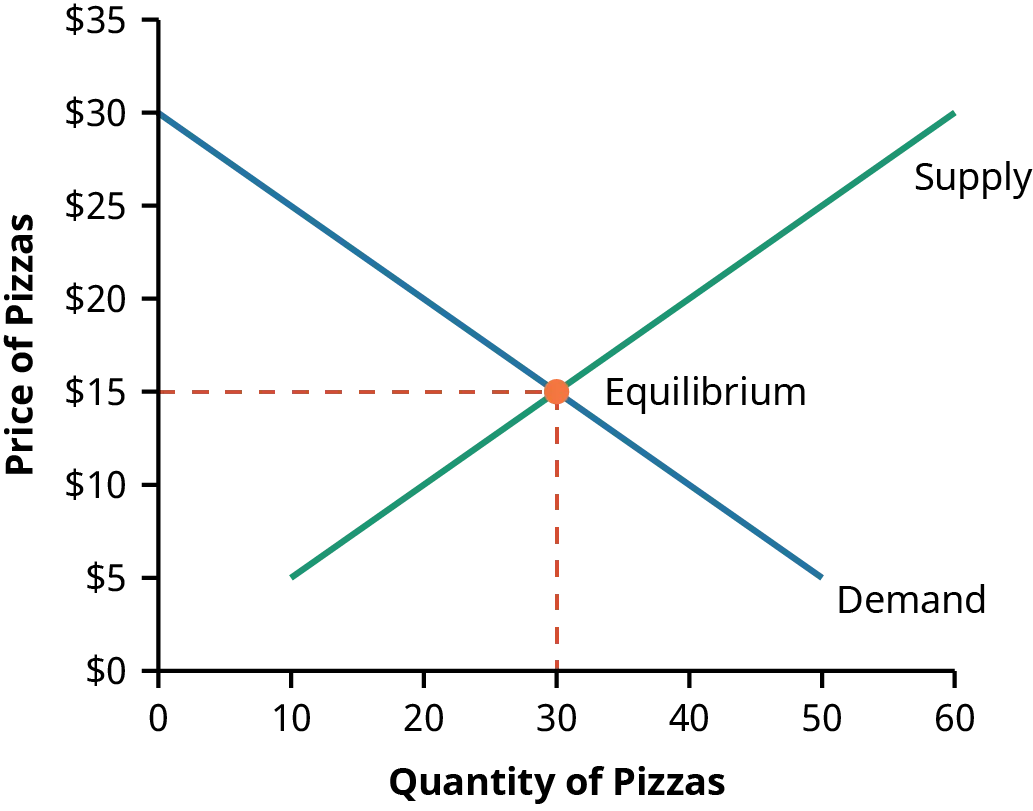
Supply and demand intersect at the market equilibrium, where the equilibrium price and equilibrium quantity are determined simultaneously. The dashed projections to each axis illustrate how to "read" on the price axis and on the quantity axis from the intersection point.. Source
Key interpretations at the intersection:
The market is cleared: no shortage, no surplus.
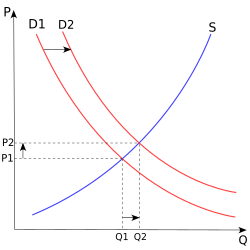
A rightward shift of demand from to moves the equilibrium along the supply curve, raising both equilibrium price and equilibrium quantity. This picture helps connect the graphical intersection idea to comparative statics: when demand increases, the market-clearing changes. Source
The price is stable in the sense that there is no systematic pressure for it to move up or down, given the current curves.
Practice Questions
Question 1 (3 marks) Define “market-clearing price” and state the condition that must hold in a perfectly competitive market for the price to be market clearing.
Defines market-clearing price as a price where there is no shortage and no surplus (1)
States that at this price quantity demanded equals quantity supplied (1)
Writes the condition as (or equivalent words/symbols) (1)
Question 2 (6 marks) A market for a product is perfectly competitive. Explain what happens if the current market price is set above the equilibrium price, and how market forces move the market towards equilibrium. Use the terms surplus, quantity demanded, and quantity supplied.
Identifies that at a price above equilibrium, (surplus) (2)
Explains that sellers cannot sell all they wish at that price / inventories build up (1)
Explains sellers have an incentive to reduce price to increase sales (1)
Explains that as price falls, quantity demanded rises (movement along demand) (1)
Explains that as price falls, quantity supplied falls (movement along supply), reducing the surplus until (1)
FAQ
Yes. Market clearing means $Q_d = Q_s$ among participants at that price.
Some individuals may be priced out, but they are not counted in quantity demanded at that price because they are not willing and able to buy it.
Stable equilibrium means small deviations from $P^$ create forces that push price back towards $P^$. For typical downward-sloping demand and upward-sloping supply, equilibrium is stable.
Instability can occur if the usual slope patterns do not hold, so deviations push price further away rather than back.
Selling out usually refers to a temporary shortage at a posted price (often because the posted price is below the market-clearing price).
Market clearing is the opposite: at the market-clearing price, the quantity available equals the quantity consumers choose to buy, so persistent stockouts are not expected.
Not necessarily. Adjustment speed depends on factors such as:
How quickly sellers can change posted prices
How costly it is to change prices (“menu costs”)
How fast buyers and sellers learn about shortages/surpluses
How quickly production and delivery respond
The equilibrium concept describes the tendency, not the time path.
With standard single-valued supply and demand curves, there is typically one equilibrium.
Multiple equilibria can arise if supply or demand is non-standard (e.g., curves that bend back), or if there are separate demand segments with different trading rules, but this requires additional structure beyond the basic competitive model.