AP Syllabus focus: ‘In the absence of market failures, market equilibrium maximizes total economic surplus, so perfectly competitive markets are efficient.’
Market equilibrium is more than where supply equals demand: under ideal competitive conditions, it coordinates buyers and sellers so that society’s gains from voluntary exchange are as large as possible.
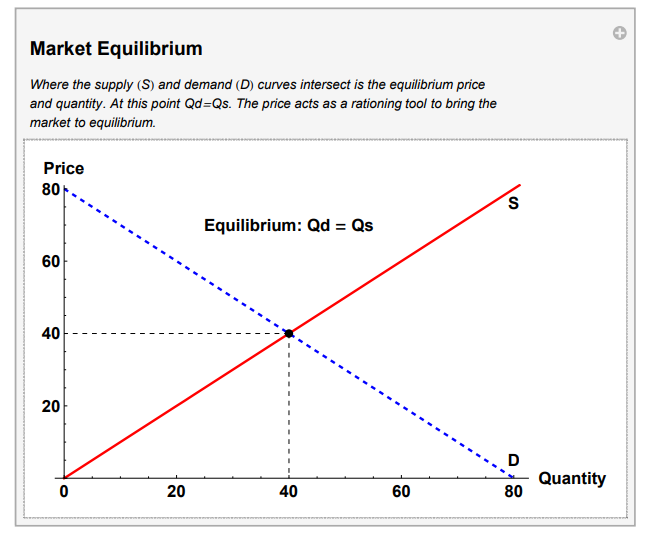
This supply-and-demand graph marks the competitive equilibrium at the intersection of the curves, where quantity demanded equals quantity supplied. It gives a visual anchor for the idea that a single market price coordinates buyers and sellers to settle on one traded quantity. Source
The efficiency claim in the supply-and-demand model
In a perfectly competitive market, the equilibrium price and quantity are not just “market-clearing”; they are efficient because they produce the greatest combined benefit to buyers and sellers from trading that good.
Total economic surplus: The sum of consumer surplus and producer surplus created in a market; it measures the gains from trade to both buyers and sellers.
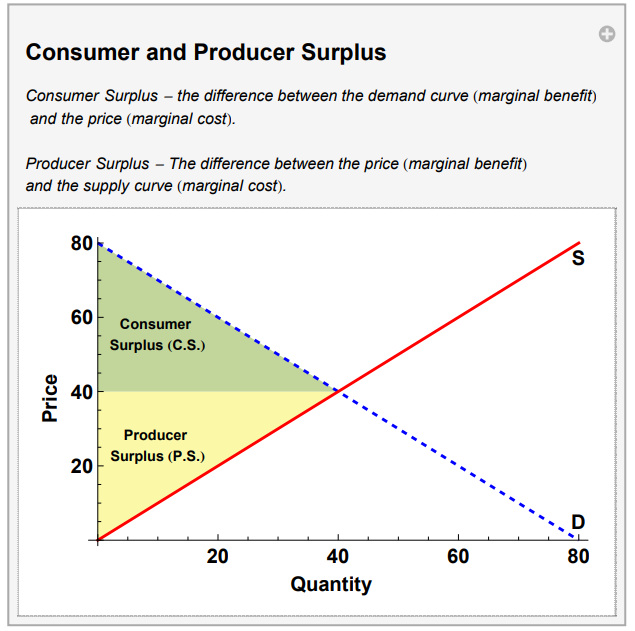
This diagram decomposes total surplus into the standard shaded regions: consumer surplus above the market price and below demand, and producer surplus below the market price and above supply. It visually reinforces that competitive equilibrium creates gains from trade on both sides of the market. Source
A key intuition: trades happen only when at least one buyer values the good more than the resources needed to produce it, and competition tends to push the market toward making all such trades.
Why equilibrium maximizes total economic surplus
Mutually beneficial trades and the marginal principle
Efficiency comes from comparing buyers’ willingness to pay with sellers’ opportunity cost at the margin.
Marginal benefit (MB): The additional benefit to consumers from consuming one more unit, measured by the maximum willingness to pay for that unit.
In a competitive market, the demand curve represents MB for each additional unit, while the supply curve represents marginal cost.
Marginal cost (MC): The additional opportunity cost of producing one more unit of a good (the value of resources in their next best alternative use).
When the market produces the equilibrium quantity, the last unit traded is the unit where MB equals MC.
= marginal benefit (dollars per unit)
= marginal cost (dollars per unit)
If for a unit, producing and trading it would increase total economic surplus (a mutually beneficial trade is being missed).
If for a unit, producing it reduces total economic surplus (resources cost more than consumers value the output).
No further gains from trade at equilibrium
At equilibrium quantity:
All units with MB ≥ MC are produced and exchanged.
No units with MB < MC are produced.
This means total economic surplus is at its maximum because there are no remaining unexploited trades that could make someone better off without making someone else worse off, given the market’s price and cost conditions.
What “efficient” means here (and what it requires)
Allocative efficiency: A situation where the quantity produced is the one that maximizes total economic surplus (equivalently, where for the last unit).
The AP efficiency result depends on the syllabus condition “in the absence of market failures.” That typically requires:
Well-defined property rights and enforceable contracts so voluntary exchange reflects true ownership and costs
No significant externalities so private MB/MC match social MB/MC
Low transaction costs so mutually beneficial trades can occur
Many buyers and sellers with price-taking behaviour, so the market price reflects underlying MB and MC rather than market power
When these conditions hold, competitive equilibrium is efficient because it aligns individual incentives (buying and selling) with the market-wide objective of maximizing total economic surplus.
Practice Questions
(2 marks) Explain why the perfectly competitive equilibrium quantity maximises total economic surplus.
States that at equilibrium all mutually beneficial trades occur (where willingness to pay is at least opportunity cost). (1)
States that equilibrium occurs where for the last unit, so no additional unit would increase total surplus. (1)
(5 marks) A market is perfectly competitive and initially in equilibrium. Explain, using marginal benefit and marginal cost reasoning, why producing a quantity below equilibrium is inefficient.
Identifies that the demand curve represents and the supply curve represents in a competitive market. (1)
States that at equilibrium for the last unit. (1)
Explains that below equilibrium there exist units where . (1)
Explains these are unrealised mutually beneficial trades, so total economic surplus is not maximised. (1)
Concludes that increasing output towards equilibrium raises total economic surplus until again. (1)
FAQ
No. Efficiency is about maximising total surplus, not how surplus is divided.
A market can be efficient while consumer surplus is small and producer surplus is large (or vice versa).
Externalities create a wedge between private and social values.
Negative externality: social $MC$ exceeds private $MC$, so equilibrium quantity is too high.
Positive externality: social $MB$ exceeds private $MB$, so equilibrium quantity is too low.
Transaction costs (search, bargaining, enforcement) can block trades with $MB \ge MC$.
If trades that should increase total surplus do not occur, equilibrium quantity need not be surplus-maximising.
Yes. With market power, firms can restrict output so that price exceeds $MC$.
That typically implies the market produces where $MB > MC$ for the marginal unit not produced, so total surplus is not maximised.
Clear property rights ensure that prices reflect legitimate control of resources and that costs/benefits are internalised via exchange.
Weak or missing rights can cause unpriced use, disputes, or exclusion problems that prevent surplus-maximising trades.