AP Syllabus focus: ‘Market disequilibrium creates surpluses or shortages, and market forces move price and quantity back toward equilibrium.’
Markets do not always sit exactly at the equilibrium price. When price is “too high” or “too low,” predictable gaps arise between quantity demanded and quantity supplied, triggering pressures that push the market back toward equilibrium.
Disequilibrium: when price is not market-clearing
A market disequilibrium occurs when the market price is set at a level where , meaning buyers and sellers’ plans do not match.
This diagram presents a standard demand-and-supply setup with price on the vertical axis and quantity on the horizontal axis, emphasizing how the intersection determines the market-clearing outcome. It works well as a visual anchor for the condition at equilibrium versus at disequilibrium prices. The clean labeling also helps students practice reading quantities at a given price from the curves. Source
Disequilibrium is revealed through either a surplus or a shortage, and it creates incentives for market participants to adjust behavior.
A key AP skill is identifying whether a given price is above or below equilibrium and then tracing the direction of changes in price and quantity exchanged that follow.
Disequilibrium: A situation in which the market price does not equate quantity demanded and quantity supplied, creating either a surplus or a shortage.
Disequilibrium is not just a graph concept; it shows up as unsold inventories, stockouts, waiting lines, and rapid price changes as firms and consumers respond to incentives.
Surpluses (excess supply): price above equilibrium
A surplus happens when the market price is above the equilibrium price. At that higher price, producers want to sell more, but consumers want to buy less, so . The gap shows up as unplanned inventory accumulation for firms.
Surplus (excess supply): The amount by which quantity supplied exceeds quantity demanded at a given price.
Typical market signals and pressures in a surplus:
Inventories rise: firms cannot sell all they planned to sell.
Firms face an incentive to cut prices to attract additional buyers.
Some producers may reduce output (fewer hours, smaller orders of inputs) because selling at the current price is difficult.
Competitive pressure encourages markdowns, promotions, or improved terms (which are forms of price competition in practice).
Graphically, at a price above equilibrium, the chosen price intersects the demand curve at a lower quantity than where it intersects the supply curve; the vertical difference between those quantities is the surplus amount.
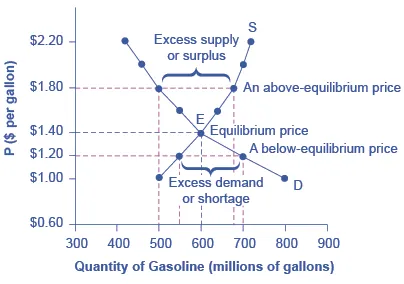
This supply-and-demand graph marks the equilibrium point where the curves intersect, then contrasts a price above equilibrium with a price below equilibrium. At a price above equilibrium, the diagram shows quantity supplied exceeding quantity demanded (a surplus). At a price below equilibrium, it shows quantity demanded exceeding quantity supplied (a shortage). Source
As price falls, there is a movement along both curves: quantity demanded rises and quantity supplied falls, shrinking the surplus.
Shortages (excess demand): price below equilibrium
A shortage happens when the market price is below the equilibrium price. At that lower price, consumers want to buy more, but producers want to sell less, so . The gap shows up as stockouts and frustrated buyers.
Shortage (excess demand): The amount by which quantity demanded exceeds quantity supplied at a given price.
Typical market signals and pressures in a shortage:
Shelves empty or services become fully booked.
Buyers have an incentive to bid up the price (willingness to pay increases when the good is scarce).
Sellers gain an incentive to raise prices because the good sells quickly at the current price.
Firms may increase output (more labour hours, expedited shipments, expanded capacity use) if higher prices make additional production worthwhile.
Graphically, at a price below equilibrium, the demand curve indicates a larger quantity than the supply curve at that price; the difference is the shortage. As price rises, quantity demanded falls and quantity supplied rises (movements along the curves), shrinking the shortage.
Measuring the size of a surplus or shortage
The size of disequilibrium is the difference between planned quantities at the current price.
= Quantity supplied at the current price (units per time period)
= Quantity demanded at the current price (units per time period)
= Quantity demanded at the current price (units per time period)
= Quantity supplied at the current price (units per time period)
In AP terms, always compute these using the quantities read at the same price (the imposed or current market price), not at equilibrium unless that is the given price.
How market forces restore equilibrium
In competitive markets, price acts as a signal and incentive:
With a surplus, sellers compete to get rid of excess inventory, pushing price down; this increases and decreases until the market clears.
With a shortage, buyers compete for limited goods and sellers recognise the opportunity to raise prices, pushing price up; this decreases and increases until the market clears.
The adjustment continues until there is no remaining tendency for price to change—when buyers can purchase the quantity they want and sellers can sell the quantity they want at the prevailing price (the market-clearing outcome).
Practice Questions
Question 1 (3 marks) A market is currently priced below its equilibrium price.
(a) Identify whether the market experiences a surplus or a shortage. (1 mark)
(b) State the direction of pressure on price and explain why. (2 marks)
(a) Shortage / excess demand. (1)
(b) Price pressured upwards. (1)
Explanation: at the current low price , so buyers compete and/or sellers can raise price to ration limited supply. (1)
Question 2 (6 marks) Explain how a surplus arises when the market price is above equilibrium and analyse how market forces move price and quantity back toward equilibrium.
Define/identify surplus as at the current price. (1)
Explain why price above equilibrium reduces and increases (movement along curves). (2)
Describe inventory accumulation/unsold output as the real-world sign of surplus. (1)
Analyse downward pressure on price from sellers competing to sell excess inventory. (1)
Link adjustment to movements toward equilibrium: falling price raises and lowers until . (1)
FAQ
Information and adjustment lags can slow responses.
Firms may not instantly observe higher demand.
Production may take time to ramp up.
Some sellers use waiting lists or limited hours before changing posted prices.
A shortage/surplus reflects a difference between $Q_d$ and $Q_s$ at a particular price (movements along curves), not a shift of the entire curve.
A shift would mean preferences, income, costs, etc. changed.
When price is temporarily “too low,” goods may be allocated by:
Queues and waiting time
First-come, first-served rules
Membership requirements
Reduced package sizes or purchase limits
These do not eliminate the shortage; they change who receives the limited quantity supplied.
Firms may adjust effective price through:
Coupons, rebates, temporary promotions
Bundling or added features
More generous return policies
These strategies clear inventory while avoiding long-run damage to the brand’s listed price.
Adjustment is typically faster when:
Prices are flexible and can change frequently
Inventories are easy to observe
Production can be scaled quickly
Adjustment is slower when production takes time (e.g., agriculture) or prices are sticky due to contracts or menu costs.