AP Syllabus focus: ‘Changes in demand or supply also change consumer surplus, producer surplus, and total surplus, with effects shaped by price elasticities.’
Price changes and shifts in supply or demand don’t just change equilibrium; they reallocate benefits between buyers and sellers. Elasticity helps predict who gains more and how large the welfare changes will be.
Surplus concepts in the supply-and-demand model
Consumer surplus and producer surplus
Consumer surplus (CS): The difference between what consumers are willing to pay (shown by the demand curve) and what they actually pay, measured as area above price and below demand up to the quantity traded.
CS rises when consumers pay a lower price and/or buy more units where willingness to pay exceeds price.
Producer surplus (PS): The difference between the market price producers receive and the minimum they would accept (shown by the supply curve), measured as area below price and above supply up to the quantity traded.
PS rises when producers receive a higher price and/or sell more units above their marginal cost.
Total surplus (TS): The sum of consumer surplus and producer surplus created by exchange in a market.
A surplus analysis always compares “before vs after” equilibrium outcomes using areas on the same supply-and-demand graph.
= total surplus (dollars per period)
= consumer surplus (dollars per period)
= producer surplus (dollars per period)
How shifts in demand or supply change CS, PS, and TS
Demand increases (demand shifts right)
Equilibrium price rises and equilibrium quantity rises.
CS is ambiguous:
Higher price reduces CS on inframarginal units (units still purchased).
Higher quantity adds CS from new units bought.
PS increases (typically): producers receive a higher price and sell more, expanding the area between price and supply.
Demand decreases (demand shifts left)
Price falls and quantity falls.
CS is ambiguous:
Lower price raises CS on remaining purchases.
Lower quantity removes CS from units no longer bought.
PS decreases: lower price and lower sales shrink producer gains from trade.
Supply increases (supply shifts right/down)
Price falls and quantity rises.
CS increases (typically): consumers pay less and buy more.
PS is ambiguous:
Lower price reduces PS on units still sold.
Higher quantity adds PS from additional units sold (especially if costs fall a lot).
Supply decreases (supply shifts left/up)
Price rises and quantity falls.
CS decreases (typically): higher price and fewer purchases reduce consumer gains.
PS is ambiguous:
Higher price can raise PS on remaining units.
Lower quantity removes PS from units no longer produced.
The role of elasticity in surplus changes
Elasticity determines how the adjustment splits between price and quantity
When a curve is more elastic, equilibrium tends to adjust more in quantity and less in price in response to a shift.
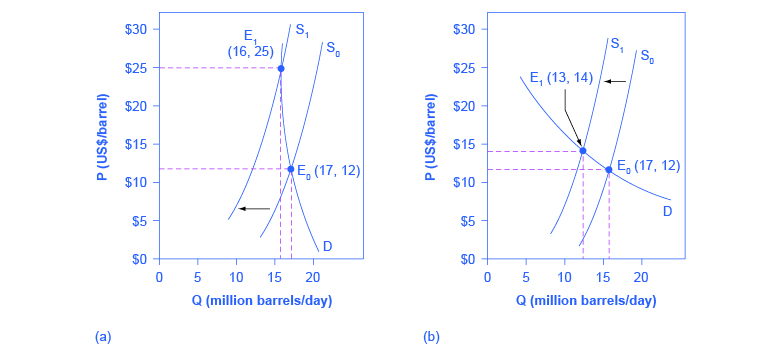
These paired panels compare outcomes when the demand curve is relatively inelastic versus relatively elastic, holding the supply shift constant. In the inelastic-demand case, the new equilibrium features a large increase in price and only a small change in quantity; in the elastic-demand case, price changes less and quantity adjusts more. This is the core intuition behind why elasticities shape how surplus changes through movements in both and . Source
When a curve is more inelastic, adjustment tends to be more in price and less in quantity. This matters because CS and PS are areas that depend on both and .
Elasticity shapes who gains more (distribution of surplus)
If demand is relatively inelastic and supply shifts (e.g., supply decreases), price changes are larger, so consumers tend to experience larger losses in CS from higher prices, while producers may be partially protected by higher prices.
If supply is relatively inelastic and demand increases, price rises sharply, so producers tend to gain more PS (big price increase on existing units), while consumers may gain less CS (they pay much more for many units).
Elasticity affects the magnitude of welfare changes
With elastic demand and supply, shifts create large quantity changes, often creating large changes in CS and/or PS through many new (or lost) units of trade.
With inelastic demand and/or supply, shifts mainly change price, redistributing surplus between consumers and producers, sometimes with smaller changes in total traded quantity and therefore smaller changes tied to “missing” or “extra” transactions.
Practice Questions
(2 marks) A market experiences an increase in demand. State what happens to equilibrium price and equilibrium quantity, and identify which surplus definitely increases.
Equilibrium price increases. (1)
Equilibrium quantity increases. (1)
Producer surplus increases (award this point only if stated alongside the equilibrium effects; no extra mark beyond 2). (0)
(6 marks) Demand increases in a competitive market. Using elasticity, explain how the relative price elasticity of supply affects (i) the change in equilibrium price and quantity and (ii) the likely division of the surplus gains between consumers and producers.
States that more elastic supply leads to a larger increase in equilibrium quantity and a smaller increase in equilibrium price. (2)
States that more inelastic supply leads to a larger increase in equilibrium price and a smaller increase in equilibrium quantity. (2)
Explains that with relatively inelastic supply, producers tend to gain more producer surplus due to a larger price rise on inframarginal units. (1)
Explains that with relatively elastic supply, consumer surplus is more likely to rise by more (or producers’ gain is smaller) because price rises less while quantity expands more. (1)
FAQ
Because CS changes through two channels: the price paid on units still bought and the number of units bought.
A price rise reduces CS on inframarginal units, but the added quantity can create new CS on additional units.
With perfectly elastic supply, price is nearly unchanged and quantity rises a lot, so gains are concentrated in expanded trade (often larger CS gains).
With perfectly inelastic supply, quantity is fixed and price rises a lot, so gains are mostly transferred via price (larger PS gains, smaller or negative CS change).
No. TS measures the combined gains from trade.
A shift can increase TS while the distribution tilts toward buyers or sellers depending on which side is relatively more inelastic.
Elasticity corresponds to curve steepness locally, which predicts whether adjustment happens mostly through $P$ or $Q$.
Since CS and PS are areas, knowing whether $P$ or $Q$ moves more is enough to infer likely surplus changes.
On many curves, elasticity varies along the curve (often more elastic at higher prices and more inelastic at lower prices).
So the same-sized shift can change CS and PS differently depending on the initial equilibrium point where the shift occurs.