AP Syllabus focus: ‘Government price floors, price ceilings, and quantity regulations change incentives and market outcomes in all market structures.’
Government interventions can prevent prices or quantities from reaching equilibrium. AP Micro focuses on how these rules change buyer and seller incentives, creating predictable shortages, surpluses, and rationing problems.
Core ideas: controls vs equilibrium
In competitive markets, equilibrium occurs where quantity demanded equals quantity supplied. A binding control is one that actually prevents the market from reaching that equilibrium; a nonbinding control is set so it does not affect the equilibrium outcome.
Price ceiling (maximum legal price)
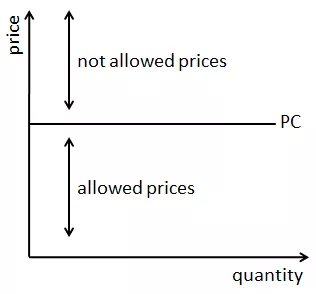
Price ceiling: A legal maximum price sellers may charge for a good or service.
If a ceiling is binding (set below equilibrium price), it reduces the incentive to supply and increases the incentive to demand.
Result: shortage and nonprice rationing (allocation by waiting lines, favouritism, coupons, search time, or reduced service).
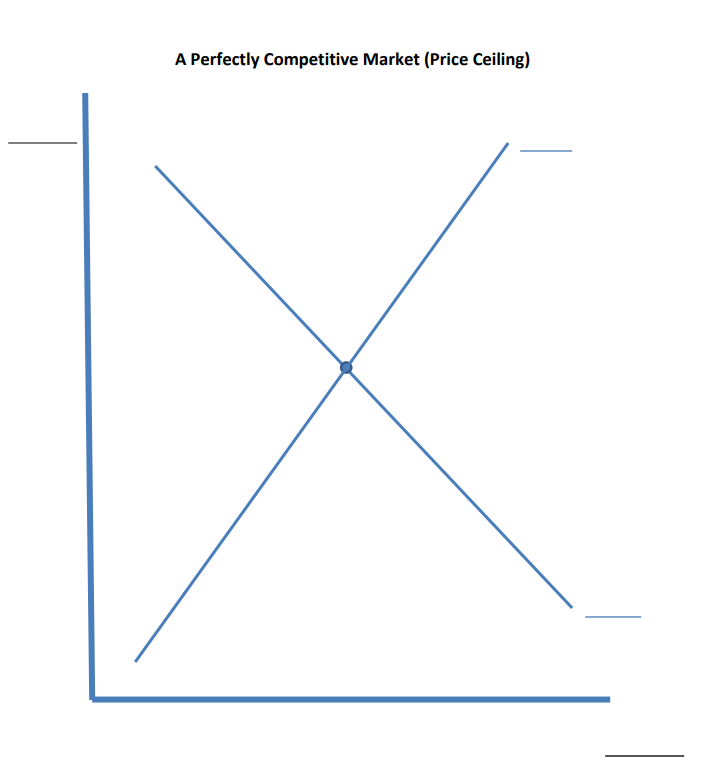
A standard competitive-market supply-and-demand graph with a binding price ceiling set below equilibrium. The diagram shows that at the controlled price, quantity demanded exceeds quantity supplied (), creating a shortage that must be resolved through nonprice rationing. Source
Common side effects:
Quality reductions (sellers cut quality to reduce costs when price cannot rise).
Black markets (illegal transactions at prices above the ceiling) when enforcement is imperfect.
A ceiling can be nonbinding if it is set at or above the equilibrium price, in which case market price and quantity are unchanged.
Price floor (minimum legal price)
Price floor: A legal minimum price sellers must receive for a good or service.
If a floor is binding (set above equilibrium price), it raises the incentive to supply and reduces the incentive to demand.
Result: surplus (excess supply), often appearing as unsold inventories or unemployed resources (e.g., labour).
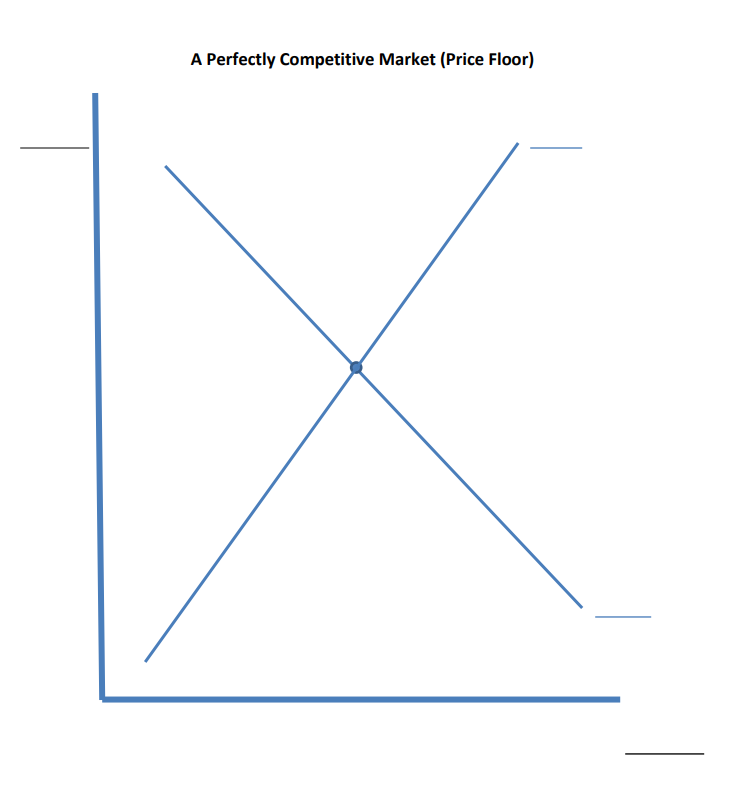
An AP-style supply-and-demand diagram illustrating a binding price floor above equilibrium. It highlights that at the floor price, quantity supplied exceeds quantity demanded (), which is the graphical source of the surplus (excess supply). Source
Common policy responses (each changes incentives further):
Government purchases of the surplus
Production limits
Penalties for selling below the floor
A floor can be nonbinding if it is set at or below the equilibrium price.
Shortages and surpluses as predictable outcomes
= Quantity demanded at the legal price (units per period)
= Quantity supplied at the legal price (units per period)
The same logic applies to a surplus: it is the gap between and at the regulated price. These gaps matter because they trigger nonprice allocation, wasteful competition for access, and changes in product characteristics.
Quantity controls (quantity floors and quantity ceilings)
Quantity regulations set a legal limit on how much can be produced, sold, bought, or used. Instead of fixing price directly, they force the market to adjust through price and nonprice mechanisms.
Quantity control: A legal restriction that sets a maximum (ceiling) or minimum (floor) quantity exchanged in a market.
Quantity ceiling (maximum quantity): if set below equilibrium quantity, it creates scarcity; the market-clearing price tends to rise toward the demand price at that limited quantity, and some mutually beneficial trades do not occur.
Quantity floor (minimum quantity): if set above equilibrium quantity, it can force excess production or participation; maintaining it typically requires monitoring, penalties, or government purchasing/stockpiling.
Key incentive effects of quantity controls:
They change the payoff to being an approved buyer/seller (e.g., licences, permits), encouraging rent-seeking (costly efforts to obtain the right to trade).
A competitive-market quota (quantity ceiling) diagram setup that emphasizes the wedge between the demand price and supply price at the restricted quantity. That wedge is the quota rent, which explains why permits/licences become valuable and why rent-seeking emerges when access to trade is legally restricted. Source
They often shift competition away from price toward access (queues, applications) or side payments (informal fees), depending on enforcement.
Practice Questions
Question 1 (3 marks) A government sets a binding price ceiling in the market for rental housing. (a) State two likely market outcomes of this policy. (3 marks)
1 mark: Identifies a shortage () at the ceiling.
1 mark: Identifies non-price rationing (e.g., queues, search time, favouritism, coupons).
1 mark: Identifies an additional valid outcome (e.g., black market, reduced quality/maintenance).
Question 2 (6 marks) A binding price floor is imposed in a market for an agricultural product. Explain how the price floor affects incentives for buyers and sellers, and how this changes market outcomes. (6 marks)
1 mark: States the floor is above equilibrium price (binding).
1 mark: Explains sellers’ incentive: higher price increases quantity supplied.
1 mark: Explains buyers’ incentive: higher price decreases quantity demanded.
1 mark: Concludes surplus arises ().
1 mark: Explains a consequence of surplus (unsold output/inventories or wasted resources).
1 mark: Mentions a plausible policy response to surplus (government purchases, production limits, or enforcement/penalties) linked to incentives.
FAQ
Weak enforcement raises the chance of illegal side-deals.
More transactions occur off-the-books at higher effective prices.
Resources shift into evasion (hidden fees, misreporting, bribery), reducing the policy’s intended benefits.
When the right to trade is scarce and valuable.
If permits/licences are allocated administratively rather than auctioned, people spend time and money lobbying or queuing to obtain them, dissipating potential gains.
Tradable permits allow exchange of rights.
This tends to allocate limited quantity to those who value it most (highest willingness to pay) and creates an explicit permit price, whereas non-tradable quotas rely more on administrative allocation.
Sellers may add non-price charges.
Examples include mandatory add-ons, higher fees for complementary services, or reduced product size/quality—so the effective price per unit of quality rises.
They often do not self-enforce.
To prevent market adjustment back to equilibrium, authorities may need monitoring, penalties for noncompliance, and sometimes direct purchasing/stockpiling to absorb excess quantity.