AP Syllabus focus: ‘Tariffs affect domestic price, quantity, government revenue, consumer surplus, and total economic surplus.’
A tariff is a tax on imported goods that changes market incentives. In the supply-and-demand model, it alters the domestic price and quantities traded, redistributing surplus and typically reducing efficiency.
What a Tariff Does in a Competitive Market
Core idea: raising the effective cost of imports
Tariff: a government-imposed tax on imported goods, paid per unit (specific tariff) or as a percentage of value (ad valorem tariff), that increases the domestic price of the imported good.
In an importing market, the tariff makes foreign sellers require a higher price to supply the domestic market, so imports become less competitive.
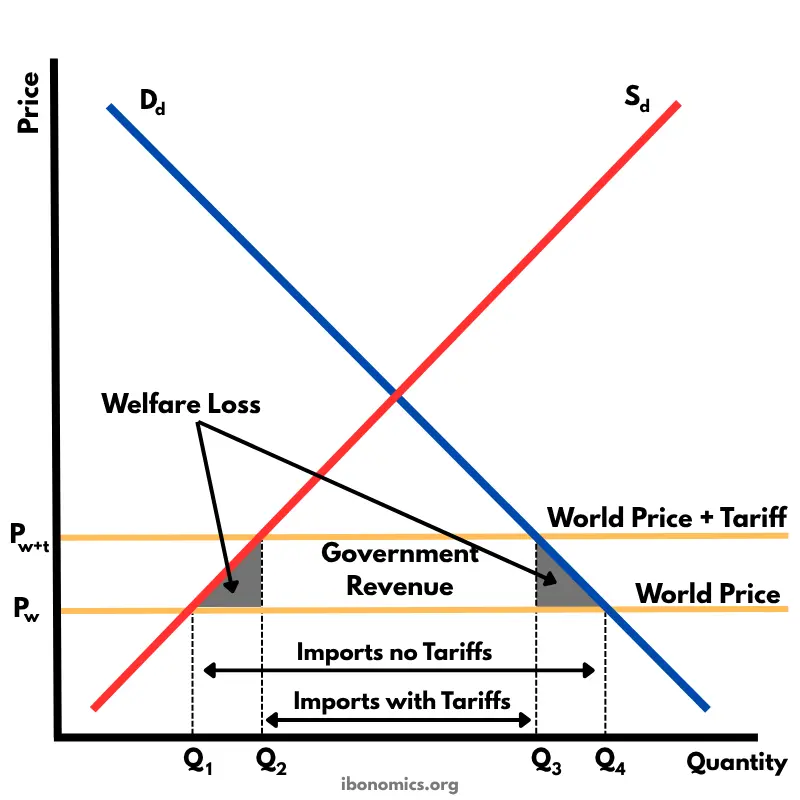
Tariff diagram for an importing country: the tariff raises the domestic price from the world price () to , reduces the quantity imported, and creates a government-revenue rectangle on the remaining imports. The shaded triangles represent deadweight loss from inefficient extra domestic production and from reduced consumption (lost gains from trade). Source
Price effect (domestic price rises)
If the country is a price taker in world markets, the world price acts like a baseline.
With a tariff, domestic buyers face a higher price, commonly described as:
Domestic price increases by (up to) the tariff amount
The domestic price moves closer to what domestic producers need to supply more
Quantity effects (domestic production rises, consumption falls)
Higher domestic price changes quantities along curves:
Quantity demanded falls (movement along demand)
Quantity supplied by domestic firms rises (movement along supply)
Imports shrink because the gap between domestic quantity demanded and domestic quantity supplied becomes smaller
Government Revenue from a Tariff
A tariff generates government revenue equal to the tax collected on each imported unit after the tariff is imposed. Revenue depends on both the tariff size and how much trade remains.
= tariff per imported unit (dollars per unit)
= quantity of imports after the tariff (units)
Because imports typically fall after a tariff, raising does not guarantee a proportional increase in if contracts significantly.
Surplus Changes: Who Gains and Who Loses?
A tariff changes consumer surplus, producer surplus, and government revenue, and it affects total economic surplus (the sum of all three).
Consumer surplus (falls)
Consumers pay a higher price and buy fewer units.
The loss to consumers includes:
Higher spending on units still purchased
Lost value from units no longer purchased (some mutually beneficial trades no longer occur)
Producer surplus (rises for domestic firms)
Domestic producers receive a higher price and sell more output.
This is a gain for domestic sellers, but it comes from:
Consumers paying more
Resources shifting into the protected industry even if it is not the lowest-cost source
Government revenue (rises, but is not “free”)
The government collects revenue on remaining imports.
This is a transfer from private buyers/importers to the government, not a net efficiency gain by itself.
Total economic surplus (typically falls)
Even after adding producer gains and government revenue, tariffs usually reduce total economic surplus because:
Some trades that were beneficial at the world price no longer happen (consumption distortion)
Some production shifts from lower-cost foreign suppliers to higher-cost domestic production (production distortion)
These efficiency losses are commonly described as deadweight loss, reflecting surplus that disappears rather than being transferred.
Practice Questions
Question 1 (1–3 marks) State two effects of imposing an import tariff on (i) the domestic price and (ii) the quantity of imports.
Domestic price rises (1)
Quantity of imports falls (1)
Accept: domestic quantity supplied rises or domestic quantity demanded falls as a correctly linked explanation (1)
Question 2 (4–6 marks) Using supply and demand analysis, explain how an import tariff affects consumer surplus, producer surplus, government revenue, and total economic surplus in the domestic market.
Consumer surplus decreases due to higher domestic price and lower quantity demanded (1–2)
Producer surplus increases for domestic firms due to higher domestic price and higher domestic output (1–2)
Government gains tariff revenue equal to on post-tariff imports (1)
Total economic surplus decreases because some gains from trade are lost (deadweight loss from reduced consumption and inefficient domestic production) (1)
FAQ
Not always. If foreign exporters reduce their pre-tariff price to keep access to the market, the domestic price may rise by less than the full tariff.
If domestic firms have market power or supply is very limited, the price response can also differ from the simple competitive prediction.
A specific tariff is a fixed charge per unit (e.g., £2 per kilogram).
An ad valorem tariff is a percentage of the import’s value (e.g., 10% of the price).
They can have different effects when prices change over time.
It depends on relative elasticities and pricing responses.
More inelastic domestic demand tends to shift more burden to consumers.
More elastic foreign supply (or strong competition among exporters) can make consumers bear more.
If a higher tariff causes imports to collapse (large reduction in $M$), then $TR = t \times M$ may rise only slightly or even fall.
This is more likely when domestic consumers can easily switch to substitutes or reduce consumption.
In standard competitive analysis, tariffs reduce total economic surplus in the importing market.
However, in special cases (e.g., strategic trade or terms-of-trade effects for a large country), a tariff could shift some surplus from foreign producers—though this requires additional assumptions beyond the basic model.