AP Syllabus focus: ‘Quotas change quantities produced and affect price, consumer surplus, and total economic surplus, but quota graphing is not required for the course.’
Quotas are government-imposed limits on how much of a good can be imported. They restrict market supply, change domestic prices and quantities, and redistribute economic surplus between consumers, producers, and license holders.
What a quota is and how it operates
Core idea: a legal limit on quantity
A quota is a quantity restriction: it caps the number of units allowed into a market over a time period (e.g., per year). In AP Microeconomics, quotas are typically discussed as import quotas that restrict foreign supply in the domestic market.
Quota: A government-set limit on the quantity of a good that can be imported (or sometimes produced) during a specified period.
Because fewer units can enter the market, a quota directly constrains total quantity available. Market participants then adjust through price changes and reallocation of surplus.
Comparing a quota to a tariff (only what’s essential here)
A quota restricts quantity directly, while a tariff changes incentives via a per-unit tax. The key syllabus-relevant point is that both can raise domestic price, but a quota’s effects depend heavily on who receives the right to import.
How quotas change domestic price and quantities
Mechanism in a competitive market
Under free trade, domestic consumers can buy at (or near) the world price, with imports filling the gap between domestic quantity demanded and domestic quantity supplied. A binding import quota reduces the number of imports available, so the market must “clear” with fewer total units.
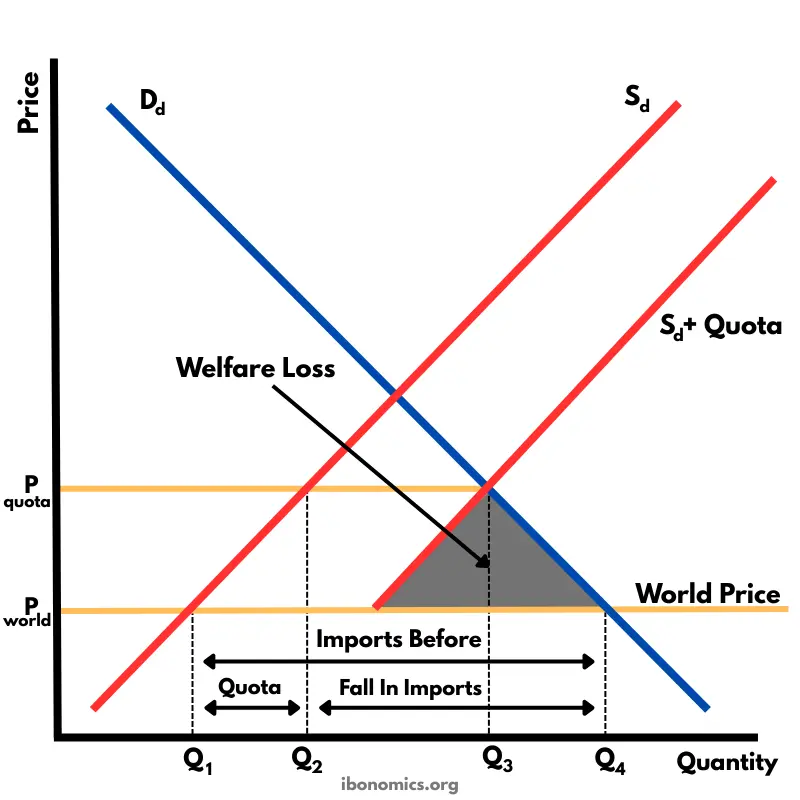
Import-quota market diagram for a small importing country: the world price line is replaced by an effectively restricted total supply once imports are capped. The figure visually links the quota to a higher domestic price, lower domestic consumption, higher domestic production, and deadweight loss from the lost mutually beneficial trades. Source
Total quantity available falls relative to free trade because imports are capped.
With fewer units available, domestic price rises until quantity demanded falls to match the restricted quantity available.
At the higher price, domestic producers expand quantity supplied (movement along domestic supply), but this typically does not fully offset the reduction in imports.
The final outcome is usually:
Higher domestic price
Higher domestic production
Lower domestic consumption
Lower imports (fixed at the quota level if binding)
Binding vs nonbinding quotas
Only a binding quota changes outcomes.
Binding quota: A quota set below the quantity that would be imported under free trade, so it actually constrains the market.
A nonbinding quota is set above free-trade import levels and does not affect price or quantities.
Effects on consumer surplus and total economic surplus
Consumer surplus falls
When a quota raises the domestic price and reduces consumption, consumers:
Pay more per unit on remaining purchases.
Buy fewer units. Both effects reduce consumer surplus (the net benefit to buyers from paying less than willingness to pay).
Consumer surplus: The difference between what consumers are willing to pay and what they actually pay, summed across units purchased.
Producer surplus typically rises
Domestic producers gain from the higher domestic price and increased domestic sales, so producer surplus generally increases. The size of the gain depends on how much domestic supply expands and how far price rises.
Total economic surplus falls (deadweight loss)
Because the quota reduces mutually beneficial transactions that would occur at the free-trade price, total economic surplus (consumer surplus + producer surplus) typically decreases.
Total economic surplus: The sum of consumer surplus and producer surplus in a market.
The loss in total surplus is due to inefficiency: some units that buyers value above marginal cost are not traded because the quota restricts quantity. This is the fundamental welfare cost of quotas emphasized in AP Micro.
Quota rents and who captures them
The importance of import licences
Quotas often require the government to allocate import licences (rights to import up to a specified amount). These licences create a valuable benefit called quota rent: the profit per unit from being able to buy at the world price and sell at the higher domestic price.
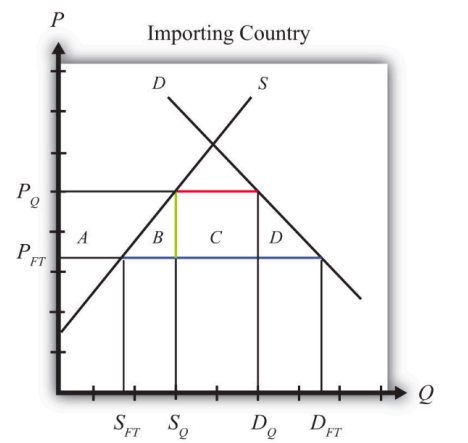
Welfare-effects diagram of a binding import quota in a small country, showing how the quota drives the domestic price above the free-trade world price and splits the welfare changes into labeled regions. The labeled areas correspond to the transfer from consumers to producers and quota-rights holders (quota rents), plus the deadweight-loss triangles representing efficiency losses. Source
Quota rent: The extra profit earned by holders of quota rights when a quota raises the domestic price above the world price.
Who gets this rent is crucial for distributional outcomes:
If the government auctions licences, licence revenue can resemble tariff revenue (a transfer to the government).
If licences are given to domestic firms, those firms capture the rents.
If foreign exporters receive the rights (or have market power to raise export prices), foreigners may capture part or all of the rent.
This affects “who wins” from the quota, even though the overall reduction in total surplus remains.
Course scope: what you must and must not do
What you are expected to understand
The AP syllabus requires that you can explain that quotas change quantities produced and affect price, consumer surplus, and total economic surplus. Focus on qualitative reasoning:
A binding quota reduces imports and total quantity available.
Domestic price rises relative to free trade.
Domestic production rises; domestic consumption falls.
Consumer surplus falls; producer surplus rises; total surplus falls.
Quota rents exist and are a redistribution based on licence allocation.
What is not required
The syllabus explicitly states that quota graphing is not required for the course. You should still be able to interpret a written description of how a quota restricts quantity and trace the resulting changes in price, quantities, and surplus without drawing the quota diagram.
Practice Questions
(2 marks) Explain how a binding import quota affects the domestic price and domestic quantity consumed of a good.
1 mark: States domestic price rises (above free-trade level) due to restricted imports.
1 mark: States domestic quantity consumed falls (because higher price reduces quantity demanded and total availability is lower).
(6 marks) A country imposes a binding import quota on sugar. Analyse the effects on consumer surplus and total economic surplus in the domestic sugar market, and explain the role of quota rents.
2 marks: Consumer surplus decreases (higher price and lower quantity purchased; must mention both channels for full credit).
2 marks: Total economic surplus decreases due to deadweight loss/inefficiency from foregone mutually beneficial trades (must link to restricted quantity).
2 marks: Explains quota rents as extra profit from selling at domestic price above world price, and identifies that who receives rents depends on allocation of import licences (government auction, domestic firms, or foreign exporters).
FAQ
If demand rises, a binding quota prevents imports from expanding, so price can rise sharply as consumers compete for limited quantity.
If demand falls, the quota may become nonbinding, causing the domestic price to move back towards the world price.
Yes.
If the quota is nonbinding (set above free-trade imports), it does not constrain quantity and has no effect on price.
If enforcement is weak (evasion/smuggling), the effective quota may be higher than the legal quota, muting price effects.
It depends on how licences are allocated and bargaining power.
Licences auctioned by the government: rents become government revenue.
Licences granted to domestic importers: importers capture rents.
Foreign exporters with strong market power: they may raise their export price, shifting rents abroad.
Quotas give more certainty about the quantity of imports, which can be politically attractive to protect domestic producers.
They can also create valuable licences that governments may allocate strategically, though this can encourage lobbying and rent-seeking.
Quotas require monitoring quantities, verifying origin, and managing licensing.
Common complications include:
Misreporting and transshipment through third countries
Lobbying for licences
Administrative costs and delays that can further restrict supply beyond the intended cap