

AP Syllabus focus: ‘Scalars have magnitude only, while vectors have both magnitude and direction.’
Motion and forces are described using physical quantities, but not all quantities carry the same information. Distinguishing scalars from vectors is essential because direction changes how quantities are interpreted, compared, and used in physics reasoning.
Core Idea: Magnitude vs. Magnitude-and-Direction
A magnitude is the “size” of a quantity expressed with a number and units (for example, 3 s or 12 N). The key difference is whether direction is part of the quantity itself.
Scalars tell you “how much.”
Vectors tell you “how much” and “which way.”
This distinction is not just vocabulary: it affects how you record measurements and how you interpret what those measurements mean physically.
Scalars
Scalars are fully described by a single value with units. If two people agree on the units, they can communicate a scalar without needing any directional information.
Scalar — a quantity that has magnitude only.
Typical features of scalars:
One number (plus units) specifies the quantity completely.
Directional words like “left,” “up,” “east,” or “negative” are not inherently required to define the quantity.
Scalars can still change over time, but the change does not involve direction as part of the quantity’s definition.
Examples of scalars commonly encountered in AP Physics 1 include:
Mass, time, temperature, energy, power (each described without a direction).
Vectors
Vectors require both a magnitude and a direction to be complete.
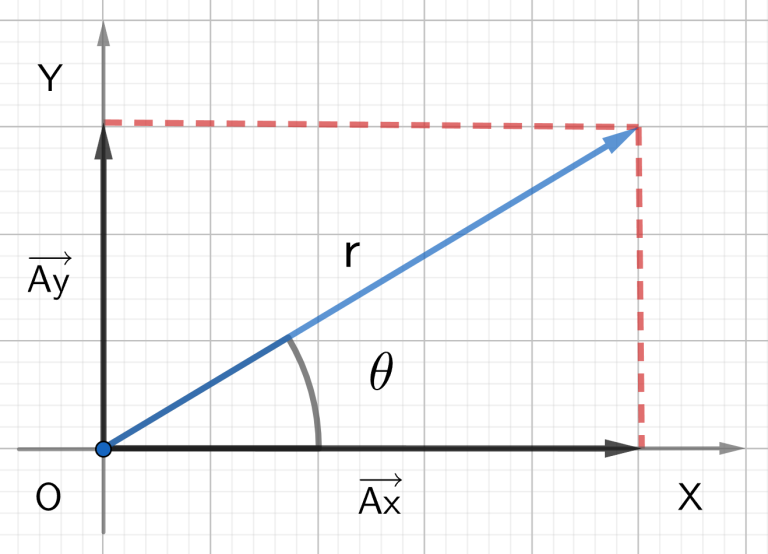
A vector can be represented by an arrow whose length gives its magnitude and whose orientation gives its direction. This figure also shows how the same vector can be decomposed into orthogonal components (often written as and ) on a chosen coordinate system. Source
Two vectors can have the same magnitude but represent different physical situations if their directions differ.
Vector — a quantity that has both magnitude and direction.
Important characteristics of vectors:
A vector is incomplete if it is missing direction.
Direction can be communicated in multiple consistent ways, such as:
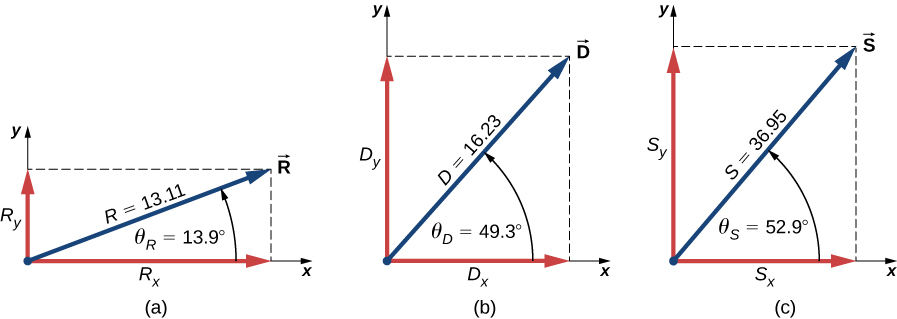
Each panel shows a vector with its magnitude, direction angle relative to the +x axis, and its x- and y-components. This directly illustrates how direction can be reported as an angle and how components encode direction through sign and axis choice. Source
A compass direction (e.g., “20 N north”)
An angle relative to a reference direction (e.g., “20 N at above the horizontal”)
A sign within a stated axis convention (e.g., “” meaning opposite the chosen positive direction)
Vectors in mechanics often represent influences or motion with direction, such as force or velocity, where reversing direction changes the physical meaning even if the magnitude stays the same.
Why the Distinction Matters in Physics
Treating a vector like a scalar (or vice versa) leads to common conceptual errors. The “direction” part of a vector is not decoration; it is essential information.
Physical meaning changes when direction changes
For vectors, changing direction can change the outcome of a situation even if the magnitude is unchanged.
A force of 10 N to the right does not have the same effect as 10 N to the left.
A velocity of 5 m/s north describes motion differently from 5 m/s south, even though both have magnitude 5 m/s.
For scalars, reversing “direction” is not a meaningful operation because direction is not part of the quantity.
5 seconds is just 5 seconds; it does not point anywhere.
What you must include when writing answers
When you report a scalar, include:
A number and unit (and, when relevant, an appropriate level of precision)
When you report a vector, include:
A magnitude with units
A clear direction statement tied to a reference (axis, compass, or angle)
Common pitfalls to avoid
Confusing magnitude with the full vector: the magnitude is only part of a vector.
Omitting direction for vectors in written responses (often treated as incomplete in marking).
Assuming that a negative sign “automatically” makes a quantity a vector; the sign only has meaning after a direction convention is stated.
Mixing up “how fast” (scalar idea) with “how fast and which way” (vector idea).
Practice Questions
Q1 (2 marks) State whether each quantity is a scalar or a vector, and give a brief reason:
(a) Mass
(b) Force
(a) Scalar (1) because it has magnitude only / no direction required (1)
(b) Vector (1) because it has magnitude and direction (1)
Q2 (5 marks) A student writes: “The car’s velocity is .”
(a) Explain what information is missing if velocity is treated correctly as a vector. (2 marks)
(b) The student then writes: “The velocity is .” Explain what additional statement is still required for this to be a complete vector description. (2 marks)
(c) State one scalar quantity that could be fully described by writing only “” with appropriate units. (1 mark)
(a) Missing direction (1) and a reference for that direction (e.g., east/west or along a chosen axis) (1)
(b) Need to define the sign convention / which direction is positive (1) so that “negative” corresponds to a stated direction (1)
(c) Any valid scalar (e.g., time, mass, energy, temperature) (1)
FAQ
No. A negative sign only indicates “opposite the positive direction” after you define a coordinate axis or reference direction.
Without a stated convention, “$-3$” is ambiguous and does not fully communicate direction.
The magnitude is the size only (always non-negative), while the vector includes both size and direction.
For instance, a vector can reverse direction while keeping the same magnitude.
Yes. In one dimension, vectors still require direction along the line (often represented relative to a chosen positive direction).
The quantity remains a vector because direction is still essential information.
Direction is meaningless without a reference. Saying “to the left” only works if everyone agrees what “left” corresponds to in the situation.
A defined axis (positive/negative) or compass/angle reference removes ambiguity.
No. Arrows are a helpful representation, but vectors can be communicated in words, with signs on an axis, or with angles.
What matters is that magnitude and direction are both clearly specified.
