

AP Syllabus focus: ‘In a one-dimensional coordinate system, opposite directions are represented by opposite signs when adding vectors.’
Adding vectors in one dimension is mainly about choosing a positive direction, representing opposite directions with opposite signs, and combining quantities algebraically to find a single “net” effect.
Core idea: direction becomes sign
In one-dimensional (1D) motion, every vector points along the same line, so the only directional information needed is whether it points in the positive or negative direction of your chosen axis.

A number line model for signed quantities: motion in the positive direction corresponds to positive values, and motion in the opposite direction corresponds to negative values. This visual connects “direction becomes sign” directly to the algebra of adding signed numbers. Source
Choosing a sign convention
Before adding vectors, define:
A coordinate axis along the line of motion
A positive direction (commonly right, up, or forward)
Once chosen:
Vectors pointing in the positive direction are written with a plus sign (or no sign).
Vectors pointing in the opposite direction are written with a minus sign.
This directly matches the syllabus requirement: opposite directions are represented by opposite signs when adding vectors.
What it means to “add” 1D vectors
Vector addition combines multiple vectors into one vector that produces the same overall effect along the line.
Resultant (net) vector: The single vector equal to the sum of two or more vectors, including sign to represent direction.
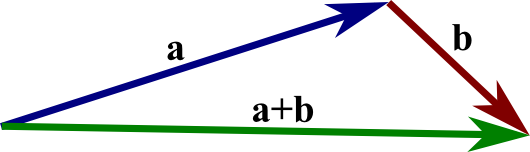
The sum of two vectors is constructed by translating so its tail coincides with the head of . The resulting vector runs from the tail of to the head of the translated , matching the definition of a resultant as a single equivalent vector. Source
A resultant can be positive, negative, or zero:
Positive resultant: net effect in the positive direction
Negative resultant: net effect in the negative direction
Zero resultant: effects cancel exactly
Algebraic addition in 1D
Because all vectors lie on the same axis, 1D vector addition is ordinary algebra with signed numbers, as long as you keep the sign convention consistent.
General net (sum) relationship
= resultant (net) vector in the chosen 1D direction (units depend on the quantity)
= each individual vector being added, written with sign from the chosen positive direction (same unit as )
Between vectors of the same type, you add only like quantities:
Add displacements to get net displacement
Add velocities to get net velocity (only in situations where velocities combine directly along the same line)
Add forces to get net force (collinear forces)
Never add unlike quantities (for example, displacement + velocity is meaningless).
A practical sign-based workflow
Pick the positive direction and state it clearly.
Rewrite every vector with a sign:
“to the right” (if right is positive) becomes +
“to the left” becomes −
Add the signed values algebraically.
Interpret the sign of the result as the direction.
Common pitfalls and how to avoid them
Mixing up “magnitude” and “signed value”
A magnitude is always nonnegative, but the vector component in 1D can be negative. Be explicit about whether a number is:
A magnitude (no direction attached), or
A signed vector value (direction encoded by sign)
Changing the axis mid-problem
If you change which direction is positive, every signed vector must be updated. Consistency is more important than which direction you choose.
Cancelling incorrectly
Opposite directions do not “add”; they subtract through signs. For example, a positive and negative term partially cancel because you are adding a negative number.
Visual interpretation (without extra dimensions)
Even in 1D, it helps to picture vectors as arrows on a line:
Arrow direction shows the sign
Arrow length shows the magnitude Adding vectors corresponds to placing arrows head-to-tail along the same line; the resultant connects the start to the final end.
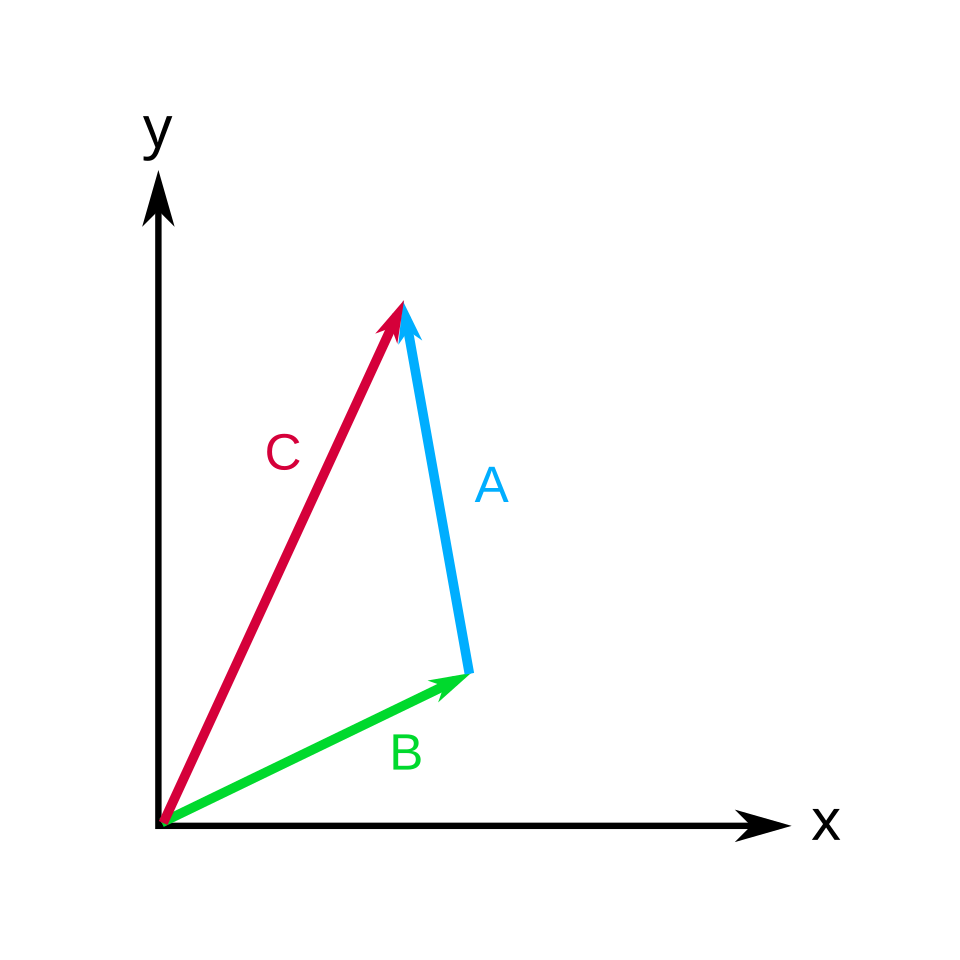
Head-to-tail vector addition: the second vector is translated (without changing its length or direction) so its tail starts at the first vector’s head. The resultant is the single arrow from the initial tail to the final head, representing the combined effect of both vectors. Source
In 1D, this geometric picture always matches the algebraic sum of signed values.
When vector addition is valid in 1D
Vector addition applies whenever the quantities are vectors along the same line:
Displacement additions along a straight path
Forces along a line (tension/compression, pushes/pulls)
Velocity combinations when motion is collinear and you are treating the velocities in the same reference frame
The essential AP Physics 1 Algebra skill here is representing direction using opposite signs and performing consistent algebra to obtain a meaningful resultant.
Practice Questions
Question 1 (2 marks) A student defines right as positive. They add two 1D displacement vectors: and . State the resultant displacement, including sign and direction.
(1 mark)
Direction correctly stated as left (or “negative direction”) (1 mark)
Question 2 (5 marks) Along a straight line, three collinear forces act on a cart. The student defines forward as positive. The forces are: forward, backward, and backward. (a) Write each force with the correct sign. (2 marks) (b) Find the net force on the cart, including sign. (2 marks) (c) State the direction of the net force in words. (1 mark)
(1 mark)
and (both correct) (1 mark) (b)
Correct sum: (1 mark)
(1 mark) (c)
Net force is backward (or “negative/against forward”) (1 mark)
FAQ
The signed number changes, but the physical vector does not.
You must flip the sign of every vector consistently; the final direction in words remains the same.
Negative indicates direction relative to your chosen axis.
Magnitude is $|A|$; the signed value is the 1D component (e.g., $A_x$), which may be negative.
First define the positive direction on that axis.
Then assign:
Positive if it matches your chosen positive direction
Negative if it points opposite
It means complete cancellation: equal magnitude in opposite directions.
Geometrically, the head-to-tail chain ends where it began on the 1D line.
Only when all vectors point in the same direction.
If directions differ, you must use signs; adding magnitudes would overestimate the resultant.
