

AP Syllabus focus: ‘Distance and speed are scalar quantities, while position, displacement, velocity, and acceleration are vector quantities.’
Kinematics uses a small set of quantities to describe motion. The most common mistakes come from mixing scalars and vectors, or confusing similar-sounding pairs like distance vs displacement and speed vs velocity.
Scalars vs vectors in kinematics
Scalars: magnitude only
Scalar: A quantity described by magnitude only, with no direction.
Scalars are fully specified by a number and a unit. In one-dimensional motion, scalars never need a plus/minus sign to indicate direction.
Vectors: magnitude and direction
Vector: A quantity described by magnitude and direction; in one dimension, direction is represented by a sign (positive or negative) relative to a chosen axis.
Vectors require a coordinate system (for example, +x to the right). The same physical motion can be described with different signs if the axis is chosen differently, so always state or infer the positive direction.
Common scalar quantities
Distance (scalar)
Distance: The total path length travelled, regardless of direction.
Distance accumulates as motion occurs and cannot decrease during a trip. Because distance ignores direction, reversing direction still increases total distance.
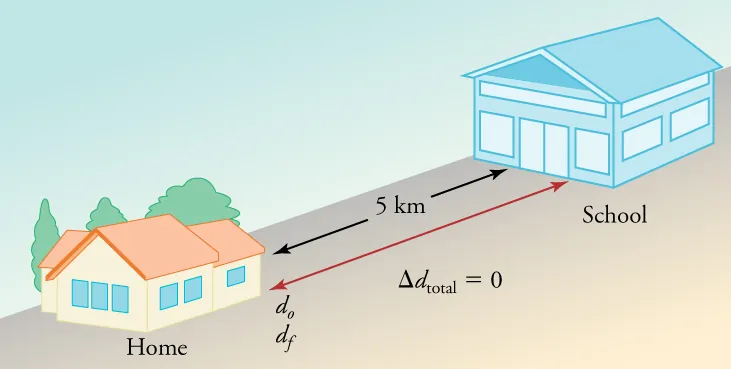
A round-trip motion example where the total path length (distance) is nonzero, but the net change in position (displacement) is zero. The straight arrow emphasizes that displacement depends only on initial and final positions, not on the route taken. Source
Key features:
Always nonnegative
Depends on the path taken
Typical unit: metre (m)
Speed (scalar)
Speed: The rate at which distance is covered; it describes “how fast” without direction.
Speed is associated with distance, not displacement, so it does not indicate whether an object is moving in the + or − direction. In many contexts, “speed” refers to an average over a time interval, but it is still scalar.
Key features:
Always nonnegative
No directional information
Typical unit: m/s
Common vector quantities (1D)
Position (vector)
Position: The location of an object relative to an origin, along a chosen axis.
In one dimension, position is often written as (or sometimes ) with a sign indicating which side of the origin the object is on.
Key features:
Can be positive, negative, or zero
Depends on the chosen origin and positive direction
Typical unit: m
Displacement (vector)
Displacement: The change in position from initial to final location.
Displacement depends only on the initial and final positions, not on the path taken. An object can travel a large distance and still have zero displacement if it returns to its starting point.
A compact way to express displacement is:
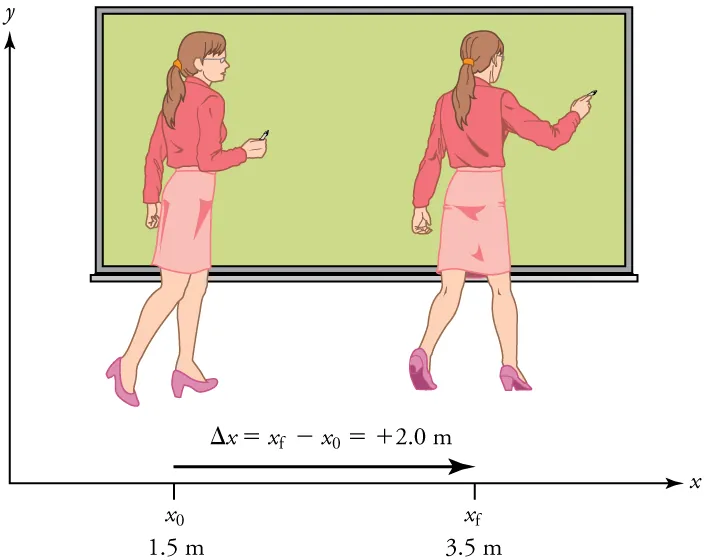
A 1D displacement diagram showing an object moving from an initial position to a final position on a chosen axis. The arrow represents and makes the sign convention visual: the direction of the arrow encodes the direction of the displacement. Source
= displacement (m)
= final position (m)
= initial position (m)
The sign of indicates direction: positive means net motion in the + axis direction; negative means net motion in the − axis direction.
Velocity (vector)
Velocity: The rate at which position changes; it includes direction.
In one dimension, the sign of velocity indicates direction of motion relative to the axis.
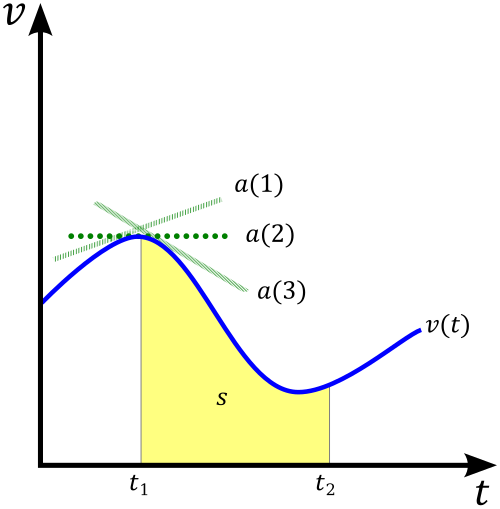
A velocity–time graph in which the shaded area corresponds to displacement over a time interval, while the slope of the curve at a point corresponds to acceleration. This reinforces that velocity and acceleration carry sign information tied to the chosen axis, so “negative” values indicate direction rather than “slowing down.” Source
A negative velocity does not mean “slowing down”; it means moving in the negative direction.
Key features:
Can be positive, negative, or zero
Related conceptually to displacement (not distance)
Typical unit: m/s
Acceleration (vector)
Acceleration: The rate at which velocity changes; it includes direction.
Acceleration can be negative or positive depending on how velocity is changing relative to the axis. An object can have negative acceleration while moving in the positive direction, and it can speed up or slow down depending on whether acceleration and velocity have the same or opposite signs.
Key features:
Direction is crucial: “negative acceleration” means acceleration points in the − axis direction
Typical unit: m/s
Quick comparisons that prevent common errors
Distance vs displacement
Distance (scalar): total path length; never negative; path-dependent
Displacement (vector): net change in position; can be negative; depends only on start and finish
Speed vs velocity
Speed (scalar): based on distance; no direction
Velocity (vector): based on position change; includes direction via sign in 1D
Direction conventions (1D)
Decide (or read) what counts as positive
Apply signs consistently to position, displacement, velocity, and acceleration
Scalars (distance, speed) do not carry direction, even if motion reverses
Practice Questions
(2 marks) A cart moves 3 m to the right, then 3 m to the left, ending where it started. State the cart’s distance travelled and its displacement.
Distance travelled = 6 m (1)
Displacement = 0 m (1)
(5 marks) An object moves along the -axis. At it is at ; at it is at .
(a) Identify whether position and displacement are scalar or vector quantities. (2 marks)
(b) Determine the displacement and state its sign meaning in words. (3 marks)
(a) Position is a vector (1)
(a) Displacement is a vector (1)
(b) (2)
(b) Positive sign means displacement is in the + direction (to the right, if + is right) (1)
FAQ
Distance adds the full path length travelled.
Displacement depends only on start and finish; returning to the start gives $\Delta x=0$ regardless of how far you travelled.
No. Negative velocity means motion in the negative axis direction.
Slowing down depends on whether velocity and acceleration are opposite in sign, not on whether velocity is negative.
You may choose any direction as positive (often rightward or upward), but you must stay consistent.
If a problem states a direction convention, use it even if it feels “backwards”.
Distance, position, displacement: $\text{m}$
Speed, velocity: $\text{m/s}$
Acceleration: $\text{m/s}^2$
Using consistent SI units reduces sign and scaling mistakes.
In kinematics, scalars like distance and speed are defined as nonnegative.
If you see a negative sign attached to “speed” in a student’s work, it usually indicates they meant velocity instead.
