

AP Syllabus focus: ‘Vectors can be shown as arrows with direction and lengths proportional to magnitude; in one dimension, signs can show component direction.’
One-dimensional vectors appear in nearly every kinematics problem. Clear drawings and consistent notation help you keep direction straight, prevent sign errors, and communicate your reasoning efficiently.
What a one-dimensional vector diagram shows
A one-dimensional situation uses a single straight line (an axis). Every vector in the problem points along that line, either in the positive direction or the negative direction.
Vector: A quantity represented with both magnitude and direction; in one dimension, the direction is shown by which way the vector points along the chosen axis.
Because the motion is confined to one line, you do not need angles; direction is encoded entirely by “left/right,” “up/down,” or whatever you choose as the axis direction.
The axis and sign convention
Before drawing any vectors, set a coordinate system:
Draw a straight axis and label it (commonly x).
Choose and label the positive direction (for example, “+x to the right”).
The opposite direction is automatically negative.
This choice is arbitrary, but once chosen it must stay consistent throughout the diagram and the algebra.
Drawing one-dimensional vectors as arrows
The syllabus expectation is that vectors can be shown as arrows with direction and lengths proportional to magnitude.
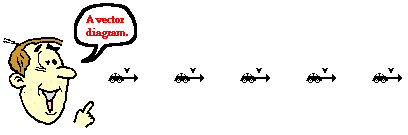
A velocity vector diagram for motion along a straight path, where the arrows are drawn along the line of motion. The arrow direction communicates the sign/direction of the velocity, and the changing arrow lengths visually encode changes in speed (i.e., larger magnitude vectors). Source
Your sketch should therefore communicate two things:
Direction
The arrow points toward the positive direction if the vector is positive.
The arrow points toward the negative direction if the vector is negative.
Place the arrow on or parallel to the axis to reinforce that it is one-dimensional.
Magnitude (size)
Use a consistent scale so that arrow length is proportional to magnitude.
If one vector’s magnitude is twice another’s, its arrow should be about twice as long.
If the problem is conceptual, approximate proportional lengths are fine, as long as they clearly distinguish “larger” vs “smaller.”
Labelling on the diagram
To make the diagram usable for later steps:
Label each arrow with the symbol for the quantity (for example, v for velocity).
If helpful, also label the magnitude with units (for example, “3 m/s”), but keep direction in the arrow itself rather than in the number.
Notating one-dimensional vectors in writing
In one dimension, the same physical vector can be communicated in two common ways: (1) vector notation, or (2) signed component notation. The syllabus highlights that in one dimension, signs can show component direction.
Vector symbol vs component value
The vector name (such as “v” for velocity) refers to the directed quantity.
The component along the axis (such as v_x) is a signed number that includes direction.
A frequent source of confusion is mixing up “magnitude” with “component.”
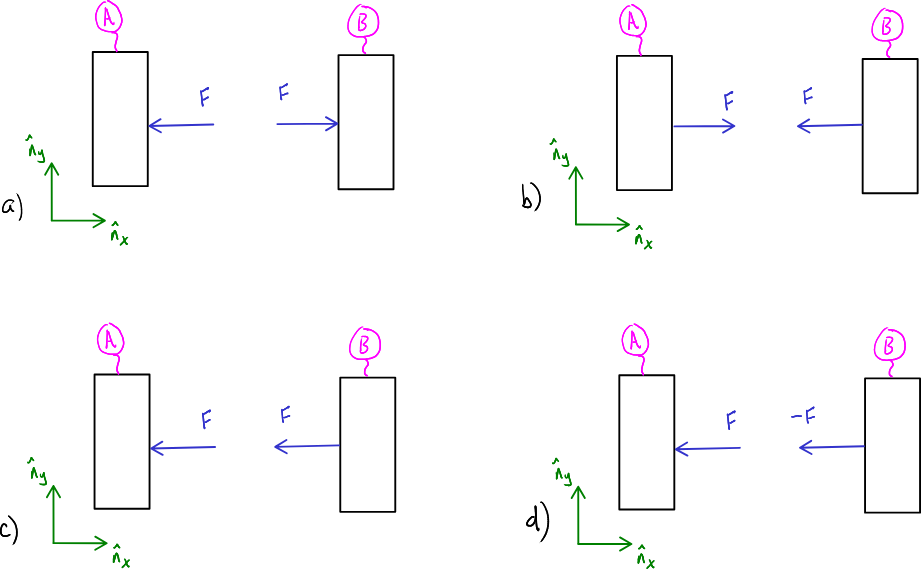
A sign-convention figure showing how a single drawn arrow can define a positive reference sense, while the algebraic sign on a labeled scalar (e.g., vs. ) determines whether the actual vector points with or against the arrow. This is the same logic used in one dimension when a component like is negative even though the magnitude is never negative. Source
The magnitude is never negative; the component can be negative.
= one-dimensional component of vector A along the chosen axis (same unit as A)
= sign that encodes direction, either +1 (along + axis) or −1 (along − axis)
= magnitude of vector A (always nonnegative, same unit as A)
Use this idea to translate between a drawn arrow (direction) and a written component value (sign).
Practical notation rules (to avoid sign errors)
Write magnitudes as positive numbers (for example, “speed = 5 m/s”).
Write components with signs (for example, “v_x = −5 m/s” means the arrow points opposite +x).
If you reverse your coordinate choice (swap which way is +x), every component sign flips, but the physical motion does not change.
Checklist for clean one-dimensional vector communication
Axis drawn and positive direction clearly marked.
Arrows aligned with the axis.
Arrow lengths reflect relative magnitudes.
Symbols placed next to the correct arrows.
Written components include signs that match arrow directions.
Practice Questions
A student chooses +x to the right. They draw a velocity vector as an arrow pointing left with a labelled length corresponding to 4 m/s. Write:
(a) the magnitude of the velocity
(b) the x-component of the velocity
(a) 4 m/s stated as a magnitude (1 mark)
(b) or equivalent negative sign with correct unit (2 marks: 1 for sign, 1 for value/unit)
You are told an object’s one-dimensional displacement vector A points in the +x direction and has magnitude 7 m. Another student writes .
(a) Explain, using the idea of sign conventions, what mistake the student has made.
(b) State what the student’s written component would imply about the arrow direction on a correct axis diagram where +x is to the right.
(c) State one change to the coordinate system that would make consistent with the same physical displacement.
(a) Identifies that the component sign must match the chosen +x direction; magnitude is positive but component sign encodes direction (2 marks)
(b) States the arrow would point in the −x direction (left) on that axis (2 marks)
(c) States that redefining +x to the left (reversing the axis) would make the component negative for the same physical displacement (2 marks)
FAQ
Pick a simple ratio that fits all arrows on the page (for example, 1 cm represents 2 m/s).
If magnitudes vary widely, prioritise showing direction clearly and note “not to scale” if needed.
Use signed components (for example, $v_x = -3\ \text{m s}^{-1}$) to encode direction.
If writing vector names, add words like “to the left/right” alongside the value.
The magnitude is a size (a nonnegative amount).
The component is a signed projection onto the chosen axis, so it can be negative when the vector points opposite the positive direction.
In one dimension, you can slide vectors along the axis without changing their meaning (as long as direction and length stay the same).
To avoid confusion, label each arrow clearly and, if relevant, note which object or time it refers to.
You may keep the original choice and let signs come out negative; that is mathematically consistent.
If you switch conventions mid-solution, explicitly state the new + direction and rewrite components accordingly to prevent mixed-sign reasoning.
