

AP Syllabus focus: ‘An inertial reference frame is one in which Newton’s first law is observed to hold.’
An inertial reference frame is the “straightforward” viewpoint for applying Newton’s laws. Understanding what makes a frame inertial (and what does not) helps you interpret motion correctly and avoid adding forces that do not correspond to real interactions.
What a reference frame is
A reference frame is the perspective from which positions and times are measured: you choose an origin, axes, and a clock. Changing frames (for example, from the ground to a moving cart) can change measured velocities and accelerations.
Inertial reference frame (the AP meaning)
Inertial reference frame: a reference frame in which an object with zero net external force moves with constant velocity (including possibly zero).
In an inertial frame, Newton’s first law works exactly as stated: if forces are balanced so the net external force is zero, motion does not “mysteriously” change.
Newton’s first law as the test for inertial frames
The syllabus statement (“Newton’s first law is observed to hold”) is both a definition and a practical test: in an inertial frame, objects do not accelerate unless an external net force acts.
A compact way to express the first-law condition is:
= net external force on the object or system, in newtons (N)
= acceleration of the object or system, in
= velocity of the object or system, in
This statement is about cause and effect: in an inertial frame, acceleration indicates a nonzero net external force.
Non-inertial frames and why problems appear
A frame can be non-inertial if it accelerates (speeds up, slows down, or changes direction) relative to an inertial frame. In such a frame, Newton’s first law is not “observed to hold” unless you modify your analysis.
Non-inertial reference frame: a reference frame in which objects can appear to accelerate even when the net external force on them is zero.
Between these ideas, the key distinction is whether “force-free” motion looks like constant velocity (inertial) or can look curved/accelerated (non-inertial).
Animation comparing an inertial-style stationary frame with a rotating, non-inertial frame . The same physical situation is described with different coordinate axes, illustrating how rotation (a form of acceleration) makes straight-line motion in an inertial frame appear curved when viewed from the rotating frame. Source
Apparent (fictitious) forces as a bookkeeping tool
In a non-inertial frame, you may see motion that cannot be explained by real interaction forces alone. One way to keep Newton’s second law in the same algebraic form is to introduce an apparent (fictitious) force that accounts for the frame’s acceleration.
In AP Physics 1, you should primarily interpret this qualitatively:
Real forces come from interactions (contact forces, gravity).
Apparent forces arise only because the observer’s frame is accelerating.
If you switch back to an inertial frame, the apparent force disappears and the acceleration is explained by the frame change rather than an interaction.
Common inertial-frame approximations in AP Physics 1
In reality, perfectly inertial frames are idealizations, but many are excellent approximations over typical lab times and distances.
Earth as “approximately inertial”
For many AP problems, a frame fixed to Earth’s surface is treated as inertial because:
the accelerations from Earth’s rotation and revolution are small compared with typical classroom accelerations, and
the time interval is short enough that tiny deviations are negligible.
However, you should still understand that Earth’s surface is not strictly inertial; it is an approximation that works when the scenario does not demand extreme precision.
Constant-velocity frames are all inertial
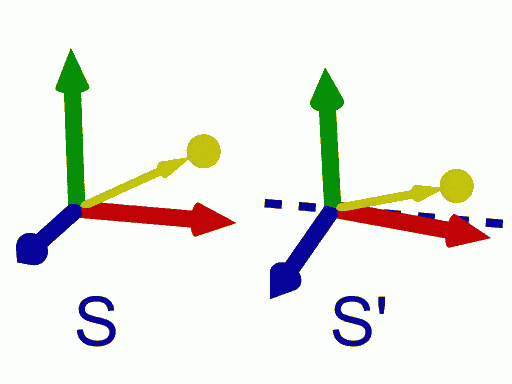
If one frame moves at constant velocity relative to an inertial frame, it is also inertial. This matters conceptually because it means:
there is no single “correct” inertial frame,
Newton’s first law can hold in many different moving frames, as long as they are not accelerating.
How to recognise the frame you are in (conceptually)
When reading a problem statement, identify the implied observer:
If the observer is attached to the ground (typical), assume inertial unless stated otherwise.
If the observer is attached to an object that is speeding up, slowing down, or turning, that frame is non-inertial.
If the problem claims a force-free object curves or speeds up “by itself,” that description signals a non-inertial frame (or missing forces).
Why inertial frames matter for free-body diagrams
A free-body diagram shows real forces from the environment. In an inertial frame, those forces alone determine acceleration through Newton’s laws. In a non-inertial frame, drawing only real forces may fail to match the observed acceleration unless you account for the frame’s acceleration (often via an apparent force in more advanced treatments).
Practice Questions
(2 marks) Define an inertial reference frame in terms of Newton’s first law.
1 mark: States that Newton’s first law holds in the frame (or equivalent wording).
1 mark: Explicitly links zero net external force to constant velocity (including rest), e.g. .
(5 marks) A student stands inside a bus that is accelerating forward. The student says, “I feel a force pulling me backwards even when I’m not touching anything.”
(a) State whether the bus frame is inertial or non-inertial. (1 mark)
(b) Explain, using Newton’s first law, why the student reports a backward “force” in the bus frame. (2 marks)
(c) Describe how the situation is explained in a ground (approximately inertial) frame without introducing any new interaction force. (2 marks)
(a) 1 mark: Non-inertial (accelerating frame).
(b) 1 mark: Notes that in an inertial frame, without a net external force the velocity would be constant, but in the bus frame objects appear to accelerate “without” the required net force.
(b) 1 mark: Identifies the backward sensation as an apparent/fictitious effect due to the accelerating frame (not a real interaction).
(c) 1 mark: Ground frame: the person’s body tends to maintain its state of motion (inertia) as the bus accelerates forward beneath/around them.
(c) 1 mark: Any actual acceleration of the student is due to real contact forces (e.g. floor pushing feet forwards), not a backward interaction force.
FAQ
They use local tests of Newton’s first law: look for “force-free” objects that move in straight lines at constant speed.
In practice, tiny residual accelerations always exist, so the question becomes whether deviations are below experimental uncertainty.
Because the laws of mechanics take the same form in any frame moving at constant velocity relative to an inertial frame.
This is the classical (Galilean) relativity principle used throughout AP Physics 1.
Locally, a freely falling frame can behave like an inertial frame because gravity affects all nearby masses similarly.
Over larger regions, differences in gravitational field (tidal effects) can reveal non-inertial behaviour.
A real force comes from an interaction and can be identified with an agent (another object or field).
An apparent force exists only because the chosen frame accelerates; it vanishes when analysed from an inertial frame.
When motions cover long times or large distances, or require high precision.
Rotational effects become more evident for very fast projectiles, long-range motion, or sensitive measurements where small accelerations matter.
