

AP Syllabus focus: ‘Gravitational force is attractive, acts along the line between centers of mass, and depends on mass and separation distance.’
Gravitation explains why masses pull on each other across space. AP Physics 1 focuses on the universal law’s proportional reasoning, direction, and how to model real objects as interacting through their centres of mass.
What universal gravitation says
Any two objects with mass exert a mutual gravitational force on one another. This interaction is:
Attractive (the force pulls objects toward each other, never pushes)
Along the line joining the centres of mass of the two objects
Dependent on both masses and on how far apart their centres are
Key terms you must use precisely
Gravitational force: the attractive interaction force between two masses, directed along the line connecting their centres of mass.
This force is an interaction: if object 1 pulls on object 2, object 2 simultaneously pulls on object 1 with equal magnitude and opposite direction.
Centre of mass: the single point where an object’s mass can be treated as concentrated for translational motion and for calculating the gravitational interaction between separated objects.
In many AP-style problems, objects are treated as point masses located at their centres of mass, especially when the separation is large compared with object size.
The inverse-square law (magnitude relationship)
For two masses and whose centres are separated by distance , the magnitude of the gravitational force is:
= gravitational force magnitude between the two masses (N)
= universal gravitational constant,
= mass of object 1 (kg)
= mass of object 2 (kg)
= centre-to-centre separation distance (m)
Because , doubling the separation makes the force one-fourth as large, and tripling the separation makes it one-ninth as large.
Direction: “along the line between centres of mass”
Universal gravitation is a central force, meaning the force vector on each object points directly toward the other object’s centre of mass.
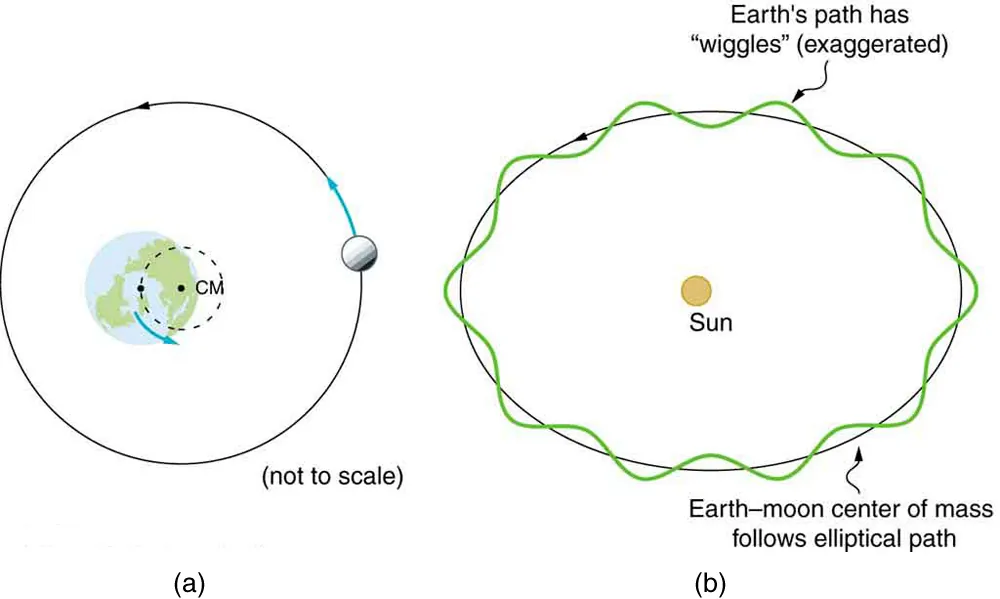
The Earth–Moon system is shown rotating about a common center of mass, illustrating that gravitational interactions are mutual and act through the bodies’ centers of mass. This kind of diagram helps connect the “central force” idea (forces point along the line joining centers) to real orbital motion. Source
The force on points toward
The force on points toward
The two forces are collinear (same line of action), equal in magnitude, opposite in direction
In one-dimensional setups, it is often enough to assign a sign (+/−) based on a chosen axis. In two-dimensional reasoning, you describe the direction as “toward the other mass” and, if needed, resolve into components based on geometry.
How the force depends on mass
The law is linear in each mass:
If doubles (with and fixed), doubles
If both masses double, increases by a factor of 4
This proportionality is frequently tested using ratios, so you can compare situations without calculating the full numerical force.
Separation distance: what “r” actually is
is the distance between centres of mass, not the distance between surfaces.
For spheres (or spherical planets), “centre-to-centre” is the clean geometric meaning
For irregular objects, AP problems usually still specify explicitly or imply a centre-to-centre separation
A common modelling step is deciding whether an object can be treated as located at its centre of mass:
Good approximation when object size is much smaller than
Also good for spherically symmetric bodies, where the external gravitational effect behaves as if all mass were concentrated at the centre
Universal means the same law applies everywhere
“Universal” indicates the same constant and the same inverse-square form apply to:
Any pair of masses (small lab objects or astronomical bodies)
Any location (not dependent on the medium between objects)
The force can be extremely small for everyday objects because is very small in SI units, but the law is still valid.
Superposition (adding gravitational influences)
When more than two masses are present, each pairwise interaction still follows the same law. The net gravitational force on a chosen object is found by vector addition of the forces from each other mass:
Compute each force’s magnitude using
Assign each force the correct direction (toward the attracting mass)
Add forces as vectors (often along a line in AP 1, so signs are sufficient)
Practice Questions
Question 1 (2 marks) Two objects attract each other gravitationally. State: (a) whether the gravitational force is attractive or repulsive, and (b) how the magnitude of the force changes when the centre-to-centre distance is doubled.
(a) Attractive (1)
(b) Uses inverse-square dependence: doubling makes the force as large (1)
Question 2 (5 marks) Two point masses and are separated by distance , producing gravitational force magnitude . (a) Write an expression for in terms of , , and . (2 marks) (b) The separation is changed to with the masses unchanged. Determine the new force magnitude in terms of . (2 marks) (c) State the direction of the force on the mass . (1 mark)
(a) (1)
(a) Simplifies to or equivalent (1)
(b) Uses : (1)
(b) Concludes (1)
(c) Force on is towards the mass, along the line joining their centres (1)
FAQ
Because the universal gravitation law is defined for point masses, and extended objects are modelled as if their mass acts at the centre of mass.
For spheres and spherically symmetric bodies, the external gravitational effect matches this model very well, so centre-to-centre distance is the correct geometric choice.
It is typically reasonable when the object’s size is much smaller than the separation distance $r$.
It is also reasonable for any spherically symmetric object when you are outside the object, even if the object is large, because symmetry makes the external effect behave like a point mass.
$G$ was measured using sensitive torsion-balance experiments (often associated with Cavendish-type setups) that detect tiny twists caused by gravitational attraction between known masses.
These experiments infer the force from measured torque and geometry, then solve for $G$.
The same physical interaction exists everywhere, but calculating the net force inside an extended body requires considering how different parts of the mass distribution contribute.
For a perfectly uniform sphere, symmetry leads to a smaller net gravitational pull as you move toward the centre, reaching zero at the exact centre.
No. In classical gravity there is no gravitational shielding.
The forces from multiple masses add by superposition, so the net force on an object is the vector sum of the individual attractions from each other mass.
