

AP Syllabus focus: ‘For the same pair of surfaces, the coefficient of static friction is usually greater than the coefficient of kinetic friction.’
Friction problems often hinge on deciding whether surfaces will slip. This page compares static and kinetic friction for the same materials, focusing on what the coefficients mean and how that comparison guides modelling choices.
Static vs. kinetic friction: what is being compared?
Static friction acts when two surfaces are not sliding relative to each other; kinetic friction acts once sliding occurs. Comparing them usually means comparing the coefficients that link friction force to the normal force for a given pair of surfaces.
Coefficients of friction (material pair property)
The “same pair of surfaces” refers to the same two materials and surface conditions (roughness, cleanliness, lubrication). Under those fixed conditions, the coefficients are treated as constants in AP Physics 1 Algebra modelling.
Coefficient of friction (). A dimensionless constant that relates friction force to the normal force for a particular pair of surfaces under specified conditions.
Even though is dimensionless, the friction force still depends on how hard the surfaces are pressed together (the normal force).
Why is usually greater than
The syllabus statement “ is usually greater than ” reflects a common physical trend: it is typically harder to start sliding than to keep sliding.
At rest, microscopic surface irregularities can interlock and form stronger contact junctions.
As you begin to push, static friction can increase to match the needed value (up to a limit) to prevent motion.
Once sliding starts, contacts continually break and reform with less time to strengthen, so the average resisting force is often smaller.
This is why motion may begin suddenly: the resistive force can drop from its maximum static value to a lower kinetic value when slipping starts.
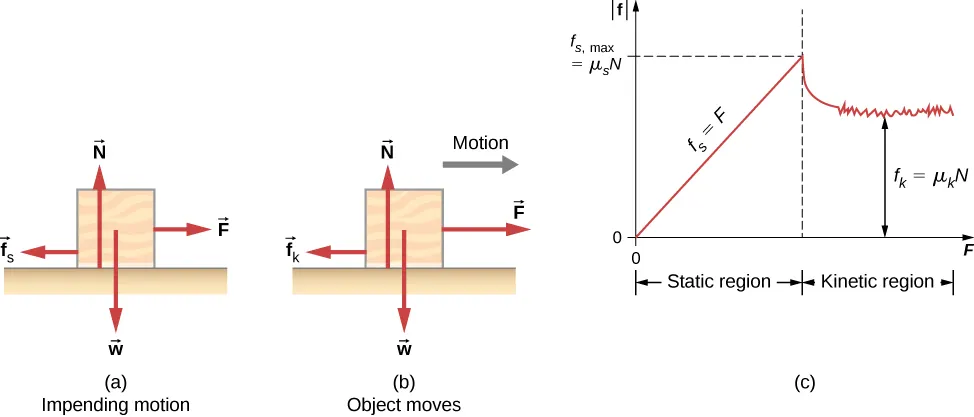
Friction-force magnitude versus applied force : the static-friction region follows until it reaches the cap , after which the motion enters the kinetic-friction region near . The figure emphasizes why slipping often begins abruptly when the model switches from static to kinetic friction. Source
The key modelling rule: static friction has a maximum
Static friction is not automatically ; instead it “adjusts” to whatever value is required to maintain no slipping, until it reaches a maximum.
Maximum static friction (). The largest possible static friction force before slipping begins; beyond this, the surfaces cannot remain at rest relative to each other.
In many setups, you determine whether the required friction to prevent slipping is less than or equal to this maximum; if it is not, slipping occurs and kinetic friction applies.
= static friction force (N)
= normal force (N)
= coefficient of static friction (dimensionless)
= maximum static friction force (N)
= kinetic friction force (N)
= coefficient of kinetic friction (dimensionless)
When switching from static to kinetic friction in a model, the direction of the friction force remains opposite the relative motion (or impending motion), but its typical magnitude changes because for the same surfaces.
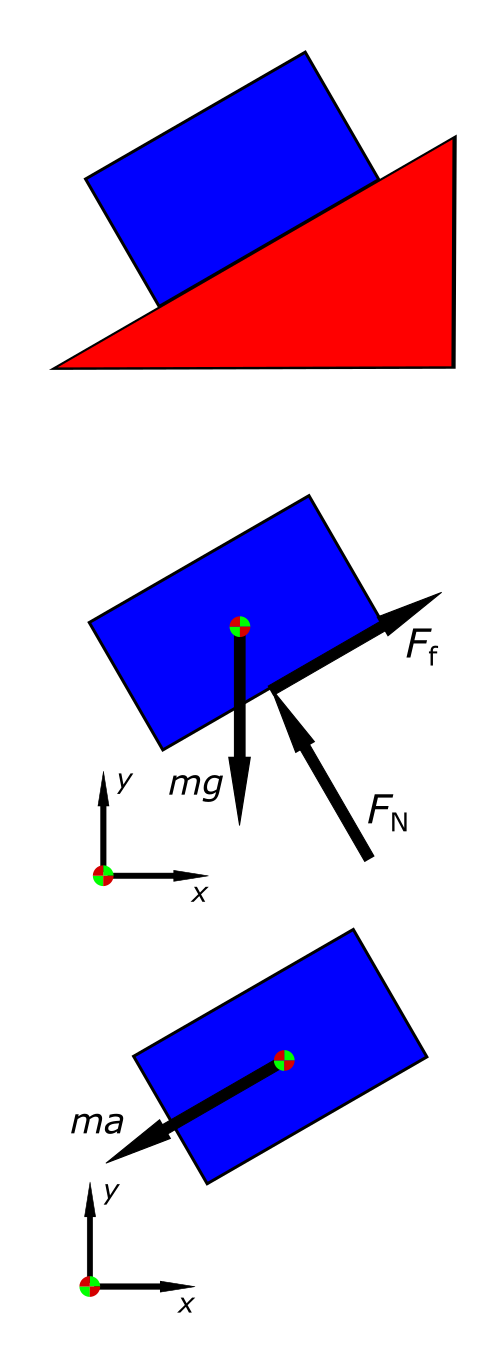
A block-on-an-incline diagram highlighting the contact geometry that governs force directions: the normal force is perpendicular to the surface, while friction lies parallel to the surface and opposes the (actual or impending) relative motion. This is the diagrammatic setup students use before choosing whether the friction force is static () or kinetic (). Source
How the comparison affects problem decisions
The inequality matters most at the instant motion begins.
If no slipping: use static friction, check against .
If slipping occurs: use kinetic friction with (constant magnitude in the simplest model).
Threshold behaviour: a system can remain at rest under increasing applied force until the required reaches ; then it transitions to sliding and the friction force often decreases to .
“Usually” is a modelling warning
The syllabus says “usually” because real surfaces can be complex.
Some materials, temperatures, or surface treatments can make and closer than expected.
Coefficients can depend on speed, wear, or contamination, even if AP problems often treat them as constants.
Practice Questions
Q1 (2 marks) A crate is pushed along a horizontal floor. For this crate-floor pair, and . State which coefficient is typically larger and what that implies about the force needed to start the crate moving compared with keeping it moving.
States for the same pair of surfaces. (1)
Explains that a larger force is typically needed to start motion than to maintain steady sliding (once moving). (1)
Q2 (5 marks) A box rests on a horizontal surface with and . A horizontal pull is increased slowly. (a) Explain why the friction force can increase even while the box remains at rest. (2 marks) (b) Determine the maximum static friction force. (2 marks) (c) Describe what happens to the friction force immediately after the box begins to slide, in terms of and . (1 mark)
Static friction adjusts to match the required value to prevent relative motion. (1)
It can do so up to a maximum value . (1) (b)
Uses on a horizontal surface. (1)
Calculates . (1) (c)
Friction changes to kinetic friction with magnitude , typically smaller because . (1)
FAQ
Because “same pair of surfaces” also includes surface condition.
Polished vs roughened finishes
Dust, oil, or water films
Temperature and wear
Exam questions may implicitly change these conditions, so coefficients are supplied rather than assumed.
It is uncommon but possible for certain material combinations or under special conditions (e.g., strong adhesion during sliding or particular polymers).
In AP-style modelling, you should follow the given values; do not assume $\mu_s>\mu_k$ if the question data contradict it.
There is typically a transition from $f_{s,\max}$ to $f_k$.
In real systems the change can be brief and messy (micro-slip, vibrations), but AP models treat it as a clean switch from $f_{s,\max}=\mu_s N$ to $f_k=\mu_k N$.
It indicates $\mu$ is a pure ratio, not a force.
This helps you check work: if you compute $\mu$ from data, units should cancel. If units remain, you have likely mixed up forces or used an incorrect normal force.
They aim to lower $\mu_s$ and/or stabilise friction during motion.
Lubricants to reduce adhesion/interlocking
Surface coatings (e.g., PTFE)
Rolling elements (bearings) to avoid sliding contact
These strategies target the mechanisms that make $\mu_s$ typically larger than $\mu_k$.
