TutorChase logo
Login
AP Physics 1: Algebra Notes

2.9.1 Centripetal Acceleration in Circular Motion

AP Syllabus focus: ‘Centripetal acceleration points toward the center of a circular path and has magnitude v squared over r.’

Circular motion is special because an object can be accelerating even when its speed is constant. In AP Physics 1, the key idea is centripetal acceleration: acceleration directed inward that continuously turns the velocity vector.

What centripetal acceleration is

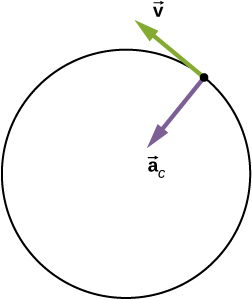
When an object moves along a circular path, its velocity is always tangent to the circle.
Pasted image

Velocity vistangenttothecircularpath,whilecentripetalacceleration is tangent to the circular path, while centripetal acceleration a_c points radially inward toward the center. This visual reinforces that an object can have constant speed but still accelerate because its direction of motion is continuously changing. Source

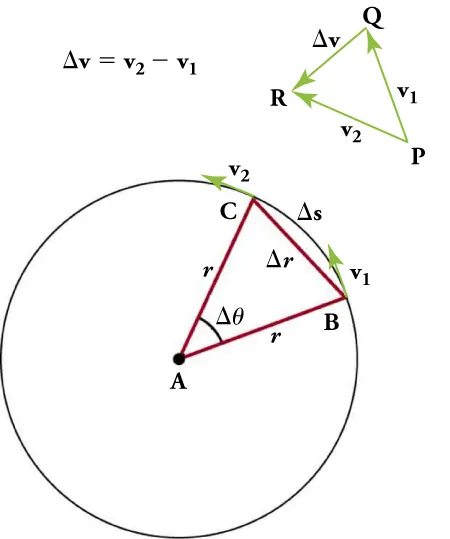
Even if the object’s speed stays the same, the direction of the velocity changes from instant to instant, which means the object is accelerating.
Pasted image

Two velocity vectors v_1and and v_2 at nearby points on a circle produce a change in velocity \Delta vthatpointsapproximatelytowardthecenter.Inthelimitofaverysmalltimestep,thisinwarddirectionbecomesthecentripetalaccelerationdirection.</em><arel="noopenernoreferrernofollow"href="https://openstax.org/books/physics/pages/62uniformcircularmotion"><em>Source</em></a></p><divclass="takeawayssection"><p><strong>Centripetalacceleration</strong>theaccelerationrequiredtokeepanobjectmovinginacircle,alwayspointingtowardthe<strong>center</strong>ofthecircularpath.</p></div><p>CentripetalaccelerationisnotanewtypeofmotionseparatefromNewtonslaws;itisageometricconsequenceofchangingdirectionincircularmotion.</p><h2class="editorheading"id="directionalwaystowardthecenter"><strong>Direction:alwaystowardthecenter</strong></h2><p>Acentripetalaccelerationvectorpointsalongthe<strong>radialdirection</strong>,straightinwardtowardthecirclescenteratthatinstant.</p><p>Keydirectionalfactstouseindiagramsandreasoning:</p><ul><li><p><strong>Inward(centerseeking):</strong>theaccelerationarrowpointsfromtheobjecttowardthecenterofcurvature.</p></li><li><p><strong>Perpendiculartovelocity(inuniformcircularmotion):</strong>becausevelocityistangentandcentripetalaccelerationisradial,theyareatrightangleswhenspeedisconstant.</p><p></p></li><li><p><strong>Changescontinuously:</strong>astheobjectmovesaroundthecircle,theinwarddirectionrotates,sotheaccelerationvectorsdirectionchangesevenifitsmagnitudestaysthesame.</p></li></ul><p>Acommonconceptualcheck:ifthepathisperfectlycircularandtheobjectisturning,theaccelerationmusthaveaninwardcomponent;otherwisetheobjectwouldmoveoffalongatangent.</p><h2class="editorheading"id="magnitudehowvandrcontroltheinwardacceleration"><strong>Magnitude:how that points approximately toward the center. In the limit of a very small time step, this inward direction becomes the centripetal acceleration direction. </em><a rel="noopener noreferrer nofollow" href="https://openstax.org/books/physics/pages/6-2-uniform-circular-motion"><em>Source</em></a></p><div class="takeaways-section"><p><strong>Centripetal acceleration</strong> — the acceleration required to keep an object moving in a circle, always pointing toward the <strong>center</strong> of the circular path.</p></div><p>Centripetal acceleration is not a new “type” of motion separate from Newton’s laws; it is a geometric consequence of changing direction in circular motion.</p><h2 class="editor-heading" id="direction-always-toward-the-center"><strong>Direction: always toward the center</strong></h2><p>A centripetal acceleration vector points along the <strong>radial direction</strong>, straight inward toward the circle’s center at that instant.</p><p>Key directional facts to use in diagrams and reasoning:</p><ul><li><p><strong>Inward (center-seeking):</strong> the acceleration arrow points from the object toward the center of curvature.</p></li><li><p><strong>Perpendicular to velocity (in uniform circular motion):</strong> because velocity is tangent and centripetal acceleration is radial, they are at right angles when speed is constant.</p><p></p></li><li><p><strong>Changes continuously:</strong> as the object moves around the circle, the inward direction rotates, so the acceleration vector’s direction changes even if its magnitude stays the same.</p></li></ul><p>A common conceptual check: if the path is perfectly circular and the object is “turning,” the acceleration must have an inward component; otherwise the object would move off along a tangent.</p><h2 class="editor-heading" id="magnitude-how-v-and-r-control-the-inward-acceleration"><strong>Magnitude: how vand and rcontroltheinwardacceleration</strong></h2><p>Forcircularmotion,themagnitudeofcentripetalaccelerationdependsonhowfasttheobjectismovingandhowtighttheturnis(theradius).</p><divclass="examplesection"><p> control the inward acceleration</strong></h2><p>For circular motion, the magnitude of centripetal acceleration depends on how fast the object is moving and how tight the turn is (the radius).</p><div class="example-section"><p> a_c = \dfrac{v^2}{r} </p><p></p><p> a_c =centripetalaccelerationmagnitude(m/s = centripetal acceleration magnitude (m/s^2)</p><p>)</p><p> v =speed(m/s)</p><p> = speed (m/s)</p><p> r =radiusofcircularpath(m)</p><p> = radius of circular path (m)</p><p> a_c = \omega^2 r </p><p></p><p> \omega =angularspeed(rad/s)</p></div><p>Thisrelationshipencodestwohighutilityideas:</p><ul><li><p>Increasingspeedincreasesinwardaccelerationstrongly:doubling = angular speed (rad/s)</p></div><p>This relationship encodes two high-utility ideas:</p><ul><li><p>Increasing speed increases inward acceleration strongly: doubling vmakes makes a_cfourtimeslarger.</p></li><li><p>Largerradiusmeansagentlerturn:doubling four times larger.</p></li><li><p>Larger radius means a gentler turn: doubling rhalves halves a_cforthesamespeed.</p></li></ul><h2class="editorheading"id="unitsandphysicalinterpretation"><strong>Unitsandphysicalinterpretation</strong></h2><p>Centripetalaccelerationhasthesameunitsasanyacceleration:<strong>m/s for the same speed.</p></li></ul><h2 class="editor-heading" id="units-and-physical-interpretation"><strong>Units and physical interpretation</strong></h2><p>Centripetal acceleration has the same units as any acceleration: <strong>m/s^2</strong>.Itmeasureshowquicklythevelocityvectorisbeingredirected,notnecessarilyhowquicklytheobjectisspeedingup.</p><p>Interpretationguidelines:</p><ul><li><p>If</strong>. It measures how quickly the velocity vector is being redirected, not necessarily how quickly the object is speeding up.</p><p>Interpretation guidelines:</p><ul><li><p>If a_cislarge,theobjectsdirectionischangingrapidly(tightcurveand/orhighspeed).</p></li><li><p>If is large, the object’s direction is changing rapidly (tight curve and/or high speed).</p></li><li><p>If a_c = 0,thereisnocurvatureinthemotionatthatinstant(straightlinemotion).</p></li></ul><h2class="editorheading"id="practicalchecklistforidentifyingcentripetalacceleration"><strong>Practicalchecklistforidentifyingcentripetalacceleration</strong></h2><p>Usethisprocesswhenyouseemovesinacircleorturns:</p><ul><li><p>Identifythe<strong>instantaneouscenter</strong>ofthecircularpath.</p></li><li><p>Draw, there is no curvature in the motion at that instant (straight-line motion).</p></li></ul><h2 class="editor-heading" id="practical-checklist-for-identifying-centripetal-acceleration"><strong>Practical checklist for identifying centripetal acceleration</strong></h2><p>Use this process when you see “moves in a circle” or “turns”:</p><ul><li><p>Identify the <strong>instantaneous center</strong> of the circular path.</p></li><li><p>Draw \vec a_c<strong>fromtheobjecttowardthecenter</strong>.</p></li><li><p>Usethepathradius <strong>from the object toward the center</strong>.</p></li><li><p>Use the path radius r(notdiameter)andtheobjectsspeed (not diameter) and the object’s speed vtodeterminethemagnituderelationship.</p></li><li><p>Treat to determine the magnitude relationship.</p></li><li><p>Treat a_c$ as the acceleration component responsible for changing direction; constant speed does not imply zero acceleration in circular motion.


FAQ

Because acceleration is change in velocity, and velocity includes direction. In circular motion the direction changes continuously, so $\Delta\vec v\neq 0$.

It is the radius of the circle that best matches the path at that instant. A sharper bend means smaller radius of curvature and larger $a_c$.

No. Centripetal acceleration is real acceleration towards the centre in an inertial frame. “Centrifugal” is a pseudo-effect used in rotating (non-inertial) frames.

Draw two nearby tangent velocity vectors; the change $\Delta\vec v$ points roughly inward. In the limit of small time steps, this inward direction is $\vec a_c$.

Yes. Any momentary turning (non-zero curvature) implies an inward acceleration component; it can vary in magnitude and direction from moment to moment.

Practice Questions

(2 marks) A car travels at constant speed around a circular track. State the direction of the car’s centripetal acceleration and give its magnitude in terms of vv and rr.

Direction: towards the centre (1). Magnitude: ac=v2ra_c=\dfrac{v^2}{r} (1).

(5 marks) A ball moves in a horizontal circle of radius 0.80 m0.80\ \text{m} at speed 4.0 m s14.0\ \text{m s}^{-1}.
(a) Calculate the magnitude of its centripetal acceleration. (2)
(b) If the speed is doubled but the radius is unchanged, state by what factor the centripetal acceleration changes. (1)
(c) Describe how the direction of the centripetal acceleration changes as the ball goes around the circle. (2)

2a) Uses ac=v2ra_c=\dfrac{v^2}{r} (1); ac=(4.0)20.80=20 m s2a_c=\dfrac{(4.0)^2}{0.80}=20\ \text{m s}^{-2} (1).
2b) Factor of 4 increase (1).
2c) Always directed towards the centre (1); direction continuously changes to keep pointing to the centre as the ball moves (1).

Hire a tutor

Please fill out the form and we'll find a tutor for you.

1/2
Your details
Alternatively contact us via
WhatsApp, Phone Call, or Email
