

AP Syllabus focus: 'Entropy can be described qualitatively as energy spreading or as the unavailability of some energy to do work.'
In AP Physics 2, entropy is best understood as a qualitative idea: it helps describe how energy becomes more spread out and why that makes some energy less useful for producing change.
Understanding entropy
Entropy is not a second name for energy. A system can have a certain total amount of energy, but that energy can be arranged in different ways. If the energy is concentrated in a few places or forms, it is often easier to use. If it is widely distributed among many particles and many possible motions, the system has greater entropy.
Entropy: A measure of how spread out energy is among the possible microscopic states of a system; greater entropy means energy is more dispersed and generally less available to do useful work.
This qualitative meaning is the most important one for AP Physics 2: higher entropy means greater energy spreading. It does not mean the system has gained energy. Instead, it means the existing energy is less localized and less organized.
How energy spreads
Energy can become more spread out in several related ways.
Spread through space
If energy that was concentrated in one region ends up distributed through a larger region, entropy is higher. For example, a hot object in a cooler environment has energy concentrated in the faster-moving particles of the hot object. As energy transfers away, it becomes shared over a larger amount of matter.
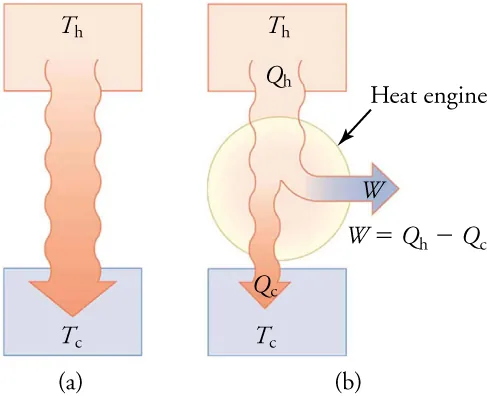
The figure shows spontaneous heat transfer from a hotter object to a cooler one, a basic example of energy spreading through the environment. As thermal energy disperses into more matter at lower temperature, the energy becomes more uniformly distributed and less able to produce a directed macroscopic effect. Source
Shared among more particles and motions
Even within one object, energy can be divided among many atoms and many kinds of microscopic motion. Instead of a large, coordinated motion of the whole object, energy may appear as random particle motion, vibrations, or collisions. When more microscopic possibilities can hold the energy, entropy is greater.
Energy may spread from one location to many locations.
Energy may spread from a few particles to many particles.
Energy may spread from organized motion to random microscopic motion.
Energy may become more uniform instead of unevenly concentrated.
A useful way to think about entropy is to compare concentrated energy with distributed energy. Concentrated energy can often create a noticeable macroscopic effect more easily. Distributed energy is still present, but it is harder to gather into one directed outcome.
Entropy and availability for work
The phrase unavailability of some energy to do work is another useful way to think about entropy. In physics, doing work requires energy to cause an organized change, such as pushing, lifting, or driving a current. Energy is most useful for work when it is concentrated enough to create a clear direction for change.
A temperature difference is a good example.
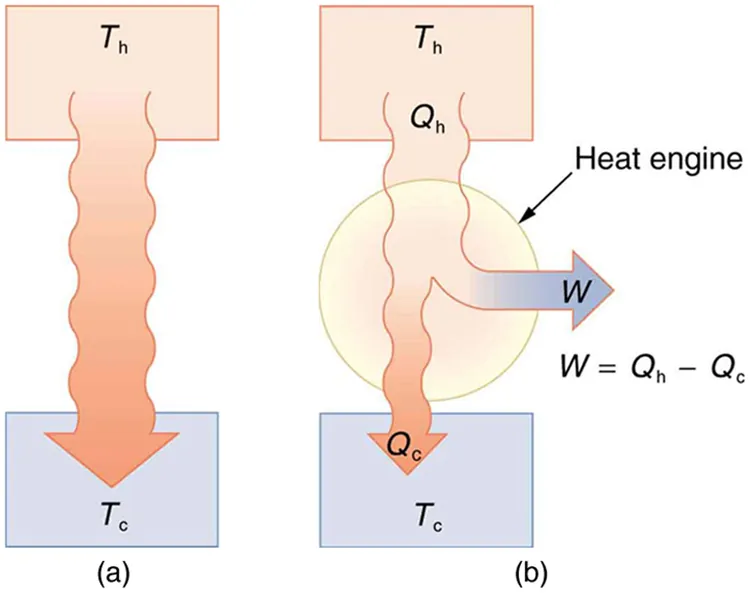
A heat engine operating between a hot reservoir and a cold reservoir converts only part of the incoming heat into work , while the remaining heat is rejected to the colder surroundings. The diagram emphasizes why a temperature difference can be useful (it can drive organized output), yet why some energy inevitably becomes unavailable for work as energy spreads into the colder reservoir. Source
If one part of a system is hot and another part is cooler, energy is unevenly distributed. That unevenness can be useful, because energy can flow in a preferred direction and potentially drive a device. As the temperatures become more alike, the energy is more evenly spread. The total energy may still be present, but less of it is available to produce organized macroscopic effects.
This is why entropy is not about “losing” energy. The energy remains, but more of it is tied up in random microscopic motion rather than in a form that can be easily redirected into useful work.
Interpreting common situations
A moving object that slows because of friction gives a helpful picture. Before friction acts, some of the energy is in organized motion of the whole object. After friction acts, much of that energy has become random molecular motion in the surfaces and nearby air. The energy has spread into many particles, so the entropy of the situation is higher and the energy is less available for doing mechanical work.
Electrical energy in a resistor can be viewed similarly. A directed current transfers energy into the resistor, but that energy ends up as random thermal motion of atoms and electrons within the material. Once the energy is spread in that way, it is harder to recover as fully organized electrical or mechanical energy.
These examples show an important pattern: concentrated or organized energy is generally more useful for producing macroscopic change, while spread-out energy is generally less useful.
What entropy does and does not mean
Entropy is often loosely described as disorder, but that shortcut can be misleading. The AP Physics 2 view is more precise if you focus on energy spreading.
Keep these ideas clear:
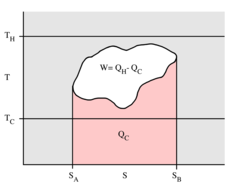
A temperature–entropy (T–s) diagram plots temperature versus entropy and is commonly used to visualize thermodynamic processes and cycles. Even when you avoid detailed calculations, placing entropy on an axis reinforces that entropy tracks how thermal energy is distributed, and that changes in entropy are closely tied to heat transfer and the limits on extracting work. Source
Entropy is not the same as total energy. Two systems can have the same total energy but different entropies.
Higher entropy does not mean energy has disappeared. Energy is still conserved.
Higher entropy does mean less energy is available for useful work. More of the energy is distributed among microscopic motions.
Entropy is a qualitative description in this course. You should be able to explain trends and physical meaning even without a detailed calculation.
When describing entropy, ask two questions: How spread out is the energy? and How much of that energy is still available to produce organized change?
Practice Questions
A hockey puck sliding across ice eventually slows down because of friction. Explain, in terms of entropy, why the energy of the puck-ice system becomes less available to do work.
1 mark: States that the energy spreads into random microscopic motion or thermal energy in the puck, ice, or surroundings.
1 mark: States that this increased spreading means greater entropy and less energy available for organized mechanical work.
An insulated container holds a hot metal block and a cooler metal block in thermal contact. Describe qualitatively how entropy changes for the two-block system as they reach the same temperature. Explain why the ability of the system’s energy to do work changes during this process.
1 mark: Recognizes that energy is initially more concentrated in the hotter block.
1 mark: States that energy transfers from the hot block to the cooler block.
1 mark: Explains that the energy becomes more spread out or more uniformly distributed among the particles in both blocks.
1 mark: States that the entropy of the two-block system increases.
1 mark: Explains that as the temperature difference decreases, less of the energy is available to do work because there is less ability to drive organized change.
FAQ
A system’s macroscopic state, such as its temperature and volume, can usually be produced by many different microscopic particle arrangements.
If energy can be distributed among particles in a larger number of possible ways, physicists say the entropy is greater. This is why entropy is tied to how many microscopic arrangements are possible, not just to how much total energy the system has.
In free expansion, a gas moves into a larger volume without needing extra energy added to it. The total internal energy can stay the same.
Even so, the gas particles now have more possible positions and more possible overall arrangements. That means the same energy is spread through a larger region and among more possible microscopic states, so the entropy increases.
Before mixing, each gas is confined to its own region. After mixing, particles of both gases can occupy the whole container.
That creates many more possible particle arrangements, even if the average kinetic energy and temperature do not change. The energy and matter are less separated and more spread out, so entropy is higher.
A sound wave is an organized pattern of pressure changes moving through air. At first, the energy is in a relatively ordered large-scale motion.
As the wave interacts with walls, objects, and the air itself, that energy gets converted into random molecular motion. The sound becomes less distinct, and the energy becomes harder to use for organized work. That is a qualitative increase in entropy.
Yes, but usually not by itself. To extract useful work from thermal energy, there must be some kind of difference to exploit, such as a temperature difference between hot and cold regions.
If energy is already spread uniformly, you usually need outside energy or a specially arranged device to make part of it useful again. Even then, not all of the thermal energy can typically be recovered as organized work.
