

AP Syllabus focus: 'An isolated system’s entropy never decreases, but a closed system’s entropy can decrease by transferring energy to or from surroundings.'
Entropy changes depend on what is included inside the system boundary. In AP Physics 2, the crucial idea is that isolated systems cannot show a net entropy decrease, while closed systems sometimes can.
Why the system boundary matters
Whether entropy can decrease depends on how the system is defined.
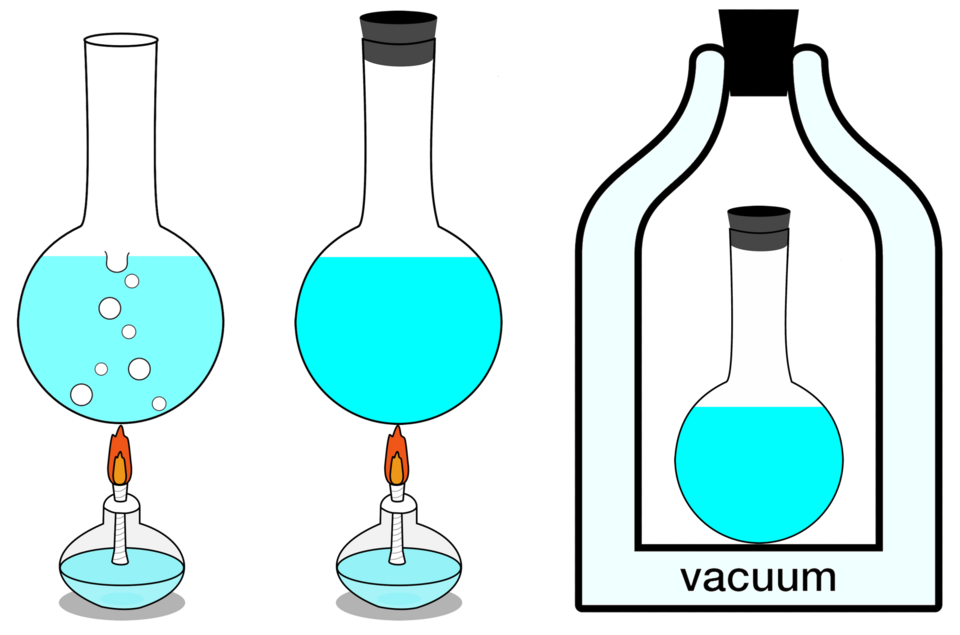
This diagram compares open, closed, and isolated thermodynamic systems by showing what can cross the system boundary. The key distinction for entropy reasoning is that an isolated system exchanges neither matter nor energy with its surroundings, whereas a closed system can exchange energy but not matter. Seeing the boundary and transfer arrows makes it easier to decide which entropy constraints apply to the chosen system. Source
If the boundary includes everything involved, no energy enters or leaves, and the entropy rule is very strict. If the boundary includes only one part of a larger situation, energy may cross that boundary, so the entropy of that chosen part may either increase or decrease.
When discussing entropy, it is important to distinguish the chosen system from the surroundings, which are everything outside the boundary.
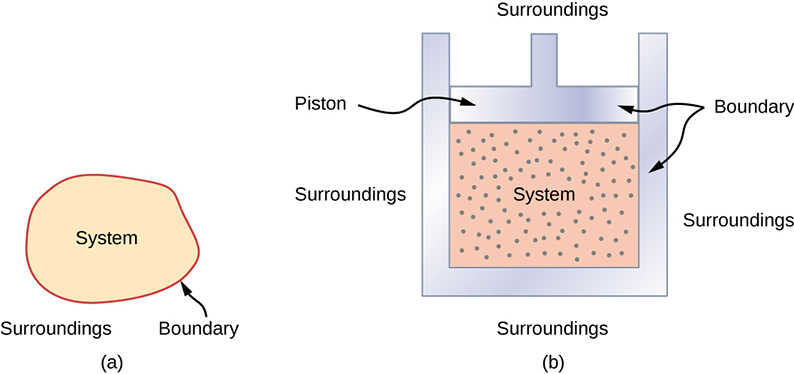
This figure illustrates a thermodynamic system separated from its surroundings by a boundary (here, the gas in a cylinder beneath a piston). It reinforces that “surroundings” means everything outside the chosen boundary, so energy crossing the boundary changes the system’s entropy while also affecting the surroundings. This boundary-based view is exactly what underlies the additivity idea . Source
Entropy: A measure of how spread out energy is within a system and how many microscopic arrangements are consistent with the system’s macroscopic state.
A change in entropy is written as . A positive means entropy increases, while a negative means entropy decreases.
Isolated systems
An isolated system is the most restrictive case for entropy analysis.
Isolated system: A system that exchanges neither matter nor energy with its surroundings.
Because no energy enters or leaves an isolated system, any change must happen entirely through internal rearrangements. One part of the isolated system cannot become more ordered unless another part changes in a way that prevents the total entropy from dropping below its starting value.
For an isolated system, the total entropy change satisfies . In words, the entropy of the whole isolated system can stay the same or increase, but it cannot decrease. A zero change is the limiting case in which the process adds no extra entropy.
This idea is especially important because students sometimes notice that one region becomes more ordered and incorrectly conclude that entropy has decreased overall. In an isolated system, that local decrease must be balanced by an equal or larger increase somewhere else inside the same system.
A useful bookkeeping relationship is shown below.
= total entropy change of the larger combined system, in
= entropy change of the chosen system, in
= entropy change of everything outside the chosen system, in
If the chosen system is actually the entire isolated setup, then there is no external surroundings to exchange energy with, so the total entropy of that isolated setup cannot become negative.
Closed systems
A closed system is less restrictive than an isolated system.
Closed system: A system that does not exchange matter with its surroundings but can exchange energy with them.
Because energy can cross the boundary of a closed system, the entropy of that system alone can decrease. Energy transfer in either direction means the system is not constrained in the same way as an isolated system. The sign of depends on the particular interaction with the surroundings.
This does not mean entropy has been destroyed. Instead, energy transfer causes entropy changes in both the system and the surroundings. If the system transfers energy to the surroundings, the system may become less thermally disordered and its entropy may decrease. If the surroundings transfer energy to the system, the system’s entropy may increase. The important comparison is not just the sign of , but the combined change for the larger situation.
So, for a closed system:
can be positive
can be zero
can be negative
A negative entropy change for the system is allowed as long as the entropy change of the surroundings makes the overall entropy change of the larger isolated combination nonnegative.
Comparing isolated and closed systems
The most common AP confusion is mixing up the entropy of a part with the entropy of the whole.
For an isolated system, there is no energy transfer across the boundary, so the entropy of the whole system never decreases.
For a closed system, energy transfer across the boundary is possible, so the entropy of the chosen system may decrease.
A decrease in the entropy of a closed system does not violate physics if the surroundings undergo an equal or greater entropy increase.
Entropy restrictions apply most strongly to the total isolated combination of system plus surroundings.
This is why wording matters. A prompt may ask about a metal block, a gas sample, or a liquid, while the surroundings are not part of the named system. In that case, a decrease in the system’s entropy may be completely acceptable.
How to reason through problems
When analyzing entropy changes, start by identifying the boundary.
Ask whether the problem’s system can exchange energy with its surroundings.
If the answer is no, treat it as isolated and require for the whole system.
If the answer is yes, treat it as closed and allow the system’s entropy to increase or decrease.
Then decide whether the question is asking about the system only or about the system plus surroundings.
Another useful habit is to watch for phrases such as insulated, sealed, in contact with a reservoir, or surrounded by air. These phrases help determine whether energy transfer is possible and whether entropy may decrease for the selected system.
Do not assume that “more order” automatically means the entropy of the relevant whole system has decreased. In closed-system problems, order may increase inside the system only because energy transfer causes a greater entropy increase outside it. The entropy rule must always be applied to the correct boundary.
Practice Questions
A gas in a perfectly insulated container undergoes a spontaneous internal change. The gas and container together are treated as the system. Can the total entropy of this system decrease? Explain briefly.
Identifies the system as isolated because no energy is transferred to or from surroundings. (1)
States that the total entropy cannot decrease, so . (1)
A warm metal block is placed in contact with cooler surrounding air. The block is defined as the system.
(a) State whether the block is an isolated system or a closed system.
(b) State the sign of as the block cools.
(c) Explain why this does not violate entropy rules for the larger situation.
(d) State what must be true about .
(a) The block is a closed system because energy can be transferred to the air, but matter remains in the block. (1)
(b) as the block cools. (1)
(c) The surroundings gain energy, so their entropy increases. (1)
(c) That increase can offset the entropy decrease of the block. (1)
(d) The larger isolated combination must satisfy . (1)
FAQ
Inside the refrigerator, food and air can lose energy and decrease in entropy. If you define only the cooled contents as the system, a negative entropy change is possible.
The full refrigerator-plus-room situation is different. The compressor does work and dumps even more energy into the kitchen, so the entropy increase of the surroundings is large enough that the total does not decrease.
Yes. In very small systems, random microscopic fluctuations can temporarily produce a decrease in entropy over short times.
That does not change the macroscopic rule used in AP Physics 2. For ordinary, large-scale systems, those fluctuations are negligible, and the overall entropy behavior follows the usual isolated-versus-closed distinction.
Real systems almost always exchange at least a tiny amount of energy with their environment through radiation, conduction, vibration, or measuring devices.
In practice, physicists call a system “isolated” when those exchanges are so small that they do not matter on the timescale of the experiment. So isolation is usually an excellent approximation, not a perfect condition.
No. Compression reduces volume, which may seem to make the system more ordered, but entropy depends on the full energy distribution, not on one feature alone.
If compression also raises the temperature enough, the entropy can increase instead. To decide the sign of $\Delta S$, you must consider both the process inside the system and any energy transfer across the boundary.
During freezing, a closed system often releases energy to the surroundings and becomes more ordered, so its entropy decreases. During melting, the system usually absorbs energy and its entropy increases.
The key point is that the system does not have to follow the isolated-system rule by itself. Its entropy change is allowed to be negative or positive because energy is crossing the boundary.
