

AP Syllabus focus: 'Localized energy tends to disperse and spread out as a system changes over time.'
This idea explains why many natural changes occur without outside direction: energy that starts concentrated in one place or form usually becomes distributed more broadly as a system evolves.
Core Idea
Localized energy means energy is concentrated in one place, one region, one object, or one small group of particles. In thermodynamics, that concentration is usually temporary because microscopic interactions constantly redistribute energy.
Localized energy: Energy concentrated in a small region of space, in a small number of particles, or in a limited form within a system.
When that concentration breaks up, the system has not lost energy. Instead, the energy has become less confined.
Energy dispersal: The spreading of energy among more particles, more regions of space, or more possible microscopic motions.
A hot spot in a material, a small energized region of a gas, or energy concentrated in only a few particles are all examples of localized energy. As the system changes over time, that energy tends to become shared more widely. The total amount of energy remains the same unless energy enters or leaves the system; what changes is the distribution of the energy.
Microscopic Picture of Dispersal
Atoms and molecules are always in motion. They collide, vibrate, and exchange energy with nearby particles. If one part of a system begins with much more energy than another part, those interactions tend to pass some of that energy outward. No single collision guarantees spreading, but an enormous number of collisions makes a persistent concentration harder to maintain.
Energy can be localized not only by place, but also by how it is stored. For example, energy may start concentrated in a small number of fast-moving particles or in a very ordered pattern of motion. As interactions continue, that energy is usually divided among more particles and more kinds of microscopic motion. The energy is still there, but it is less concentrated than before.
Why Dispersal Is Favored
The main reason energy dispersal is so common is probability.
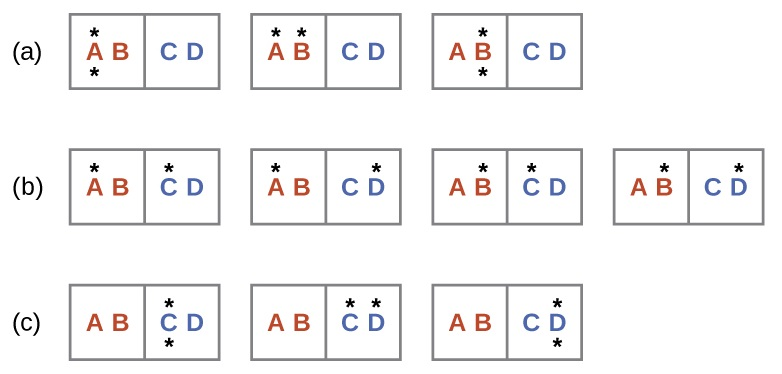
A simple microstate model shows multiple possible microscopic arrangements (“microstates”) for the same overall energy distribution (“macrostate”). The evenly dispersed case has the greatest number of microstates, making it the most probable outcome and illustrating why spontaneous processes tend to spread energy out. Source
There are usually far more ways for energy to be spread out than for it to stay concentrated in one small region or one narrow pattern. A localized state is relatively special. A dispersed state can be produced by many more possible particle arrangements and motions.
Because particle motion is random, a system does not usually preserve a special concentrated arrangement for long. Random collisions continually reshuffle energy. Over time, the system is much more likely to move toward states in which the energy is shared more broadly. This is why energy dispersal is a natural trend, not a rare exception.
What Dispersal Looks Like in Physical Systems
Hot and cool regions
If one part of an object is hotter than another part, energy is initially concentrated in the hotter region.
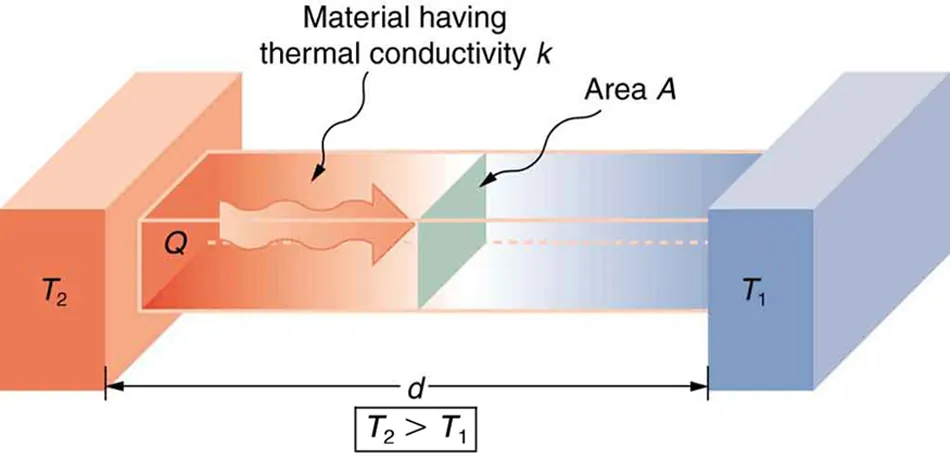
Heat conduction transfers thermal energy through a material from the higher-temperature side to the lower-temperature side. The labeled arrow indicates the net direction of energy flow, while the slab geometry emphasizes that conduction depends on the material and the distance energy must travel. Source
Interactions between neighboring particles transfer energy away from that region. As time passes, the sharp concentration weakens, and the energy becomes spread more widely through the object.
A temporary energy pulse
If a small region of a system briefly receives extra energy, that region may stand out at first because its particles have greater motion than nearby particles. As those particles interact with surrounding particles, the difference becomes less extreme. The original energy pulse does not stay sharply confined unless something keeps supplying energy to the same place.
Energy shared among many motions
Energy may also begin concentrated in a limited set of motions. As particles interact, that energy can become divided among many different microscopic motions. In this way, energy becomes more dispersed even if the total amount of energy in the system has not changed at all.
What This Idea Does Not Mean
Energy dispersal does not mean energy is destroyed. It means energy becomes less localized and more widely shared. A system can keep the same total energy while changing from a concentrated state to a dispersed one.
Energy dispersal also does not mean every part of a system instantly has exactly the same energy. Real systems change gradually. During that change, some regions may still have more energy than others. The key idea is the overall direction: away from concentration and toward spreading.
Localized energy can persist for a while if a system is continually supplied with energy or if something limits how easily the energy can spread. Even then, without continued support, concentrated energy distributions are usually not stable over long times.
Why This Idea Matters
This principle helps explain why physical systems left on their own rarely keep sharp energy concentrations. It connects microscopic particle behavior to large-scale observations: hot spots fade, strong local disturbances weaken, and energy becomes harder to identify as belonging to one specific place or small set of particles.
Common Misunderstandings
Dispersal is a tendency, not a statement about a single collision. One interaction can briefly increase localization, but the long-term trend still favors spreading.
More spread out does not mean perfectly uniform at every moment. Systems pass through many intermediate states.
Localized energy can exist temporarily. The important point is that it usually does not remain concentrated indefinitely.
The idea is statistical. Spread-out arrangements are more likely because there are many more ways for them to occur.
Practice Questions
A metal block has a small hot spot near one corner. Explain why the energy initially localized in that hot spot tends to spread through the block over time.
1 mark: States that particles in the hotter region interact or collide with neighboring particles.
1 mark: States that these interactions transfer energy outward so the energy becomes shared among more particles or becomes less localized.
A sealed container of air is briefly heated in one small region by a tiny heater. The heater is then turned off. After a long time, that region is no longer noticeably warmer than the rest of the air.
Explain, in terms of localized energy and dispersal, why the warm region does not stay concentrated. Your answer should include microscopic behavior and why the spread-out state is favored.
1 mark: States that the heater initially creates a region where energy is concentrated in a small part of the air.
1 mark: States that air particles move randomly and collide with other particles.
1 mark: States that collisions transfer energy away from the initially warm region.
1 mark: States that the energy becomes shared among more particles or more regions of space.
1 mark: States that the spread-out state is favored because there are more possible microscopic arrangements for dispersed energy than for concentrated energy.
FAQ
Yes, but only as a small, temporary fluctuation.
In a real system, random particle motion can briefly make one region gain more energy than its surroundings. However, large spontaneous concentrations are extremely unlikely because they require many particles to behave in just the right way at the same time.
So small local increases can happen, but the overall long-term trend still favors dispersal.
Insulation does not stop dispersal completely. It slows it down.
It works by reducing the interactions that move energy from one region to another. If fewer collisions or other transfer processes connect one part of a system to another, localized energy can last longer.
That does not change the tendency toward dispersal. It only changes the rate.
No. They are related, but they are not identical.
Particles can stay in nearly the same places while energy disperses, such as in a solid.
Particles can also spread into a larger volume without a large change in how energy is shared per particle.
Energy dispersal is about how energy is distributed, not just where matter is located.
A reversal would mean dispersed energy suddenly becoming concentrated again without outside help.
That is not forbidden by basic mechanics, but it is overwhelmingly improbable in a large system. There are vastly more microscopic arrangements that correspond to dispersed energy than concentrated energy.
Because of that imbalance, random motion almost never rebuilds a highly localized state.
No. Different materials and systems allow energy to spread at very different rates.
The rate depends on factors such as:
how strongly particles interact
how freely particles move
how easily the system exchanges energy internally
So the tendency toward dispersal is general, but the speed of dispersal depends on the physical properties of the system.
