

AP Syllabus focus: 'Entropy is a state function, so it depends only on the current state or configuration, not the path taken.'
Entropy is most useful in AP Physics 2 when you treat it as a property of a system’s state. The key idea is that only the starting and ending states matter.
Entropy as a property of the system
In thermodynamics, a system is described by its current macroscopic condition. Entropy belongs to that condition. If you specify the system’s state, you have specified its entropy, whether or not you know the history that produced that state.
Entropy: A thermodynamic quantity that describes the state of a system and can change when the system changes from one state to another.
This makes entropy different from quantities that describe a transfer or process; it is attached to the system itself, not to the route used to change the system.
State function: A quantity whose value depends only on the system’s current state, not on the process used to reach that state.
A system can move from one state to another in many possible ways. It may change gradually, rapidly, or through several intermediate states. The central AP Physics idea is that all those possible routes lead to the same entropy change as long as the initial state and final state are identical.
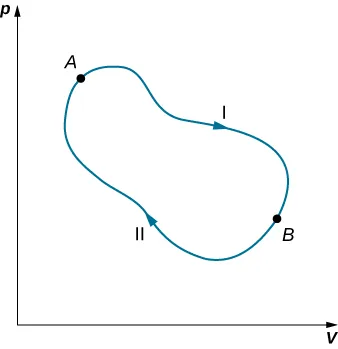
A state-diagram sketch showing two different reversible paths connecting the same states A and B. It reinforces that for a state function like entropy, the endpoint difference is the same regardless of which reversible path is taken. The closed-loop idea also foreshadows why returning to the starting state gives net . Source
What “state or configuration” means
The word state refers to the system’s present thermodynamic condition. In practice, that means the measurable features that describe the system at that moment. The word configuration emphasizes the arrangement of the system at a macroscopic level, not the detailed story of how it arrived there.
For a gas, the state is commonly described using variables such as pressure, volume, and temperature.
For a substance changing between phases, the phase itself is part of the state.
If those defining features are the same at the start and end of two processes, the entropy change is the same.
Because entropy is tied to the current state, you should think of it as a property that can be assigned at any particular equilibrium state. The path matters for describing the process, but not for assigning the entropy value of that state or the entropy change between two states.
Why path does not matter
Imagine two different processes that both take a system from state A to state B. One process may use many small steps, while the other may use only one large change. Since entropy is a state function, the change in entropy from A to B is the same for both. Only A and B matter. The intermediate steps do not change the final answer for .
= change in entropy of the system, in J/K
= entropy in the final state, in J/K
= entropy in the initial state, in J/K
This equation captures the main idea of path independence.

A temperature–entropy (T–s) diagram comparing reversible and irreversible evolutions. In a reversible process, the curve makes the heat–entropy connection explicit via , while the endpoints still determine the state change . The side-by-side comparison helps students separate “path details” (process-dependent) from the entropy values assigned to equilibrium states (state-dependent). Source
The entropy change is found by comparing the entropy of the final state with the entropy of the initial state. Nothing in the expression depends on the number of stages, the time taken, or the specific sequence of changes between those two states.
The same reasoning also explains cyclic processes. If a system eventually returns to exactly its original state, then its final entropy equals its initial entropy, so the net change is . A cycle may involve many different stages, but once the system is back where it started, the entropy of the system is also back to its original value.
Consequences for AP Physics reasoning
Treating entropy as a state function gives you a powerful way to analyze situations conceptually. You do not need to memorize every possible process in detail. Instead, start by identifying the initial state and the final state. Then ask how the system’s entropy compares between those two states. That is the quantity that has physical meaning for the change.
If two students describe different paths between the same states, they must predict the same entropy change.
If a problem asks about the entropy change of the system after it returns to its starting condition, the answer must be zero.
If the final state is not fully specified, the entropy change cannot be determined from the state-function idea alone.
This is why AP questions often emphasize the wording initial state and final state. Those phrases signal that you should focus on state variables and on the difference between states, not on narrating every part of the process.
Common misunderstandings
A common mistake is to confuse entropy with the process that changes it. The process may be complicated, but the entropy value belongs to the state. Another mistake is to assume that different-looking processes must produce different entropy changes. That is not true when the system begins and ends in the same states.
Incorrect idea: “Entropy depends on how the change happened.”
Correct idea: “Entropy change depends on where the system started and where it ended.”
Incorrect idea: “A longer or more complicated path automatically means a larger entropy change.”
Correct idea: “Path length or complexity does not determine .”
Important nuance: the state-function idea applies to the entropy of the system. To analyze a situation clearly, the system must be identified first.
A useful check in any problem is to ask whether the initial and final states are actually different before deciding that the entropy changed.
Practice Questions
(2 marks)
A system is taken from state A to state B by two different processes. State whether the entropy change of the system is the same or different for the two processes, and justify your answer.
1 mark: States that the entropy change is the same.
1 mark: Justifies that entropy is a state function and depends only on the initial and final states, not the path.
(5 marks)
A gas sample starts in state A. Process 1 takes it from A to B in a single step. Process 2 takes an identical gas sample from A to B through several intermediate states. A student claims that Process 2 must produce a different entropy change because it is more complicated.
(a) State whether the student’s claim is correct.
(b) Explain why the entropy change is or is not different.
(c) The gas in Process 1 is then taken from B back to A. Determine the net entropy change of the gas for the entire cycle.
1 mark: States that the student’s claim is incorrect.
2 marks: Explains that entropy is a state function.
1 mark: Explains that the same initial and final states give the same regardless of intermediate steps.
1 mark: States that the net entropy change for the full cycle is .
FAQ
In many practical situations, the measurable and useful quantity is the change in entropy between two states.
That is because experiments usually compare an initial equilibrium state with a final equilibrium state. A change like $\Delta S$ directly tells how the system’s thermodynamic state has shifted, even when the absolute starting value of $S$ is not the main focus.
Yes. Temperature alone does not fully determine entropy.
Entropy depends on the full state of the system. Two systems can have the same temperature but differ in:
volume
phase
amount of substance
pressure
Because those state details are different, their entropy values can also be different.
Then assigning a single entropy value to the entire system can become more difficult.
In AP Physics 2, problems usually use clearly defined initial and final equilibrium states so that entropy can be treated cleanly as a state function. If the system is far from equilibrium, extra detail is needed to describe different parts of it accurately.
Yes. Entropy belongs to the chosen system, so changing the boundary changes what is included.
For example, the entropy of a gas alone is different from the entropy of the gas plus its container. Before discussing $S$ or $\Delta S$, you must decide exactly what objects are part of the system.
It gives a strong consistency test.
If two correct methods start from the same state and end at the same state, they must give the same $\Delta S$. If they do not, then at least one method contains an error, or the states were not actually the same as assumed.

