

AP Syllabus focus: 'Maximum entropy occurs when a system is in thermodynamic equilibrium, and isolated systems spontaneously move toward that equilibrium.'
This idea explains why isolated systems do not remain in uneven, highly restricted states. Random microscopic motion drives them toward the most stable macroscopic condition allowed by the system’s constraints.
Isolated systems and the direction of change
A central idea in thermodynamics is that an isolated system evolves on its own. When an isolated system is left alone, it cannot exchange matter or energy with its surroundings.
Isolated system: A system that does not exchange matter or energy with its surroundings.
If such a system begins in a non-equilibrium state, it will not remain there indefinitely. Random microscopic motion and collisions continually redistribute energy within the system. Over time, these microscopic changes drive the system toward a state with no natural tendency for further macroscopic change.
This direction of change is called spontaneous because it does not require ongoing outside action. The system simply moves in the direction that is statistically favored by the huge number of possible microscopic particle arrangements.
Thermodynamic equilibrium
That final stable condition is called thermodynamic equilibrium.
Thermodynamic equilibrium: The state of a system in which its macroscopic properties remain constant over time and there is no net spontaneous change within the system.
At equilibrium, the system does not become motionless. Particles still move and collide, but the large-scale properties no longer drift in one direction. The system has reached the most stable macroscopic state available to it under its constraints.
In AP Physics 2, equilibrium means that there is no further net spontaneous change to observe at the macroscopic level. If the system is isolated, this equilibrium state is also the state it naturally approaches over time.
Maximum entropy
The equilibrium state of an isolated system is also the state of maximum entropy.
Maximum entropy: The greatest possible entropy for a system, given the constraints on that system, such as its total energy and amount of matter.
For this subsubtopic, entropy is best understood as describing how broadly energy is spread and how many microscopic arrangements are consistent with the system’s observable condition.
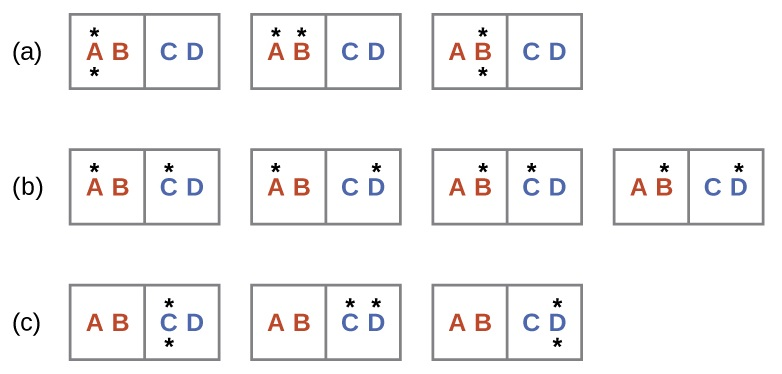
A microstate model for heat flow that compares several macrostates (energy concentrated vs. more evenly distributed) and counts the corresponding microstates. The key takeaway is that the more even energy distribution typically has higher multiplicity , making it more probable and therefore associated with higher entropy. This visually links “spreading out” at the microscopic level to the macroscopic direction of spontaneous change. Source
A lower-entropy state is more restricted.
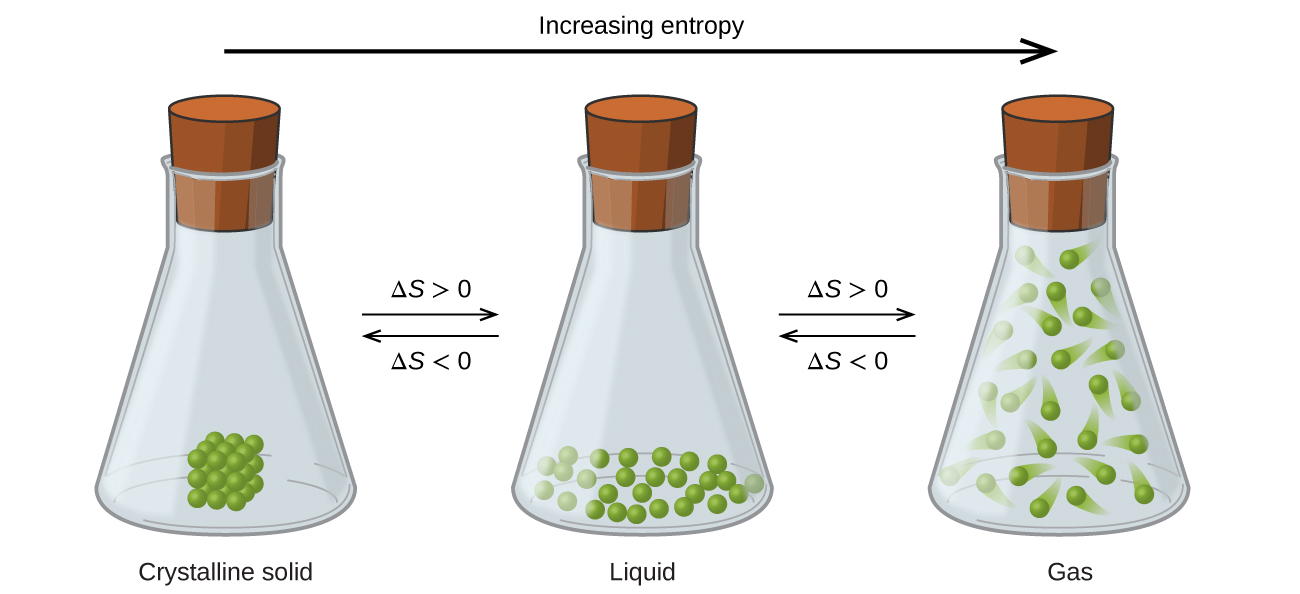
Diagram comparing particle configurations in a crystalline solid, liquid, and gas, with an arrow indicating increasing entropy. It emphasizes that as particles become less constrained in position and motion, the number of accessible microstates increases. This supports the notes’ qualitative claim that higher-entropy states are “less restricted” and realizable in many more microscopic ways. Source
A higher-entropy state is less restricted and can be realized in many more microscopic ways.
This is why equilibrium and maximum entropy go together. The equilibrium state is not important because it is especially neat or especially messy. It is important because it is overwhelmingly the most probable macroscopic state for the isolated system. There are far more ways for energy to be spread out than to stay concentrated in one region or one part of the system.
Why isolated systems move toward equilibrium
A spontaneous process in an isolated system moves toward maximum entropy, not away from it. This does not happen because the system “wants” a higher entropy. It happens because random microscopic motion explores possible arrangements, and the equilibrium macrostate corresponds to vastly more of those arrangements than a non-equilibrium state does.
If energy starts out unevenly distributed, collisions redistribute it. If matter starts out confined to one region, random motion spreads it out.
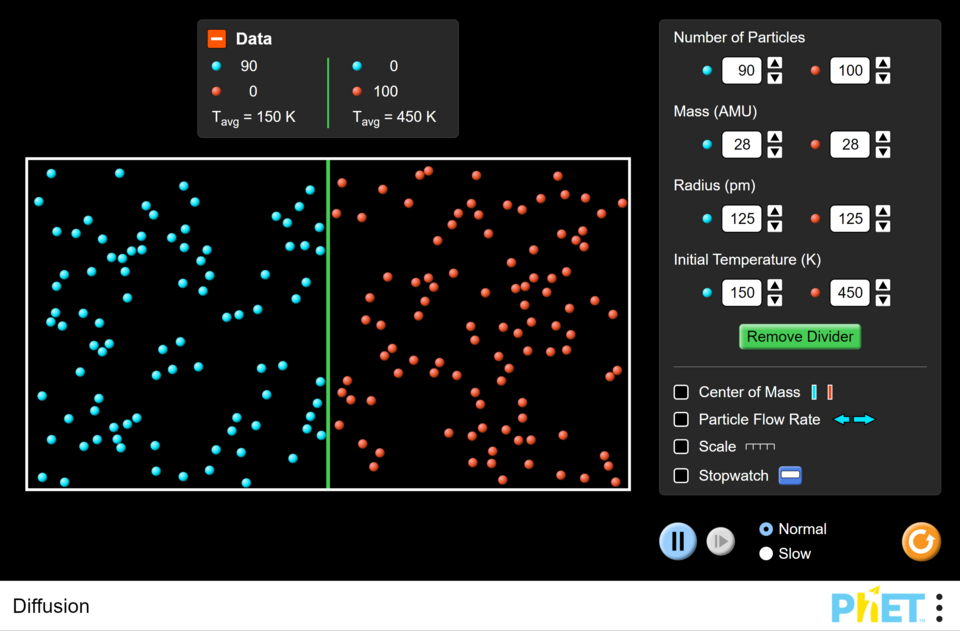
Screenshot of a diffusion simulation showing particles spreading from a region of higher concentration into a more uniform distribution. This is a standard visual model for a spontaneous process: random microscopic motion produces a predictable macroscopic trend toward equilibrium. The “mixed” state corresponds to vastly more accessible microstates than the “separated” state, so it aligns with maximum entropy for the given constraints. Source
In each case, the isolated system moves toward the state with the greatest entropy available under its constraints.
This is the key link required by the syllabus: maximum entropy occurs when the system is in thermodynamic equilibrium, and isolated systems spontaneously move toward that equilibrium. The two ideas are not separate. They describe the same final state from two viewpoints:
equilibrium describes the absence of further net macroscopic change
maximum entropy describes the statistical character of that same state
What “maximum” means in context
The word maximum does not mean “largest imaginable under all circumstances.” It means the largest entropy possible for that particular isolated system while its constraints remain fixed.
This matters because equilibrium always depends on what is allowed. The system cannot evolve into a state that violates conservation laws or the physical limits placed on it. Instead, it moves toward the most probable state consistent with those limits.
So, when physicists say entropy is maximum at equilibrium, they mean maximum for the given isolated system and its constraints. That is why equilibrium is a precise thermodynamic idea, not just a vague sense of “balance.”
Dynamic equilibrium and stability
Thermodynamic equilibrium is dynamic at the microscopic level. Particles still have kinetic energy. Collisions continue. Individual particles keep changing position and speed. What disappears is the net large-scale trend.
At equilibrium:
macroscopic properties stay constant
no spontaneous macroscopic direction of change remains
entropy is already at its maximum value for the isolated system
small microscopic fluctuations do not create a lasting overall change
This helps explain why equilibrium is stable. A temporary fluctuation can occur, but the system remains overwhelmingly likely to stay near the equilibrium state because that state corresponds to so many possible microscopic arrangements.
Recognizing the idea in AP Physics 2 situations
For this subsubtopic, the most important reasoning is qualitative. If a problem describes an isolated system that is not in equilibrium, the spontaneous direction of change is always toward thermodynamic equilibrium and therefore toward maximum entropy.
Useful clues include:
energy initially concentrated in one part of the system
matter initially confined or unevenly distributed
any state that appears highly restricted compared with a more spread-out alternative
In each case, the equilibrium state is the one with no further spontaneous macroscopic change and with entropy at its maximum for the isolated system.
Practice Questions
An isolated gas is initially confined to one side of a container, while the other side is empty. A barrier is removed.
(a) State the spontaneous direction of change. (1 mark)
(b) Explain why this change is associated with entropy and equilibrium. (1 mark)
(a) The gas spreads to fill the available volume / moves toward an equilibrium state. (1)
(b) The spread-out state has higher entropy because it corresponds to more possible microscopic arrangements, and the equilibrium state is the maximum-entropy state for the isolated system. (1)
A well-insulated box contains two objects at different temperatures. The objects are placed in thermal contact and left for a long time.
Explain, in terms of entropy and thermodynamic equilibrium, why the system changes as it does. Your answer should include the direction of spontaneous energy transfer, why the final state is more probable, what is true about entropy at equilibrium, whether microscopic motion stops, and why there is no further net macroscopic change.
Energy is transferred from the higher-temperature object to the lower-temperature object. (1)
The final state is more probable because energy is more spread out / there are more possible microscopic arrangements. (1)
The equilibrium state has maximum entropy for the isolated system. (1)
Microscopic motion does not stop; particles still move and collide. (1)
There is no further net macroscopic change because the system has reached thermodynamic equilibrium. (1)
FAQ
Yes. Entropy must be tracked for the entire isolated system, not just one region.
A local decrease can happen if a larger increase occurs elsewhere. The total entropy still increases if the combined change for the isolated system is positive.
A metastable state is a long-lasting state that is not the highest-entropy state but is separated from it by a barrier.
It can appear stable for a long time, yet a disturbance can move it to the true equilibrium state. True thermodynamic equilibrium is the maximum-entropy state allowed by the constraints.
A reverse change is not absolutely impossible at the microscopic level, but it is extraordinarily improbable.
Macroscopic systems contain huge numbers of particles, so the equilibrium state corresponds to an overwhelming majority of possible microscopic arrangements. A large reverse fluctuation is therefore effectively never observed in ordinary life.
In very small systems, random changes involve a larger fraction of the total number of particles or total energy.
As a result:
measurable properties can wander more noticeably
short-lived departures from average equilibrium values are more common
equilibrium is still meaningful, but the fluctuations are easier to detect
Yes. Maximum entropy does not mean that every equilibrium state must look completely uniform.
The final state depends on the system’s constraints and interactions. If those conditions allow stable boundaries, phases, or other structure, the highest-entropy state may still include them. The key idea is that it is the most probable state available under the actual physical conditions.

