

AP Syllabus focus: 'The chosen reference frame determines the direction and magnitude of quantities measured by an observer.'
Choosing a reference frame is the first decision in any kinematics problem. It sets how positions and motions are described, so clear frame choices prevent sign errors and ambiguous physical interpretations.
What a Reference Frame Does
When physicists describe motion, they do not begin by writing equations. They first decide how an observer will measure location and direction. That choice is the reference frame.
Reference frame: A chosen system consisting of an observer, an origin, coordinate directions, and a way to assign positions and times to events.
Measurements in a frame are attached to an observer, even when the observer is represented by a sensor, camera, or lab setup rather than a person.
Observer: The person or instrument that records positions, directions, and times within a chosen reference frame.
A reference frame tells you where zero is, which way is positive, and how to label motion as forward, backward, upward, or downward.
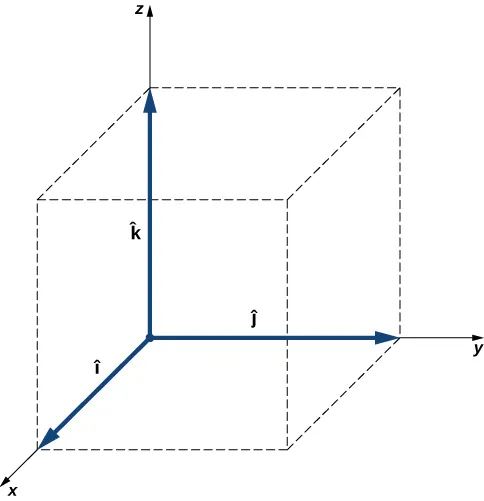
A three-dimensional Cartesian coordinate system is drawn with labeled unit vectors along each axis, making the frame’s orientation explicit. This kind of figure helps students separate the physical motion from the bookkeeping choice of axes and positive directions in the reference frame. Source
Without that information, a statement like “the object moved 4 meters” is incomplete. A coordinate value only has meaning relative to an origin and a chosen direction. The same event may be labelled with different coordinates by different observers, and neither description is automatically privileged.
Why the Choice Matters
The same physical motion can receive different numerical descriptions in different frames.
If one observer chooses right as positive, a cart moving right has a positive velocity. If another observer chooses left as positive, the same cart has a negative velocity. The cart has not changed its behavior; only the description has changed.
The magnitude of a measured quantity can also depend on the frame. Position is the clearest example. An object may be reported at one coordinate in one frame and at a very different coordinate in another because the observers chose different origins. Each value can be correct within its own frame. What matters is internal consistency between the frame choice and the quantities reported. This is why a physics answer should name the frame, not only the number.
Even the judgment of whether an object is “at rest” depends on the observer. A passenger seated on a train may describe another passenger as stationary, while a person standing beside the track describes that passenger as moving. This does not create a contradiction. It shows that motion is always described relative to a frame.
Elements of a Useful Reference Frame
A good frame is not random. It is chosen to make the physics easy to interpret. A convenient frame often makes graphs easier to read and algebra shorter.
Choose an Origin
The origin is the point where position is defined to be zero. A smart origin often simplifies a problem:
the starting point of an object
the launch point
the floor or ground
the center of a track or system
Choosing an origin does not alter the motion. It only changes the coordinate labels attached to the motion. Two students may draw the same motion perfectly but assign different position values because they placed zero in different locations.
Choose Positive Directions
In one-dimensional motion, defining a positive direction is essential. Common choices are:
right as positive for horizontal motion
up as positive for vertical motion
down as positive in some gravity-based problems
Any of these choices can work. The key rule is to keep the choice consistent. Once positive is defined, signs on position, displacement, velocity, and acceleration must follow that definition.
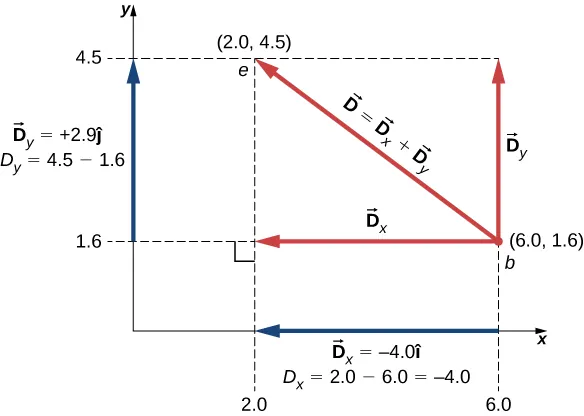
A displacement vector is shown on an – coordinate system and decomposed into orthogonal components, including a negative -component when the displacement points opposite the direction. The diagram visually connects sign conventions to the chosen axes, emphasizing that component signs encode direction relative to the reference frame. Source
A negative sign does not mean “wrong” or “smaller”; it means the quantity points in the direction opposite the chosen positive axis.
Match the Frame to the Situation
In more complicated motion, axes are often aligned with the geometry of the setup. If motion occurs mainly along a ramp, track, or straight path, the frame is usually chosen so one axis lies along that direction. This reduces unnecessary sign changes and makes the physical interpretation cleaner.
A poorly chosen frame does not make the physics impossible, but it can hide simple patterns. A well-chosen frame makes the important direction in the problem obvious from the start.
What a Sign Actually Tells You
Students often treat a negative sign as meaning “slowing down” or “small,” but in kinematics a sign usually says something about direction in the chosen frame. A negative position means the object lies on the negative side of the origin. A negative velocity means the object moves in the negative coordinate direction. A negative acceleration means the acceleration vector points in the negative direction chosen for that axis.
Because signs come from the frame, changing the frame can change the sign of a quantity without changing the motion itself. This is why a sign should never be interpreted without first identifying the reference frame. Positive and negative signs do not, by themselves, tell you whether velocity and acceleration point in the same or opposite directions; that interpretation still depends on the frame definition.
The most common mistake is mixing two frame choices in one solution. For example, a student may draw upward as positive but later treat downward quantities as positive when substituting values. The mathematics then appears inconsistent because the frame was not used consistently.
Good Frame-Choice Habits
Before solving a mechanics problem, explicitly state the frame. Useful habits include:
identify the observer or laboratory viewpoint
mark the origin on a sketch
label the positive direction on each axis
keep that choice unchanged unless you clearly announce a new frame
check whether the signs in your final answers match your original axis choices
On diagrams, writing a small arrow with “positive” beside it is often enough to prevent later mistakes. A well-chosen reference frame does not change the underlying physics, but it strongly affects how clearly the physics is communicated. In AP Physics C Mechanics, many later errors in graphs, equations, and interpretations begin with a frame that was never clearly defined.
Practice Questions
A student defines right as positive. A cart moves left at 4.0 m/s. State the sign of the cart’s velocity in this reference frame and explain what that sign means.
1 mark: States that the velocity is negative, or gives -4.0 m/s.
1 mark: Explains that the negative sign means the cart moves opposite to the chosen positive direction.
A roof is 20 m above the ground. A ball is falling straight downward. At a certain instant, the ball is 12 m below the roof and moving downward at 8.0 m/s.
Observer L chooses the ground as the origin and upward as positive.
Observer R chooses the roof as the origin and downward as positive.
(a) State the ball’s position and velocity as measured by Observer L.
(b) State the ball’s position and velocity as measured by Observer R.
(c) Explain why the two observers obtain different coordinate values even though they describe the same physical motion.
1 mark: Position for Observer L is +8 m.
1 mark: Velocity for Observer L is -8.0 m/s.
1 mark: Position for Observer R is +12 m.
1 mark: Velocity for Observer R is +8.0 m/s.
1 mark: Explains that different origins produce different position coordinates.
1 mark: Explains that different positive directions produce different velocity signs, while the physical motion remains the same.
FAQ
The centre of mass can be a very convenient origin when several objects move together or interact strongly.
It often makes the motion of the whole system easier to describe, especially when the system has symmetry. Even if individual parts move in complicated ways, coordinates measured from the centre of mass can reveal simpler patterns.
Yes. The origin is an arbitrary reference point, not a special physical location.
For example, you might place the origin at a wall, at the middle of a field, or even outside the region of motion entirely. This is perfectly acceptable as long as all coordinates are measured consistently from that chosen point.
Yes. If they choose different axis directions, they can assign different coordinate components to the same motion.
For instance, in two dimensions, one observer may align axes with the room, while another rotates the axes to match a slope. The physical path is unchanged, but the numerical components along each axis can differ.
Video analysis software creates a frame when you set:
a scale
an origin
axis directions
If the axes are tilted or the scale is poorly set, the measured coordinates will reflect that choice. This is why careful calibration matters: the software is only reporting motion within the frame you told it to use.
A convenient frame usually does at least one of these:
makes a key direction line up with an axis
reduces the number of negative signs
places zero at a meaningful location
matches how data are actually measured
There is not always a single “correct” frame, but there is often a frame that makes the mathematics and interpretation much clearer.
