

AP Syllabus focus: 'Velocity and acceleration can differ from one dimension to another and may be nonuniform.'
In multidimensional motion, the key idea is that each coordinate direction can have its own velocity and acceleration behavior. Careful use of components reveals motion that cannot be described by a single number.
Velocity and Acceleration as Vector Quantities
In two- or three-dimensional motion, velocity and acceleration must be treated as vectors. A single value is not enough, because an object can move differently along each coordinate axis. It may speed up in one direction, slow down in another, or have zero motion along one axis while still moving overall.
When physicists analyze multidimensional motion, they usually describe each vector with components along chosen axes.
Component: The part of a vector that lies along a particular coordinate direction, such as the -, -, or -direction.
A component-based description is useful because it shows that motion in space is built from several simultaneous directional behaviors, not from one combined scalar change.
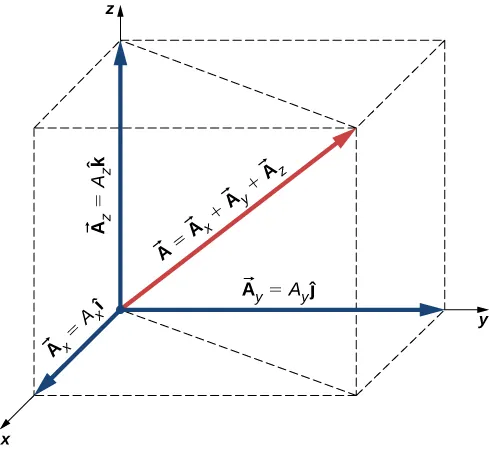
A 3D vector shown as the vector sum of its , , and components in a Cartesian coordinate system, with the component vectors aligned to the axes. This supports interpreting (and similarly for ) as a geometric decomposition, not just an algebraic expression. Source
= velocity vector
= velocity components along the coordinate axes
= unit vectors in the coordinate directions
= acceleration vector
= acceleration components along the coordinate axes
Why separate components matter
The values of , , and do not have to be equal, and they do not have to change in the same way. The same is true for , , and . For example:
an object can have a positive horizontal velocity and a negative vertical velocity at the same instant
one acceleration component can be zero while another is nonzero
one component can remain constant while another varies with time
These possibilities mean that motion in multiple dimensions is often more complex than motion along a straight line.
Different Dimensions Can Behave Differently
A key AP Physics C idea is that each dimension may have its own kinematic behavior. There is no requirement that the -direction and -direction share the same velocity pattern or the same acceleration pattern.
Suppose an object moves so that its horizontal velocity remains steady while its vertical velocity changes.
Then the acceleration is not the same in both dimensions. Likewise, if the horizontal acceleration changes with time but the vertical acceleration stays constant, the two dimensions are again behaving differently.
This is why statements such as “the acceleration is increasing” or “the velocity is constant” can be incomplete unless the direction is identified. In multidimensional motion, it is often more accurate to talk about velocity components and acceleration components.
Nonuniform motion: Motion in which a relevant quantity, such as a velocity component or acceleration component, changes with time.
Nonuniform behavior can occur in either velocity, acceleration, or both. A component is nonuniform whenever it does not remain constant over time.
Time Dependence of Components
To describe how motion changes, physics connects position, velocity, and acceleration separately for each coordinate.
= x-component of velocity
= x-coordinate of position
= y-component of velocity
= y-coordinate of position
= x-component of acceleration
= y-component of acceleration
These relationships show that a change in one component of position produces the corresponding component of velocity, and a change in one component of velocity produces the corresponding component of acceleration. Because each coordinate has its own function of time, the rates of change can be different from one dimension to another.
Uniform and nonuniform component behavior
A component of velocity is uniform if it stays constant. A component of acceleration is uniform if it stays constant. In many realistic situations:
one velocity component is constant while another is changing
one acceleration component is constant while another is changing
both components vary, but at different rates
the signs of the components can change during the motion
A changing sign is especially important. If changes from positive to negative, the object has reversed its direction along the -axis, even if its overall motion in the plane continues smoothly.
Interpreting Multidimensional Motion
The full motion of an object comes from combining all of its components at the same instant. Two objects can have the same speed but different component velocities, and two objects can have the same acceleration magnitude but different acceleration components. Looking only at magnitude can therefore hide essential directional information.
For AP Physics C, it is important to distinguish between speed, which is a scalar, and velocity, which is a vector. An object’s speed may increase, decrease, or remain constant depending on how the velocity vector changes relative to the acceleration vector. In more than one dimension, that comparison is often impossible to see unless the motion is expressed through components.
Common interpretive pitfalls
Zero in one dimension does not mean zero overall. If , the object may still be moving in the -direction.
Equal magnitudes do not imply identical motion. The pair represents a different velocity from .
A nonzero acceleration does not always mean the object is speeding up. It may instead be changing direction, or some components may increase while others decrease.
Different dimensions can have different mathematical forms. One component might be constant, another linear in time, and another quadratic in time.
What to Focus on in Problems
When reading or solving a multidimensional kinematics problem, identify the motion along each coordinate direction before thinking about the full vector behavior. Pay attention to:
the sign of each velocity component
whether each acceleration component is zero, constant, or time-dependent
whether different dimensions are described by different equations
whether the behavior is uniform or nonuniform in each direction
This component viewpoint is the central tool for understanding why velocity and acceleration in multiple dimensions can differ and why their behavior may be nonuniform.
FAQ
No. The physical motion does not change; only its numerical components change.
If you rotate the axes, the same vector is resolved differently. A component that was constant in one coordinate system may no longer look constant in the new one, even though the object’s actual motion is unchanged.
Yes. Constant speed only means the magnitude of velocity stays the same.
In two dimensions, the direction of velocity can still change. That requires acceleration, so one or more acceleration components may be non-zero even though the speed itself does not vary.
It means the object is momentarily not moving along that axis, but it is about to begin moving in that direction or has just stopped moving there.
This often happens at a turning point for one coordinate. For example, $v_y=0$ with $a_y \ne 0$ means the vertical component has an instantaneous pause, not permanent rest.
Yes. In two dimensions, the magnitude is $|\vec{a}|=\sqrt{a_x^2+a_y^2}$.
So if $a_x$ is constant but $a_y$ changes with time, then the overall acceleration magnitude can also change with time. Constant behaviour in one dimension does not guarantee constant overall behaviour.
Acceleration depends on how velocity changes, so it usually comes from taking another derivative or from comparing velocity values over very short intervals.
That makes acceleration more sensitive to measurement noise. In experimental data, small uncertainties in position can produce much larger uncertainty in the calculated acceleration components.
Practice Questions
A particle has m/s, m/s, , and m/s at an instant.
(a) Is the particle moving at that instant?
(b) Is the acceleration zero?
1 mark: States that the particle is moving, because .
1 mark: States that the acceleration is not zero, because .
A particle moves in the plane with and , where and are in meters and is in seconds.
(a) Determine and .
(b) Determine and .
(c) State whether the acceleration is the same in both dimensions, and identify any nonuniform component.
1 mark:
1 mark:
1 mark:
1 mark:
1 mark: States that acceleration is not the same in both dimensions; is constant, while is time-dependent and therefore nonuniform.
