

AP Syllabus focus: 'A change in motion in one dimension does not necessarily cause a change in a perpendicular dimension.'
In multidimensional motion, each perpendicular direction can be analyzed separately. This idea simplifies many mechanics problems by connecting vector motion to familiar one-dimensional kinematics.
Core Idea
In two-dimensional motion, the motion along one axis and the motion along a perpendicular axis are treated as separate component motions. Choosing axes such as and allows you to describe a single moving object with two independent sets of kinematic quantities.
The key idea is independence of perpendicular components.
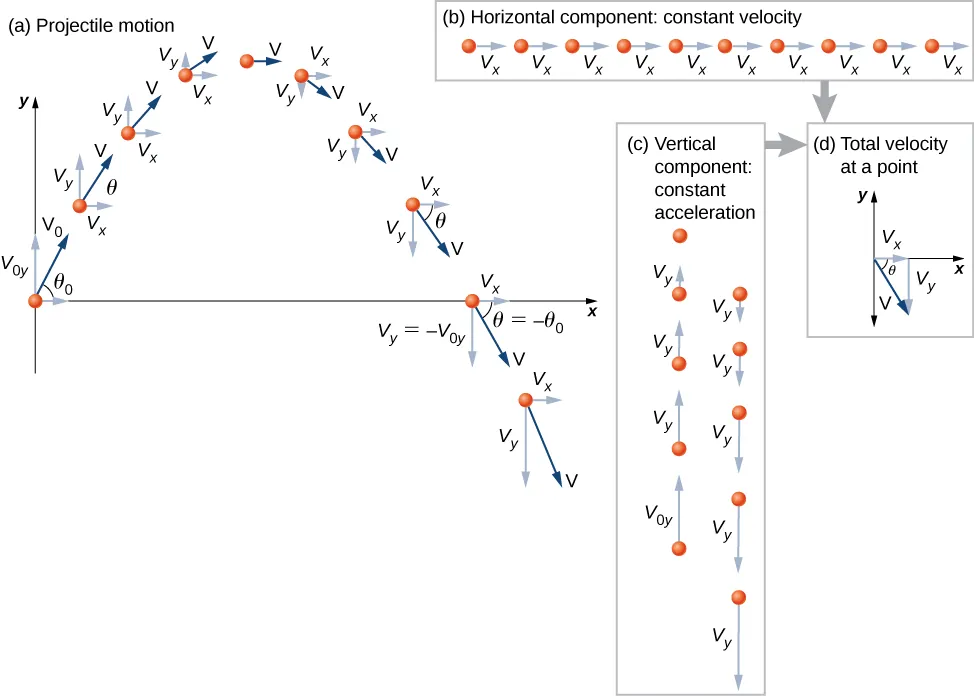
This diagram breaks a single 2D projectile trajectory into two separate 1D descriptions: uniform motion in (constant when ) and uniformly accelerated motion in (changing due to gravity). It also shows how the component velocity vectors recombine to form the instantaneous total velocity tangent to the path. Source
Independence of perpendicular components: In multidimensional motion, a change in one component of motion does not by itself require a change in the component along a perpendicular direction.
This principle is why multidimensional motion can be broken into simpler one-dimensional descriptions. A change in the object's x-component of velocity does not automatically mean its y-component of velocity changes, and vice versa.
What independence means physically
If acceleration acts only in one direction, only the velocity component in that same direction changes.
A perpendicular velocity component can remain constant throughout the motion.
Position in a direction can still change even when acceleration in that direction is zero, because nonzero velocity may already exist.
The overall path can curve even if one component of motion is completely unchanged.
Although the components are analyzed separately, they still belong to the same velocity vector. That means the object's overall speed and overall direction of motion can change when just one component changes. Independence applies to the component equations, not to the visual appearance of the full path.
Component-by-Component Analysis
For perpendicular axes, each coordinate has its own velocity and acceleration relationship.
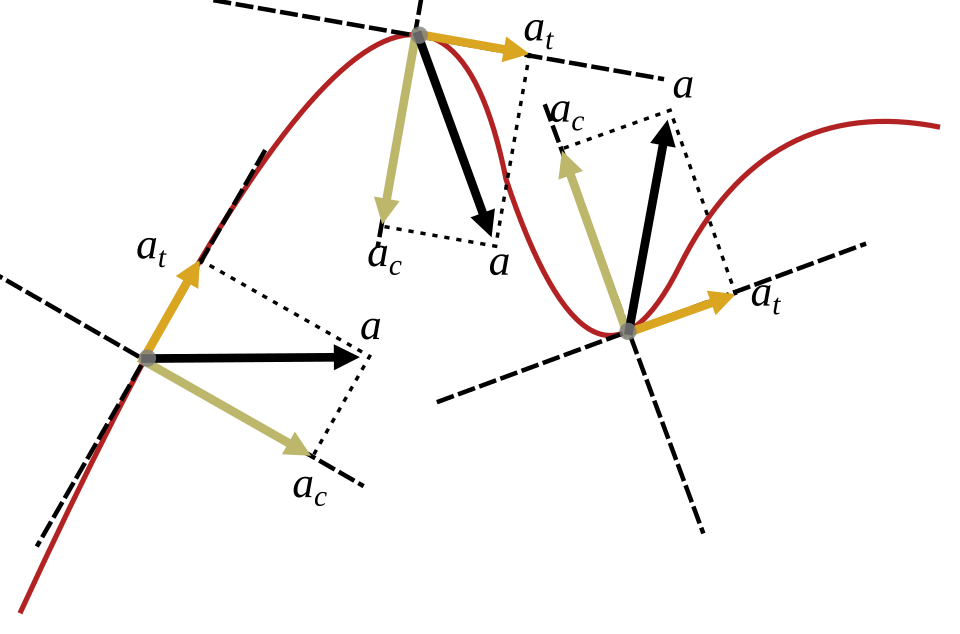
This figure illustrates how a single acceleration vector can be decomposed into perpendicular components along chosen axes, emphasizing that each component is a projection that can be analyzed separately. It reinforces the idea that changes in motion can be discussed component-wise (e.g., affecting and affecting ) even though the object has one overall acceleration vector. Source
The rate of change of depends on alone, and the rate of change of depends on alone.
= acceleration components, in
= velocity components, in
= position coordinates, in
= time, in
These relations show the heart of the subsubtopic: the equations for one direction do not contain the coordinate from the perpendicular direction.
If , then is constant, even if and is changing. If , then is constant, even if the motion in the direction is speeding up, slowing down, or reversing. If both acceleration components are nonzero, each component of motion still evolves according to its own acceleration component.
A common source of confusion is that constant component velocity does not mean constant overall velocity.
An unchanged combined with a changing produces a changing velocity vector. The motion therefore has changing direction even though nothing is happening dynamically in the direction.
What independence does not mean
Independence does not mean the two directions are unrelated in every possible sense. They share the same time variable, and together they determine the object's single trajectory in space. What it means is more specific: the kinematics in one perpendicular direction do not require a change in the other direction.
It also does not mean that a quantity with no change in one component must be zero. Students often incorrectly assume that if there is no acceleration in the direction, then the object cannot move in . In fact, zero acceleration means only that does not change; itself may be nonzero.
Using the Idea in Mechanics Problems
When a problem involves motion in perpendicular directions, treat each axis as its own one-dimensional kinematics problem before interpreting the full motion. A useful approach is:
Choose perpendicular axes that match the geometry of the motion.
Identify the initial velocity component in each axis.
Determine whether acceleration exists in each axis.
Apply kinematics separately in each direction.
Recombine the component results to describe the full motion.
This approach helps prevent sign mistakes and incorrect reasoning. It also makes clear which quantities are actually affected by a given acceleration component and which are not.
Another important point is that independence concerns changes in motion. A nonzero tells you that the -motion changes with time. It says nothing by itself about the -motion. Likewise, a zero tells you that the -velocity stays constant, not that the object has no transverse displacement.
Recognizing Independence in Motion Descriptions
You can often identify this principle from qualitative descriptions alone. If a problem states that an object continues moving uniformly in one direction while its motion changes in a perpendicular direction, the unchanged part of the motion is evidence of zero acceleration in that axis. The changing part identifies the axis where acceleration is present.
This is especially important when interpreting curved motion. A curved path does not necessarily imply acceleration in every direction. The curvature may arise because one velocity component is changing while the perpendicular component remains fixed. In the same way, the path may become steeper or flatter even though only one component of acceleration is acting.
Common Reasoning Errors
Assuming that if one component changes, the perpendicular component must also change.
Confusing zero acceleration with zero velocity in a direction.
Forgetting that the total velocity vector can change direction even when one component stays constant.
Treating the full motion as one inseparable quantity instead of two perpendicular component motions.
FAQ
Yes, but only if the axes are fixed and perpendicular in an inertial frame.
If you rotate from one Cartesian set of perpendicular axes to another, the numerical values of the components change, but the independence idea still holds. If the axes are not perpendicular, or if they rotate with time, the equations can become coupled and the simple separation is less direct.
The object does not stop unless all velocity components are zero at that instant.
If, for example, $v_y=0$ while $v_x\neq 0$, the motion at that moment is entirely along the $x$ direction. After that instant, the object may continue in the same transverse direction or reverse, depending on the sign of $a_y$.
They can. A constraint can create forces that change which directions are physically useful for analysis.
In some situations, $x$ and $y$ components are still independent. In others, coordinates along and perpendicular to the constraint are more natural. The principle remains valid, but the best axes may no longer be the standard horizontal and vertical ones.
Yes. They share the same time variable, but they do not need the same mathematical form.
One component might be constant, another might vary linearly with time, and another could vary quadratically. Independence means each component follows its own kinematic behaviour based on its own acceleration component.
Yes. In Cartesian coordinates, the same reasoning applies to $x$, $y$, and $z$.
A change in the $x$ component of motion does not by itself require a change in either the $y$ or $z$ component. Each component is analysed separately, and the full three-dimensional motion is then reconstructed from those three independent descriptions.
Practice Questions
A particle moves in the plane with and . At one instant, both and are positive. State which velocity component remains constant and state whether the direction of motion can still change.
1 mark for stating that remains constant.
1 mark for stating that the direction of motion can still change because changes while does not.
A particle has initial velocity components and . Its acceleration components are and .
(a) Find after .
(b) Find after .
(c) Find the particle's speed at .
(d) State whether the speed is increasing or decreasing at that instant.
(e) Explain, using independence of perpendicular components, why the motion is unaffected by the nonzero -acceleration.
1 mark for
1 mark for
1 mark for speed
1 mark for stating that the speed is decreasing
1 mark for explaining that acceleration in the direction changes only the component of motion, so the component remains unchanged because
