

AP Syllabus focus: 'Projectile motion is two-dimensional motion with zero acceleration in one dimension and constant nonzero acceleration in the other.'
Projectile motion is one of the most important motion models in mechanics because it combines two simultaneous one-dimensional motions into a single curved path governed by a simple acceleration pattern.
Understanding Projectile Motion
A projectile is an object that, after being launched, moves under the influence of an acceleration that acts in only one direction. In the usual AP Physics C Mechanics treatment, that acceleration is constant and downward, so the motion is described using a horizontal direction and a vertical direction.
Projectile motion: Two-dimensional motion in which acceleration is zero in one direction and constant and nonzero in the perpendicular direction.
The key idea is that the two directions are analyzed separately. The projectile has no acceleration along one axis, so its velocity in that axis stays constant. At the same time, it has a constant acceleration along the perpendicular axis, so its velocity in that axis changes steadily with time. The full trajectory is the combination of these two simpler motions.
Separating the Two Directions
Choosing perpendicular axes makes the physics much easier to see. If the horizontal axis is called and the vertical axis is called , the projectile’s acceleration is described by one zero component and one constant component.
= horizontal acceleration in
= vertical acceleration in
= magnitude of the constant downward acceleration in
These acceleration statements control everything else about the motion.
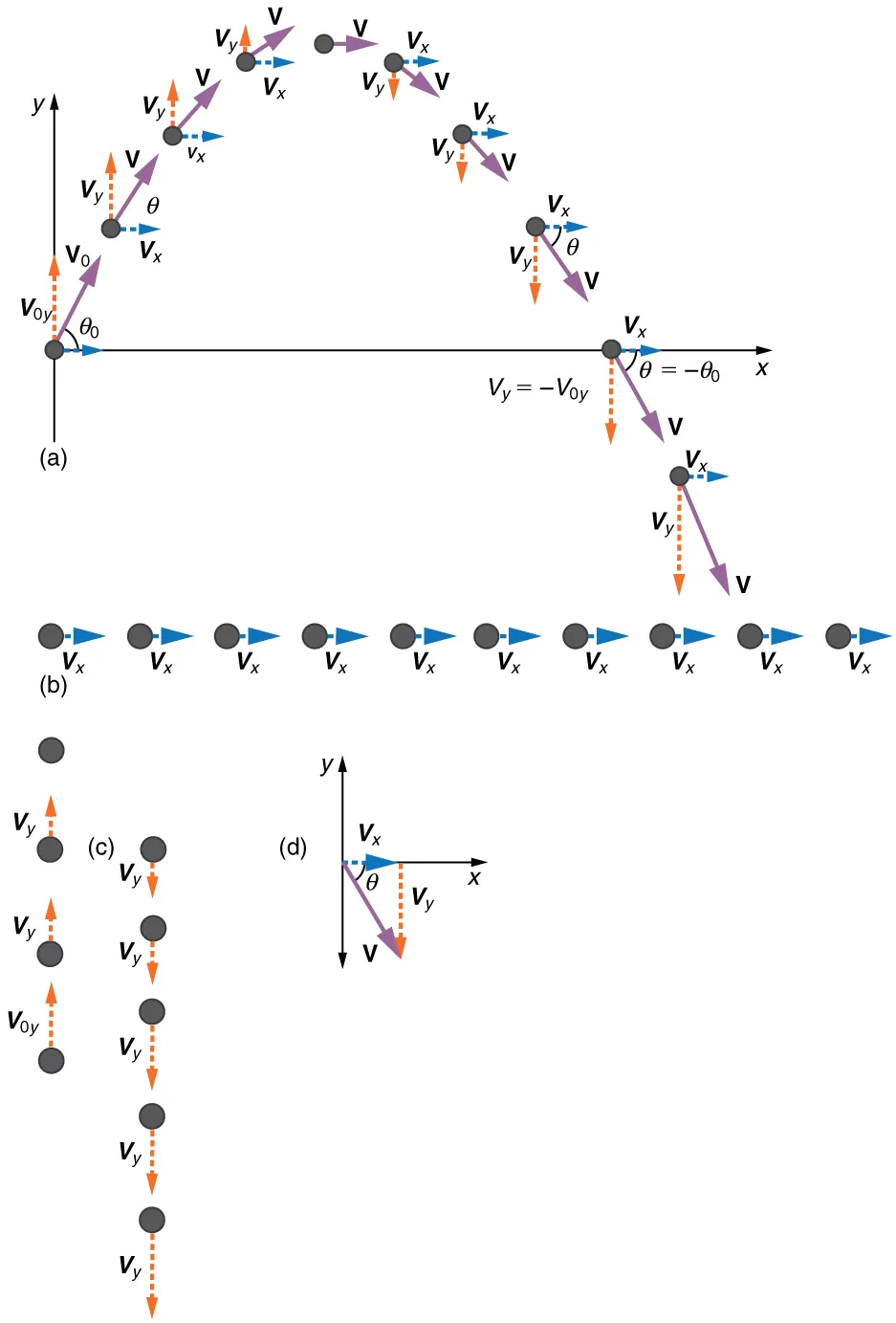
A multi-panel projectile-motion diagram showing the parabolic trajectory together with the velocity vector decomposed into components at several points. It highlights that remains constant while changes due to the constant downward acceleration, including the instant at the highest point where . Source
Since , the horizontal velocity does not change. Since , the vertical velocity changes linearly with time. This is why a projectile does not move in a straight line even when its horizontal motion is uniform.
If the projectile is launched with initial speed at angle above the horizontal, its initial velocity can be split into components: and . Those component values are then treated independently in the two directions.
Motion Along Each Axis
The horizontal and vertical positions come from applying the correct kinematic model to each axis. The horizontal direction uses constant velocity, while the vertical direction uses constant acceleration.
= horizontal velocity at time in
= initial horizontal velocity in
= horizontal position at time in
= initial horizontal position in
= elapsed time in
= vertical velocity at time in
= initial vertical velocity in
= vertical position at time in
= initial vertical position in
These relations show why projectile motion is a special case of two-dimensional kinematics. One direction is especially simple because there is no acceleration at all. The other direction follows the familiar constant-acceleration form. A single time variable connects both directions, allowing horizontal and vertical information to be combined.
Shape of the Path
Because changes linearly with time and changes quadratically with time, the projectile’s path is a parabola when the acceleration is uniform and air resistance is neglected.
The curvature comes entirely from the accelerated direction, not from any horizontal force continuing to push the object forward.
This matters conceptually. Students sometimes think the projectile “runs out of horizontal motion” as it rises. That is incorrect. The rising or falling behavior is controlled by the vertical component of velocity, while the horizontal component remains constant throughout the idealized motion.
Important Features of Projectile Motion
Several physical features follow directly from the component model.
At the highest point, the vertical velocity is zero for an instant, but the vertical acceleration is still nonzero.
The horizontal velocity is the same at launch, at the highest point, and just before landing, as long as air resistance is ignored.
If launch and landing occur at the same vertical height, the upward and downward parts of the motion are symmetric in time and speed.
If launch and landing heights are different, that symmetry is no longer complete, even though the acceleration pattern is unchanged.
What the Zero and Nonzero Accelerations Mean
A zero acceleration in one dimension does not mean the object has no motion in that direction. It means the velocity in that direction stays constant. Likewise, constant nonzero acceleration in the other dimension does not mean the object always moves downward; it means the vertical velocity changes steadily, possibly from upward to downward.
This distinction is essential on AP problems. A projectile can move upward while its acceleration points downward. It can also move forward horizontally while having no horizontal acceleration. The direction of velocity and the direction of acceleration do not have to match.
Common Reasoning Pitfalls
Projectile motion questions often test whether you can keep the two axes conceptually separate.
Do not combine horizontal and vertical quantities in one one-dimensional equation.
Do not assume the speed is constant just because one component of velocity is constant.
Do not set acceleration equal to zero at the top of the path; only the vertical velocity becomes zero there.
Do not assume equal horizontal and vertical displacements; the two directions obey different kinematic rules.
Do use the same time interval for both axes, because the projectile is undergoing both motions simultaneously.
When solving or interpreting projectile motion, start by identifying which direction has zero acceleration and which has constant nonzero acceleration. That structure determines the entire motion and is the defining feature of the model.
FAQ
The result $45^\circ$ comes from the equal-height case, where launch and landing occur at the same vertical level and air resistance is neglected.
If the projectile lands lower than it started, a smaller angle can give a greater range because the object already has extra time to travel forwards.
If it lands higher than it started, a larger angle may be better because more upward speed is needed to stay in the air long enough.
Yes, in the ideal equal-height case.
For a fixed launch speed, the range depends on $\sin 2\theta$. That means angles such as $30^\circ$ and $60^\circ$ produce the same range because they have the same value of $\sin 2\theta$.
However, their motions are not identical:
the steeper launch has a longer time in the air
the flatter launch has a greater horizontal speed
the maximum height is different
This pairing does not generally hold when launch and landing heights differ.
A parabola appears only when the acceleration is constant in one direction and zero in the other.
With air resistance, the drag force depends on the projectile’s velocity. That means:
the horizontal acceleration is no longer zero
the vertical acceleration is no longer constant
both acceleration components can change during flight
As a result, the position is no longer a simple linear function in one direction and quadratic in the other, so the trajectory is not exactly parabolic.
The acceleration can still be constant, but the geometry changes.
If the projectile lands below its launch point, it spends more time descending than ascending. If it lands above its launch point, the opposite is true. The upward and downward parts no longer mirror each other in time or in vertical displacement.
What remains unchanged is the acceleration model itself: zero in one dimension and constant nonzero in the other.
In the ideal model, if a projectile could be given exactly the opposite velocity at any point on its path, it would retrace the same curve backwards.
This happens because the acceleration is fixed and depends only on direction, not on the object’s speed. The equations of motion therefore allow the same path to be followed in reverse.
In real life, air resistance spoils this reversibility, because the drag force changes direction when the velocity reverses.
Practice Questions
A ball is launched horizontally from the edge of a table. Ignore air resistance. State the horizontal and vertical accelerations immediately after the ball leaves the table.
1 mark for stating
1 mark for stating or “downward with constant magnitude ”
A projectile is launched from ground level with initial speed at angle above the horizontal. Ignore air resistance.
(a) Derive an expression for the total time of flight.
(b) Derive an expression for the horizontal range.
(c) State the vertical velocity at the highest point.
1 mark for resolving the initial vertical velocity as
1 mark for using to obtain
1 mark for stating the total time of flight as
1 mark for using with
1 mark for obtaining and for stating in part (c) that
