

AP Syllabus focus: 'Forces between objects inside the same system are internal forces. These internal forces do not affect the motion of the system's center of mass.'
When several objects interact, their internal pushes and pulls can strongly change the motion of individual parts, but the translational motion of the entire system depends only on forces exerted from outside.
Internal forces within a system
In mechanics, internal forces are forces between objects that are all included inside the chosen system boundary.
Internal force: A force exerted by one part of a system on another part of the same system.
This idea depends completely on how the system is defined. If two interacting objects are both inside the system, their interaction is internal. If one object is outside the system, that same interaction becomes external to the chosen system.
Internal forces matter greatly for the behavior of the parts of a system. They can stretch, compress, separate, or accelerate individual objects inside the system. However, when the system is treated as a single whole, internal forces do not change its overall translational motion.
This happens because internal forces occur in equal-and-opposite interaction pairs. One object pushes or pulls on another, and the second object pushes or pulls back on the first. When every object in the interaction is included in the system, both members of each pair are included too. In the total force sum for the whole system, those paired forces cancel.
That cancellation does not mean internal forces are weak or irrelevant. It means their effects are confined to the motion of parts relative to one another, not to the motion of the system as a whole through space.
Center-of-mass motion
The center of mass is the point that represents the average location of a system's mass for translational analysis.
Center of mass: The point whose motion describes the translational motion of the entire system.
The center of mass is especially useful when different parts of a system move in complicated ways.
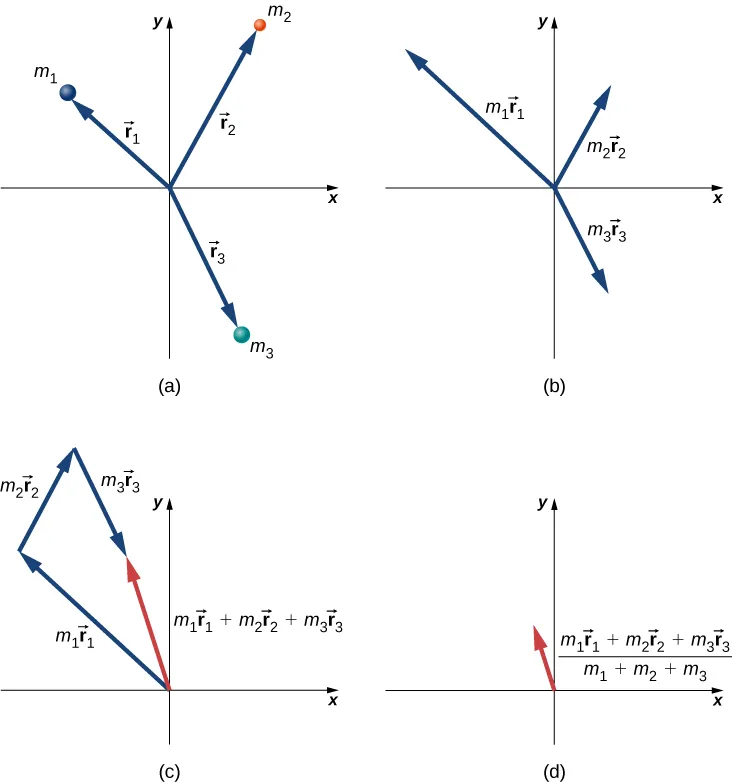
This OpenStax figure shows a step-by-step geometric construction of the center-of-mass position vector for multiple particles. It visualizes the mass-weighted sum and the final normalization by total mass to obtain , clarifying what “average location of the system’s mass” means. Source
Even if individual objects speed up, slow down, or move in opposite directions, the center of mass follows a simpler rule: it responds only to the net external force on the system.
This means internal rearrangements cannot by themselves accelerate the center of mass. The objects inside the system may move relative to one another, but those internal interactions cannot change the motion of the system's center of mass. As a result, the center of mass can remain at rest or continue with constant velocity even while the system's internal structure changes.
A useful way to think about this is to separate two questions:
How do the parts move relative to each other?
How does the system as a whole move?
Internal forces answer the first question. External forces determine the second.
The governing equation
For translational motion of a system as a whole, Newton's second law is written in terms of the center of mass and the net external force.
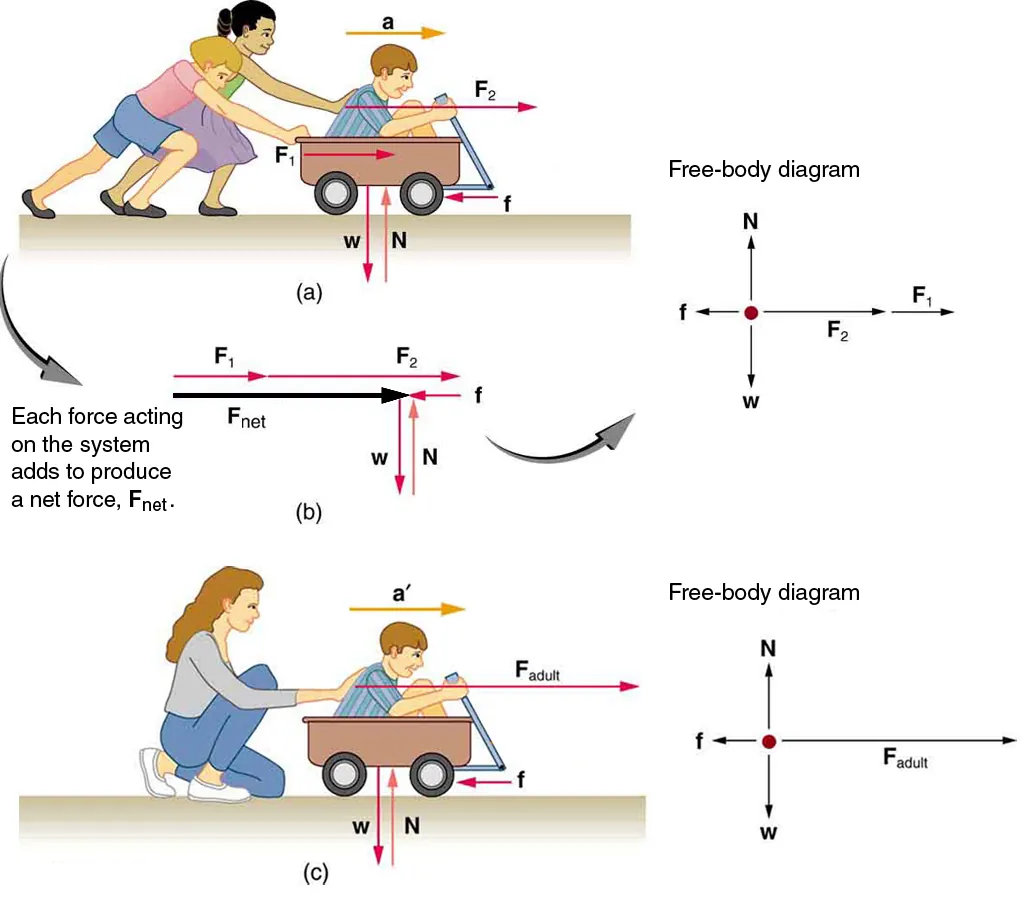
OpenStax’s system free-body diagram uses a dot for the system’s center of mass and shows only the external forces acting on the chosen system. This is the diagrammatic counterpart of writing for the whole system, where internal interaction forces are not included in the net-force sum. Source
= net external force on the system, N
= total mass of the system, kg
= acceleration of the center of mass, m/s^2
Notice that internal forces do not appear in this equation for the whole system.
They may be large and important for the motion of individual parts, but they cancel when all parts of the system are included in the analysis.
A key consequence follows immediately. If the net external force is zero, then the acceleration of the center of mass is zero. The center of mass then stays at rest or moves with constant velocity. Internal interactions can still occur, but they cannot change that center-of-mass motion.
What internal forces can still change
Saying that internal forces do not affect center-of-mass motion does not mean they have no physical consequences. It means their consequences are internal to the system rather than translational for the system as a whole.
Internal forces can:
change the speeds of individual objects within the system
change distances between objects
change the shape or configuration of the system
redistribute motion among different parts of the system
Internal forces cannot:
create a net force on the whole system
produce acceleration of the system's center of mass by themselves
change the velocity of the center of mass without help from an external force
This distinction is essential in AP Physics C. A system may look very active internally, yet its center of mass may still move in a perfectly simple way.
Choosing the correct system
Whether a force is internal or external depends on the chosen system boundary, so careful system selection is necessary before writing equations.
If you analyze only one object from a larger interacting group, the forces from the other objects are external to that one-object system. If you analyze the entire interacting group together, those same forces become internal and are excluded from the net-force equation for the whole system.
The classification of a force therefore depends on the model, not just on the physical situation. A force is not automatically internal or external by nature. It is internal only when both interacting objects are inside the selected system.
Common misunderstandings
A frequent mistake is to think that internal forces “cancel” on each object. They do not. Internal forces cancel only when forces on all parts of the system are added together.
Another common mistake is to assume that if the center of mass does not accelerate, then nothing inside the system can accelerate. In fact, individual parts can have large accelerations, as long as the internal forces balance in the total system analysis.
Finally, remember that center-of-mass motion is about the system's overall translation. Internal forces may change how the mass moves around inside the system, but they do not determine how the center of mass moves through space.
FAQ
Equal and opposite forces do not imply equal accelerations.
Each object obeys Newton’s second law individually, so its acceleration depends on both the force and its mass. Two objects can feel forces of equal magnitude but have different accelerations if their masses differ. That is why internal forces can strongly change the relative motion inside a system while still leaving the system’s centre of mass unaffected.
Yes. Internal forces cannot change the translational motion of the centre of mass, but they can change how parts of the system move around that point.
For example:
they can make parts spin faster or slower relative to one another
they can change the shape of the system
they can redistribute angular motion within the system
So “no effect on centre-of-mass motion” does not mean “no effect on all motion”.
In recoil or explosion situations, parts of a system fly apart because of internal forces.
If external forces are negligible during the interaction, the centre of mass continues along the same motion it had before the event. The dramatic motion of the fragments comes from internal forces changing the motion of the parts relative to one another, not from any new force on the whole system.
Yes. The centre of mass is a mathematical point, not necessarily a point made of material.
For some systems, especially curved or hollow ones, the centre of mass can lie in empty space. The same rule still applies: the motion of that point is determined by the net external force on the system. Internal forces still do not alter its motion.
Yes, provided the system is defined so that both members of each interaction pair remain inside it.
The forces may vary from moment to moment, but at each instant the internal interaction still appears as paired forces within the system. Their detailed values can change quickly, yet they still do not create a net force on the whole system’s centre of mass.
Practice Questions
A student defines a system as two carts that push apart on a frictionless track. Are the contact forces between the carts internal or external to this system? What effect do those forces have on the acceleration of the system's center of mass? [2 marks]
Identifies the contact forces between the carts as internal forces. (1)
States that they do not affect or cannot accelerate the center of mass of the two-cart system. (1)
Two masses and interact only with each other on a horizontal frictionless surface.
(a) Explain why the interaction forces between the masses do not appear in the net-force equation for the two-mass system. [2 marks]
(b) Write the equation relating the acceleration of the system's center of mass to the net external force. [1 mark]
(c) The net external force on the two-mass system is zero. Describe the motion of the center of mass, even if the two masses move relative to each other. [2 marks]
(a)
States that the interaction forces are internal because both masses are inside the chosen system. (1)
States that the internal forces cancel in the total force sum for the whole system. (1)
(b)
Writes or an equivalent correct expression. (1)
(c)
States that the acceleration of the center of mass is zero. (1)
States that the center of mass remains at rest or moves with constant velocity, even though the masses may move relative to one another. (1)
