

AP Syllabus focus: 'An ideal string has negligible mass and does not stretch, so its tension is the same throughout. In a massive string, tension can vary. An ideal pulley has negligible mass and friction.'
Strings and pulleys simplify many Newton’s-law problems, but only when their idealizations are used carefully. AP Physics C expects you to know when tension is uniform, when it changes, and how pulley assumptions affect force models.
Ideal strings
In mechanics, an ideal string is a simplified model used when the string’s own mass and stretching can be ignored.
Ideal string: A string with negligible mass that does not stretch, so it can be modeled as having one tension magnitude throughout a continuous segment.
The phrase negligible mass means the string’s inertia is so small that it does not need a noticeable net force just to accelerate itself. The phrase does not stretch means the string’s length stays fixed during the motion being analyzed.
Together, these assumptions are what make the ideal-string model powerful. Since the string does not appreciably store mass-related or stretching-related complications, AP Physics C problems usually treat a continuous ideal string as carrying the same tension magnitude at every point.
For a single continuous ideal string used with an ideal pulley, the standard result is that the tension magnitude is uniform along that string.
= tension at one point on the same ideal string, N
= tension at another point on the same ideal string, N
= common tension magnitude in that string, N
This does not mean all strings in a problem have the same tension. It applies only to one continuous ideal string. If two separate strings appear, each can have a different tension.
Uniform tension also does not mean the force points in the same direction everywhere. Tension always pulls along the string, so the direction can change from one segment to another even when the magnitude stays the same.
Massive strings
A real rope or cable may have enough mass that the string itself must be treated as part of the system rather than ignored.
Massive string: A string or rope whose mass is not negligible, so its tension may vary from one location to another.
In a massive string, different parts of the string may need to support or accelerate different amounts of mass. That is why the tension can change along the length.
A simple way to understand this is to imagine a rope hanging vertically at rest. Near the bottom, the rope only supports a small amount of material below that point. Near the top, it supports all of the rope below. Therefore, the tension is larger at the top than at the bottom.
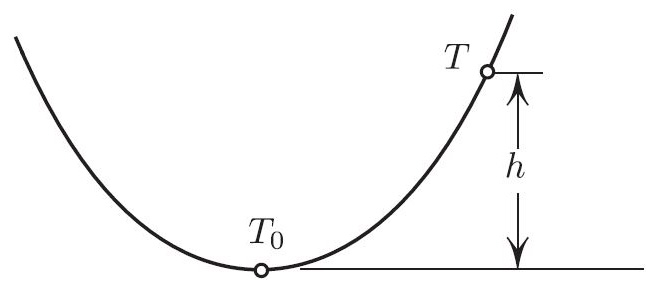
Figure illustrating that the tension in a hanging cable varies (approximately linearly) with height because each point must support the weight of the cable below it. This is a direct visual model of position-dependent tension in a massive rope, contrasting with the uniform- ideal-string assumption. Source
The same idea applies during motion. If a massive string is accelerating, one part of the string may need to pull not only on attached objects but also on other parts of the string. In that case, assigning one single tension value to the entire string is no longer valid.
For AP Physics C, the main contrast is conceptual:
Ideal string same tension throughout one continuous string
Massive string tension can depend on position
Ideal pulleys
A pulley redirects a string and changes the direction of the pull transmitted through that string.
Ideal pulley: A pulley with negligible mass and negligible friction.
If a continuous ideal string passes over an ideal pulley, the pulley changes the direction of the tension force without changing its magnitude.
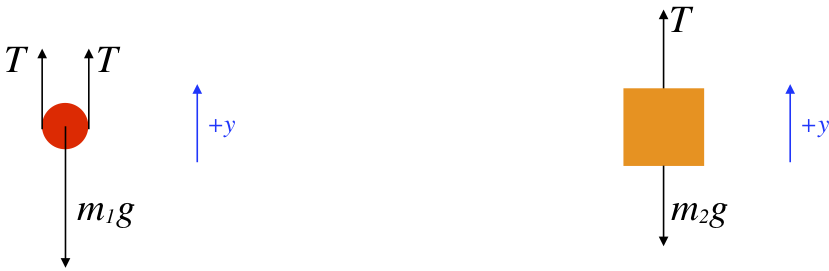
Free-body diagram of a pulley showing equal tension forces on both sides when the pulley is ideal (massless and frictionless). The figure emphasizes that the pulley changes the direction of the tension forces while keeping their magnitudes equal for a single continuous ideal rope. Source
This is why many connected-object problems use the same symbol on both sides of the pulley.
The two pulley assumptions matter separately:
Negligible mass means the pulley does not require a tension difference simply to account for its own inertia.
Negligible friction means the axle does not add resistive effects that would make one side’s tension larger than the other.
So, for one ideal string over one ideal pulley, the tension magnitude remains the same on both sides. The pulley redirects the force, but it does not create extra tension.
If the pulley is not ideal, this equal-tension result cannot automatically be assumed. A pulley with significant mass or friction can have different tensions on different sides of the string.
Using the model correctly
Common rules
When reading or solving a problem, identify the model before writing equations.
If the problem says light string, massless string, or inextensible string, it is usually signaling an ideal string.
If the problem says massless, frictionless pulley, it is signaling an ideal pulley.
Use one tension variable only when the string is continuous and ideal.
Do not extend that same tension automatically to a different string.
If the string has mass, be prepared for tension to vary with location.
If the pulley is not ideal, do not assume equal tension on opposite sides.
These assumptions are not minor details. They determine whether a connected system can be simplified into a clean Newton’s-law model or whether the string and pulley must be treated more carefully as physical objects.
Practice Questions
A light string passes over a massless, frictionless pulley. The tension on the left side of the pulley is .
State the tension on the right side, , and briefly justify your answer.
1 mark: States .
1 mark: Correct justification that the string is ideal and the pulley is ideal, so the tension is the same throughout one continuous string.
A rope of total mass hangs vertically at rest from the ceiling.
(a) Is the tension the same at all points in the rope? Explain.
(b) Compare the tension at the top, middle, and bottom of the rope.
(c) If the rope were instead modeled as ideal, how would your answer to part (a) change?
1 mark: States that the tension is not the same at all points.
1 mark: Explains that the rope has mass, so different points support different amounts of rope below them.
1 mark: States that the tension at the top is greatest.
1 mark: States that the tension at the bottom is smallest, with the middle in between.
1 mark: States that for an ideal string, the tension would be treated as uniform throughout one continuous segment.
FAQ
Negligible mass does not mean negligible force. It means the string’s own inertia is so small that it can be ignored in the model.
The tension is set by how the connected objects interact and by the constraints of the system. A very light string can still transmit a large pull.
In reality, any string has a breaking limit, but AP ideal-string models ignore failure unless the problem specifically includes it.
No. An ideal pulley does not automatically create a mechanical advantage.
A single fixed ideal pulley usually changes the direction of the force, not its magnitude.
A reduced input force occurs only when the arrangement creates multiple supporting string segments.
So the word ideal means no mass and no friction, not “smaller force required”.
The axle force is the vector sum of the tension forces applied by all string segments touching the pulley.
For example, if two vertical segments each pull downward with tension $T$, the string pulls downward on the pulley with total force $2T$, so the axle must provide an upward force of $2T$.
This is why the support force on a pulley is often larger than the tension in any one segment.
It is usually reasonable when:
the rope’s mass is very small compared with the attached masses
its stretch is negligible during the motion studied
pulley friction is small enough to ignore
This is an approximation, not a statement that the rope is literally massless or perfectly rigid.
Good modelling means checking whether those neglected effects would noticeably change the answer.
If the pulley has significant mass, a tension difference may be needed to produce angular acceleration.
If the axle has friction, one side may also need a larger tension to overcome that friction.
So unequal tensions are not caused by the string “forgetting” how to transmit force. They come from the pulley itself no longer behaving ideally.
