

AP Syllabus focus: 'Tension is the macroscopic result of forces that neighboring parts of a string, cable, or chain exert on each other in response to external forces.'
Strings, cables, and chains often seem like passive connectors, but in mechanics they transmit forces through their own material. Tension describes that transmitted pull and helps explain how forces act across extended objects.
What Tension Means
In everyday language, people say that a rope “has tension.” In physics, that means the rope is transmitting a pulling force. The key idea is origin: the force does not appear from nowhere. One part of the material pulls on the next part, and this sequence of interactions continues along the string, cable, or chain.
Tension: The pulling force transmitted through a string, cable, or chain because neighboring parts of the material exert forces on one another in response to external forces.
Because tension is a macroscopic idea, mechanics does not track every tiny interaction inside the material. Instead, it describes the overall transmitted pull from one region of the object to the next.
How Tension Arises
External forces start the process
If nothing pulls on a loose cord, there is no reason for neighboring parts to pull strongly on one another. Tension develops when external forces act on the string, cable, or chain. A hand may pull one end, a support may hold another end, or an attached object may pull back on the material. Those outside interactions create the conditions that make internal pulling forces appear.
This is why tension should not be treated as something the string creates independently. The string, cable, or chain responds to what the environment does to it.
Neighboring parts transmit the pull
A useful mental model is to divide a cable into many small segments. A segment near one end is pulled by whatever is attached there. That segment then pulls on the next segment, which pulls on the next one, and so on. This is the core meaning of tension in mechanics: a transmitted pull carried through neighboring parts.
Tension is therefore not only a force at the ends. It exists throughout the stretched object because adjacent pieces are continuously exerting forces on each other. If you focus on a small portion of the string, the parts on either side pull on that portion. If you focus on the object attached to the end, the end of the string pulls on that object.
Why the description is macroscopic
At the AP Physics C level, macroscopic means that the material is treated as an ordinary visible object rather than being analyzed in microscopic detail. The many tiny interactions inside the material are bundled into one large-scale description: tension.
This matters because it lets mechanics focus on force transmission. You do not need a microscopic model of every fiber in a rope or every metal strand in a cable to describe the pull it exerts on an attached object.
Strings, Cables, and Chains as Force Transmitters
Although strings, cables, and chains are built differently, they play the same mechanical role when they are taut: they transmit pulling forces along their length. A string may be made of fibers, a cable may consist of multiple strands, and a chain may be a series of connected links. In each case, one part pulls on the next.
For a chain, the idea is especially visible. One link pulls on the neighboring link, which then pulls on the next link. The same mechanical idea applies to a rope or cable even when the internal structure is less obvious.
When such an object acts on something attached to its end, the force on that attached object is a tension force. The attached object is being pulled by the end segment or end link. Likewise, the attached object pulls back on the string, cable, or chain. The transmitted pull is therefore tied directly to the interaction between the connector and whatever is attached to it.
The direction of the tension force is along the string, cable, or chain at the point being considered.
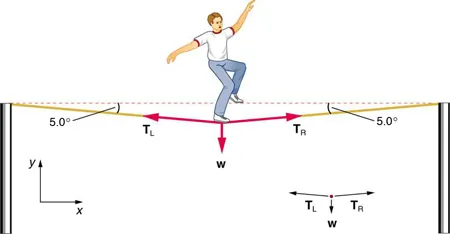
A tightrope/wire under load with left and right tension vectors drawn along the rope segments as the wire sags. The picture highlights that tension at a given point is directed tangent to (along) the connector, so changing cable direction changes the direction of the tension forces while remaining a pull along the material. Source
Common Interpretations and Pitfalls
Tension is not an extra source of force
Students sometimes speak as if tension is a separate agent that exists on its own. A better description is that the string, cable, or chain exerts a tension force because neighboring parts of the material are pulling on each other. Saying “the tension pulls the object” is useful shorthand, but the physical source is still the connector itself.
Tension is transmitted, not independently created everywhere
If one end of a rope is pulled, the far end can pull on another object because the intermediate parts pass the interaction along. This is what makes strings, cables, and chains useful in mechanics: they connect separated objects and allow forces to be carried through the material.
Slack versus taut
A slack rope may exert little or no meaningful tension because its neighboring parts are not being required to sustain a strong transmitted pull. Once the rope becomes taut, the material can carry the pull from place to place. For this reason, AP Physics C questions about tension usually involve strings, cables, or chains that are tight enough to transmit force clearly.
What You Should Know for AP Physics C Mechanics
Identify the physical origin of tension as forces between neighboring parts of a string, cable, or chain.
State the role of external forces: tension appears in response to pulls or constraints imposed from outside the material.
Describe tension as a pull, not as an independent force source.
Recognize the force on an attached object as the pull exerted by the connector at the point of attachment.
Use the macroscopic model appropriately: treat the string, cable, or chain as transmitting force without analyzing every tiny internal interaction.
FAQ
In a real cable, a change in pull travels through the material at a finite speed. The cable must deform slightly for one part to begin pulling more strongly on the next part.
That means a sudden tug produces a travelling disturbance rather than an immediate change everywhere at once. Idealised models often ignore this delay because it is very small in many AP-level situations.
Tension is the overall pulling force transmitted through a string, cable, or chain.
Tensile stress is how that force is spread over cross-sectional area inside the material. Two cables can carry the same tension but have different stresses if one cable is thinner. Stress is more useful when discussing failure or material strength.
Each link pulls on the next link through their contact points. Even though the chain is not one continuous piece, the links still form a connected path for transmitting a pull.
So, at the macroscopic level, a chain behaves like a force-transmitting connector. The discreteness matters for design and flexibility, but the basic idea of transmitted pull remains the same.
Knots and clamps can create local regions where the material bends sharply or is squeezed unevenly. That can concentrate force into a small region instead of distributing it smoothly.
As a result, the string may fail at the knot or clamp even when the overall tension is below the breaking load of an undamaged straight section.
A thick cable may not share force perfectly across all its strands or across its full cross-section. Small differences in construction, wear, or loading can make some parts carry more of the pull than others.
In that case, the single word “tension” is still useful, but engineers may need more detailed models to describe how the force is distributed within the cable.
Practice Questions
A rope is stretched between two students. Explain why the force transmitted through the rope is described as tension rather than as a force created independently by the rope.
1 mark: States that neighboring parts of the rope pull on one another.
1 mark: States that these internal pulls occur in response to external forces applied at the ends.
A crate is attached to the end of a chain and is pulled by a machine at the other end. Without performing any calculations, describe how the machine’s pull produces a force on the crate. Your answer should refer to the chain’s internal structure, neighboring links, the meaning of “macroscopic,” and the direction of the force on the crate.
1 mark: Identifies the machine’s pull as an external force on the chain.
1 mark: States that each link pulls on the neighboring link.
1 mark: Explains that the pull is transmitted through the chain to the crate.
1 mark: Explains that “macroscopic” means describing the overall transmitted pull without tracking microscopic details.
1 mark: States that the force on the crate is a pull along the chain at the point of attachment.
