

AP Syllabus focus: 'Newton's third law describes interactions using paired forces. If object A exerts a force on object B, object B exerts an equal and opposite force on object A.'
Newton’s third law explains why forces always come in pairs between interacting objects. Understanding these pairs helps you describe forces precisely and avoid one of the most common mistakes in mechanics: matching the wrong forces together.
Newton’s Third Law as an Interaction Rule
Every force comes from an interaction between two objects. Newton’s third law says an interaction cannot create a force on only one object. Instead, it creates an action-reaction force pair.
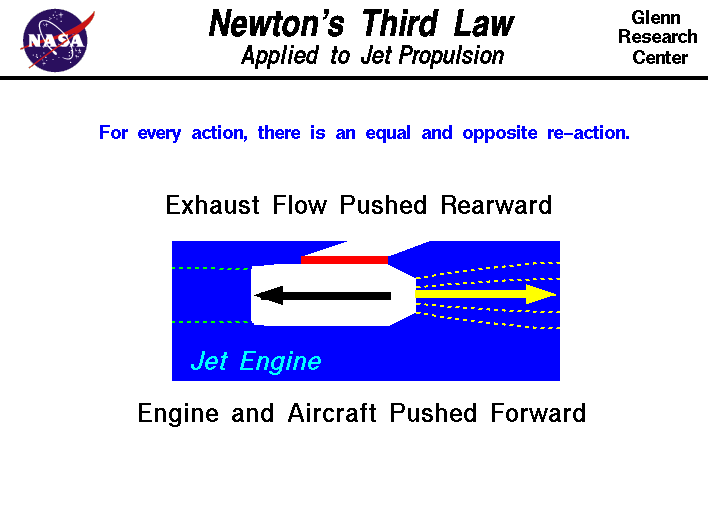
A jet-engine schematic illustrating thrust as an interaction pair: the engine pushes exhaust gases backward, and the exhaust gases push the engine forward with equal magnitude and opposite direction. This is a concrete example that Newton’s third law applies to forces mediated by fluids, not only solid-object contact forces. Source
Action-reaction force pair: Two forces produced by one interaction that act on two different objects, have equal magnitude, opposite direction, and exist at the same time.
The words action and reaction can be misleading. They do not mean one force happens first and the other happens later. Both forces exist simultaneously as part of the same interaction.
= force exerted by object on object , in newtons
= force exerted by object on object , in newtons
This equation is a compact statement of the law. It shows that the two forces have the same magnitude and opposite directions, but it also shows something equally important: the forces act on different objects.
Features of a Valid Action-Reaction Pair
To decide whether two forces form a true third-law pair, check all of the following:
Same interaction: The forces come from one physical interaction, such as a push or gravitational attraction.
Two objects: One force acts on object and the other acts on object .
Equal magnitude: Neither force is larger.
Opposite direction: The vectors point in opposite directions.
Same type of force: A gravitational force pairs with a gravitational force, and a contact force pairs with a contact force.
Same time: If the interaction is present, both forces are present.
If even one of these checks fails, the forces are not a third-law pair.
Naming forces clearly
It is helpful to name forces in the form force of object on object . This naming makes the partner force easy to identify by reversing the objects: force of object on object .
That language keeps the interaction clear and prevents you from choosing two forces simply because they point in opposite directions.
Why Third-Law Pairs Do Not Cancel
A very common mistake is to say that equal and opposite forces must cancel. That is only true when the forces act on the same object. Third-law pairs never do that.
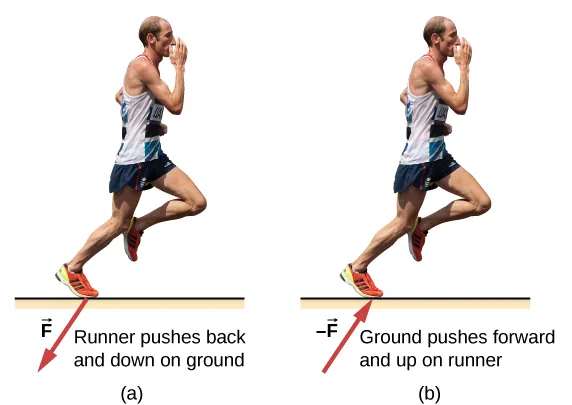
A runner–ground interaction diagram showing the force of the runner on the ground and the equal-and-opposite force of the ground on the runner. It makes the “two objects” rule visually explicit: the paired forces belong on different bodies (and thus on different free-body diagrams). Source
If a hand pushes a cart, the hand exerts a force on the cart, and the cart exerts an equal and opposite force on the hand. These forces are a third-law pair, but they cannot cancel because one acts on the cart and the other acts on the hand.
Forces that cancel in a net-force calculation must act on one chosen object. Third-law partners act on two different chosen objects.
Equal forces can still produce different motion
Students sometimes think equal and opposite forces must produce equal and opposite changes in motion. That is not required. The forces are equal, but the objects can respond differently because they may have different masses or may also experience other forces.
For instance, when a light cart and a heavy cart push on each other, each exerts the same force on the other during the interaction. Even so, the lighter cart can undergo a larger acceleration. Newton’s third law is about the interaction force pair itself, not about identical motion.
How to Identify the Correct Partner Force
A reliable method is to start with one specific force and ask two questions: Who is exerting the force? and What object is receiving it? Then reverse those roles.
If the force is Earth on ball, the partner is ball on Earth.
If the force is shoe on floor, the partner is floor on shoe.
If the force is planet on satellite, the partner is satellite on planet.
This method prevents a classic error: pairing two forces that happen to be opposite in direction but come from different interactions. For example, a downward gravitational force on an object and an upward support force on that same object are not a third-law pair. They act on the same object and come from different sources.
Contact and Noncontact Interactions
Newton’s third law applies to all interactions, not just collisions or pushing. Contact interactions make the law easy to see, but noncontact interactions obey it as well.
In a collision, each object pushes on the other with equal and opposite force during the brief contact.
In gravity, each mass pulls on the other with equal and opposite force.
Because forces are always paired, you should never describe an interaction with only one force. A one-sided force description is incomplete.
Common Misconceptions
Several misunderstandings appear repeatedly in mechanics problems:
“The bigger object exerts the bigger force.” False. In the interaction, the forces are equal in magnitude.
“If one object is moving and the other is at rest, the moving object exerts the larger force.” False. Motion does not break the third law.
“The action force happens first, then the reaction force follows.” False. The pair is simultaneous.
“Equal and opposite means equilibrium.” False. Third-law pairs act on different objects, so they do not by themselves determine whether either object is in equilibrium.
“Only contact forces come in pairs.” False. Gravitational forces also satisfy the law.
When solving AP Physics C problems, the safest habit is to state every force with both object names. Doing so makes third-law pairs much easier to recognize and helps separate interaction pairs from the forces that determine one object’s net force.
Practice Questions
A soccer player kicks a ball. State the Newton's third-law partner to the force of the player's foot on the ball, and state the relationship between the two forces. [2 marks]
1 mark: Identifies the partner force as the force of the ball on the player's foot.
1 mark: States that the two forces are equal in magnitude and opposite in direction.
A book rests motionless on a table. Consider the downward gravitational force exerted by Earth on the book and the upward normal force exerted by the table on the book.
(a) Identify the Newton's third-law partner to the gravitational force exerted by Earth on the book. [1 mark]
(b) Explain why the normal force exerted by the table on the book is not the third-law partner of the gravitational force exerted by Earth on the book. [2 marks]
(c) Identify the Newton's third-law partner to the normal force exerted by the table on the book, and describe the relationship between the two normal forces. [2 marks]
(a) 1 mark: Force of the book on Earth.
(b) 1 mark: States that the gravitational force and the normal force both act on the book.
(b) 1 mark: States that they come from different interactions or different sources.
(c) 1 mark: Identifies the partner force as the force of the book on the table.
(c) 1 mark: States that the two normal forces are equal in magnitude and opposite in direction.
FAQ
No. A single force belongs to exactly one third-law pair because it comes from one specific interaction between two objects.
An object may experience several forces at once, but each of those forces has its own separate partner. Naming both objects carefully is the best way to keep the pairs straight.
The link is through impulse. If two objects interact only with each other, the forces are equal and opposite at every instant, so the impulses are also equal and opposite.
That means one object’s momentum change is the negative of the other’s. As a result, the total momentum of the two-object system stays constant, provided external forces are negligible.
Each sensor measures one side of the same interaction. Ideally, the graphs should have the same shape and size but opposite signs, because the forces are equal and opposite throughout the collision.
Small differences can appear because of:
sensor calibration
slight timing offsets
vibrations
experimental noise
These practical issues do not contradict the law.
Yes. The law matches the forces, not the torques. Torque depends on both force and lever arm about a chosen axis.
So two equal and opposite interaction forces can lead to very different rotational outcomes if they act at different locations on the two bodies. One object might spin noticeably while the other hardly rotates at all.
In swimming, a swimmer pushes water backwards, and the water pushes the swimmer forwards with an equal and opposite force.
In a rocket, the rocket pushes exhaust gases backwards, and the gases push the rocket forwards. The forward motion is not a violation of the law; it is a direct consequence of the interaction pair acting on different parts of the physical situation.
