

AP Syllabus focus: 'Newton's first law states that when the net force on a system is zero, the system continues with constant velocity.'
Newton’s first law explains motion when forces balance. It shows that motion does not need a continuing push; instead, unchanged motion is the natural result of zero net external force.
Newton’s First Law
Newton’s first law describes what happens when the vector sum of forces on a system is zero. If nothing from the environment produces an unbalanced force, the system does not change its motion. This means an object already moving keeps moving in the same direction at the same speed, and an object initially at rest stays at rest. The law is not about a special kind of motion that needs support; it is about motion that remains unchanged because no net external force is available to change it.
Constant velocity: Motion in which both speed and direction remain unchanged.
Because velocity is a vector, constant velocity is more restrictive than constant speed. A car traveling around a curve may keep the same speed, but its direction changes, so its velocity is not constant and Newton’s first law does not apply to that motion.
Net force and unchanged motion
A system can experience several individual forces at the same time and still satisfy Newton’s first law if those forces cancel as vectors.
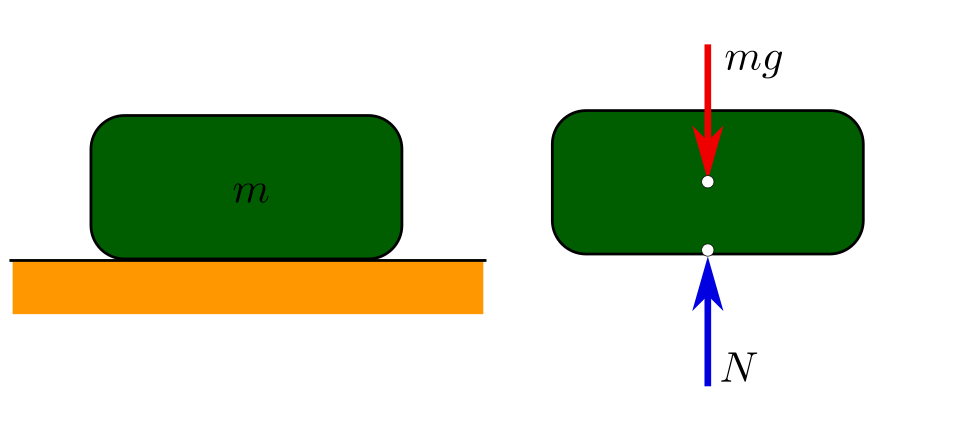
Force diagram of an object on a horizontal surface showing the normal force upward and weight downward. The equal-and-opposite vectors illustrate how multiple external forces can be present while still producing zero net force. Source
Net force: The vector sum of all external forces acting on a system.
The word external matters. Forces within the chosen system do not determine whether the system as a whole changes velocity. What matters is whether the environment exerts an overall unbalanced force on the system.
Mathematical statement
The law is usually recognized in mechanics problems through a zero net force condition.
= net external force on the system, in newtons
When this condition holds, the velocity does not change with time.
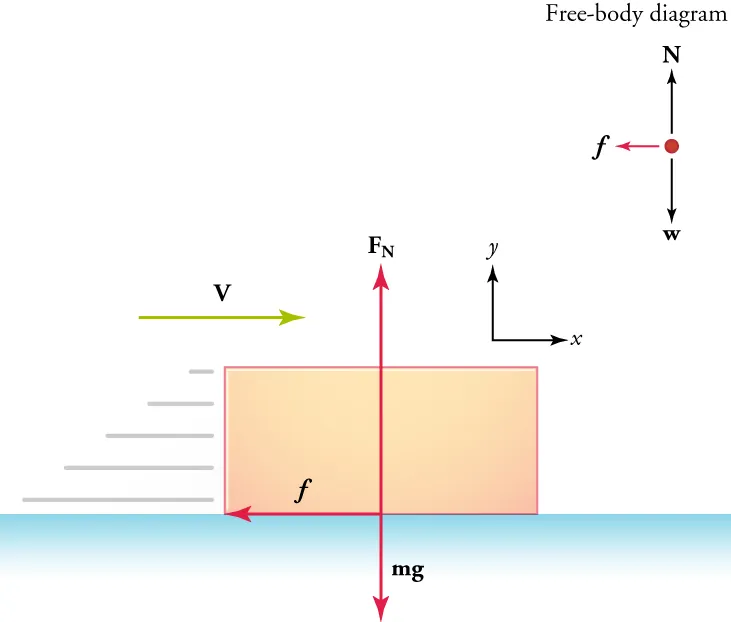
A block moving to the right at constant velocity with kinetic friction acting left, alongside a corresponding free-body diagram. The diagram reinforces that constant velocity requires the horizontal forces to cancel so that . Source
The motion can therefore be represented as a straight-line motion with fixed speed, or as rest if the initial velocity is zero.
What Constant Velocity Means Physically
Newton’s first law often corrects an everyday intuition: many people expect motion to require an ongoing force in the direction of travel. In mechanics, that is not true. A net force is needed to change velocity, not to maintain it. If an object moves across a nearly frictionless surface and no unbalanced external force acts, its motion continues without speeding up, slowing down, or turning.
Several important consequences follow:
Zero net force does not mean zero motion.
A moving object can have zero net force.
An object at rest can also have zero net force.
Any change in speed or direction means the net force is not zero.
These ideas are central when interpreting motion descriptions. If the problem states that velocity is constant, then the acceleration is zero and the net external force must also be zero. If the path bends or the speed changes, Newton’s first law no longer describes the motion.
Balanced Forces Are Not the Same as No Forces
It is common for an object to have multiple forces acting on it while still moving with constant velocity. For example, one force may point upward and another downward with equal magnitude, while a pair of horizontal forces also cancel. The object is then subject to forces, but the net force is still zero.
This distinction is essential. Saying “the forces are balanced” means their vector sum is zero; it does not mean the object is isolated from all interactions. In AP Physics C Mechanics, you should always separate the idea of individual forces from the idea of the resultant force. Newton’s first law depends only on the resultant.
Rest as a special case
An object at rest is simply an object with constant velocity equal to zero. Newton’s first law therefore includes the familiar idea that a stationary object remains stationary when no unbalanced external force acts. This is not a different rule from the moving case. Both situations belong to the same principle: unchanged velocity.
How to Use the Law in Analysis
When a problem mentions constant velocity, treat that phrase as a powerful clue. It tells you that the forces on the chosen system must balance. This allows you to infer relationships among forces even before doing any algebra.
A useful reasoning pattern is:
Identify the system.
Decide whether the velocity is changing.
If the velocity is constant, set the net external force equal to zero.
Use that condition to compare force components in each relevant direction.
This reasoning is especially helpful in conceptual questions, where the exam may ask for an explanation rather than a numerical result. The strongest answers explicitly connect zero net force to unchanged velocity, not just to “motion” in a vague sense.
Common Misunderstandings
One common error is to think that if an object is moving to the right, there must be a net force to the right. Newton’s first law says otherwise: rightward motion can persist even when the net force is zero.
Another common error is to confuse constant speed with constant velocity. Constant speed alone is not enough. If direction changes, the velocity changes, so the net force cannot be zero.
A third error is to assume that everyday objects stop “naturally.” In mechanics, stopping is not the natural state of motion. Objects stop because external forces from the environment act on them. If those external forces were absent or perfectly balanced, the motion would continue unchanged.
Finally, do not treat Newton’s first law as merely a sentence about still objects. Its more powerful statement is about all motion with zero net force. The law applies equally to an object at rest and to an object traveling in a straight line with constant speed. Both are cases of constant velocity.
FAQ
Before Newton, many thinkers believed that continuous motion required a continuous force.
Newton’s first law replaced that idea with a deeper one: force is needed to change motion, not to maintain it. That shift made it possible to analyse motion using precise cause-and-effect reasoning and became one of the foundations of classical mechanics.
Your body tends to keep its existing velocity when the car begins to slow down. The car changes speed quickly, but your body does not change speed at the same instant.
You move forwards relative to the car until another force, such as a seat belt or the seat itself, changes your motion. This is a direct everyday consequence of Newton’s first law.
They reduce unwanted external forces, especially friction.
That matters because Newton’s first law is easiest to observe when the net force is very close to zero. In an ordinary classroom setting, hidden forces from rough surfaces can make an object slow down, which can disguise the principle unless the apparatus is designed to minimise those effects.
Yes. Zero net force does not mean zero position change; it means zero change in velocity.
If an object already has a nonzero velocity, its position will continue to change steadily with time. On a graph, this usually appears as:
a straight line on a position-time graph
a horizontal line on a velocity-time graph
Real data often show tiny changes in velocity even when a setup is meant to have zero net force.
That usually means small residual forces are still present, such as slight surface contact, air resistance, or imperfect alignment. In practice, Newton’s first law is used as an ideal model, and experimentalists judge how well a real system matches it by looking at how nearly constant the measured velocity remains.
Practice Questions
A hockey puck moves east across frictionless ice at a constant velocity of . State the net horizontal force on the puck and justify your answer using Newton’s first law.
1 mark: States that the net horizontal force is .
1 mark: Explains that constant velocity means the velocity is not changing, so Newton’s first law requires zero net force.
A box moves north at on a level floor. At one instant, the forces on the box are north, south, upward from the floor, and downward due to Earth.
(a) Determine the net force on the box.
(b) State the box’s acceleration.
(c) Describe the box’s motion immediately after this instant.
(d) Explain why the box can still be moving even though the net force is zero.
1 mark: Recognises that the horizontal forces cancel.
1 mark: Recognises that the vertical forces cancel.
1 mark: States that the net force is .
1 mark: States that the acceleration is .
1 mark: States that the box continues moving north at in a straight line, with explanation that zero net force means constant velocity, not zero velocity.
