

AP Syllabus focus: 'Forces can be balanced in one dimension and unbalanced in another. A system changes velocity only in the direction of the unbalanced net force.'
Many mechanics situations are easiest to understand by splitting force and motion into perpendicular directions.
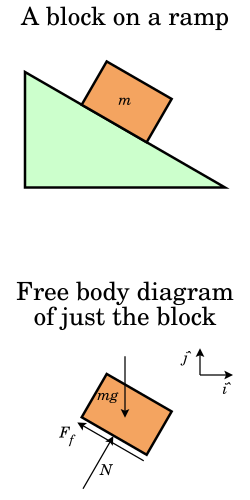
Free-body diagram of a block on an incline with labeled forces (weight, normal, and friction) and an explicit coordinate choice. This visual reinforces that only force components along a chosen axis contribute to or for that axis. Source
An object can be in equilibrium along one axis while still accelerating along another.
Separating Motion by Direction
In AP Physics C Mechanics, force and acceleration are vectors, so they must be analyzed by components. This means a problem in two dimensions is really two linked one-dimensional problems: one along the x-direction and one along the y-direction.
The key idea is that balance must be checked separately for each direction. If the upward and downward forces cancel, the object has no vertical acceleration. That fact alone does not tell you anything about the horizontal motion. There may still be a nonzero horizontal net force.
Likewise, if the leftward and rightward forces cancel, the object has no horizontal acceleration, even if the vertical forces are not balanced. A system can therefore be:
balanced in one direction
unbalanced in a perpendicular direction
moving in either or both directions at the same time
This is why an object can keep a constant velocity component in one direction while its velocity component in another direction changes.
Balanced forces in a direction: Forces whose components along one chosen axis add to zero, producing zero acceleration along that axis.
A common mistake is to think that if any force is present, the object must accelerate in every direction. In fact, only the net force component matters, and only along the axis where it acts.
Component Equations
When the forces are resolved into perpendicular directions, the laws of motion apply independently to each component.
This is the mathematical statement of the physical idea in this subsubtopic.
= Net force in the x-direction, N
= Mass of the system, kg
= Acceleration in the x-direction, m/s^2
= Net force in the y-direction, N
= Acceleration in the y-direction, m/s^2
If , then . The y-component of velocity therefore remains constant. It might be zero, but it could also be a nonzero constant value. Zero acceleration does not mean zero velocity.
If , then . The x-component of velocity changes. That change may be an increase, a decrease, or a reversal, depending on the object’s current motion.
What Balanced in One Direction Really Means
Balanced forces in one direction do not mean that no forces act there. It means the forces acting there cancel exactly.
For instance, an object on a level surface often has:
weight downward
normal force upward
These two forces may balance in the vertical direction, so the object has no vertical acceleration. However, the same object may also have horizontal forces that do not cancel. The result is motion with:
no change in vertical velocity
a change in horizontal velocity
This distinction is important because students often confuse equilibrium with rest. An object can be moving while the forces in one direction are balanced. What stays unchanged is the velocity component in that direction, not the position.
Balanced forces in one direction also do not “help” balance forces in a different direction. An upward force cannot cancel a rightward force, because they act along different axes.
What Unbalanced in Another Direction Changes
A system changes velocity only in the direction of the unbalanced net force. That is the central physical meaning of this topic.
If the net force is horizontal, then only the horizontal velocity component changes. The vertical velocity component remains constant if the vertical forces are balanced.
This has several important consequences:
The object’s speed may change.
The object’s direction of motion may change.
The object’s path may become diagonal or curved even when only one force component is unbalanced.
The acceleration vector points in the same direction as the unbalanced net force component. The velocity vector does not need to point that same way at that instant. An object can already be moving in one direction while accelerating in another.
That is why motion must be described component by component. Saying “the object is moving to the right” is not enough. You must ask:
Is the rightward velocity changing?
Is there any vertical velocity?
Which direction has zero net force?
Which direction has nonzero net force?
Common Errors in Reasoning
Several recurring mistakes appear in this kind of analysis.
Combining perpendicular forces as if they cancel: Only forces along the same axis can cancel directly.
Assuming zero net force in one direction means zero net force overall: The other direction must be checked separately.
Assuming balanced forces imply the object is stationary: Balanced forces imply constant velocity in that direction, not necessarily zero velocity.
Assuming an unbalanced force changes all components of motion: It changes only the component parallel to that net force.
Ignoring existing motion: A new unbalanced force affects acceleration immediately, but the object may still keep a previous velocity component in a balanced direction.
In mechanics problems, the most reliable approach is to identify each force component, test for balance along each axis, and then decide which velocity components stay constant and which must change.
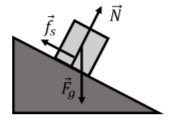
Worked free-body-diagram examples showing forces labeled on isolated objects (e.g., blocks on an incline with normal, weight, friction, and tension). The collection highlights how choosing axes and resolving forces leads directly to separate statements about and . Source
FAQ
Yes. The physical motion does not change, but the force components do depend on the axes you choose.
If you choose axes that line up with the actual acceleration, one component may come out as zero very clearly. With a less convenient axis choice, both components may be nonzero even though the underlying physics is identical.
This is why physicists often choose axes that make the balance easiest to see.
Yes. Balance in a direction can be an instantaneous condition.
For example, if forces are changing with time, the net force component along one axis might equal zero at one moment and become nonzero immediately afterward. At that instant, the acceleration component along that axis is zero, but it will not remain zero unless the balance continues.
So “balanced” can describe either a sustained state or a single moment in time.
A common sign is a constant velocity component along that axis.
In practice, you might:
track position frame by frame
calculate the velocity components
check whether one component stays constant
If the component remains constant within uncertainty, that suggests the net force in that direction is zero.
Real data are noisy, so you usually look for an approximately flat velocity-component graph rather than a perfectly exact one.
Because the total speed depends on all velocity components together, not just one.
In two dimensions, the speed is $v=\sqrt{v_x^2+v_y^2}$. If $v_y$ stays constant but $v_x$ changes, then the total speed changes as well.
So a balanced force in one direction does not guarantee constant speed. It guarantees only that the velocity component in that direction remains unchanged.
Even a very small nonzero net force produces a nonzero acceleration component.
At first, the effect may seem negligible, but over time it can become noticeable because the velocity component keeps changing. This is why tiny imbalances matter in precise experiments and simulations.
A direction that is “almost balanced” is not physically the same as one that is exactly balanced; it simply has a smaller rate of change of velocity.
Practice Questions
A puck slides across frictionless ice. The upward normal force equals the downward weight, and a constant force acts to the east. State whether the forces are balanced or unbalanced in the vertical and horizontal directions, and state the direction of the puck’s acceleration.
1 mark: Vertical forces are balanced.
1 mark: Horizontal forces are unbalanced.
1 mark: Acceleration is to the east.
A particle of mass moves north while a constant horizontal force of acts east. The vertical forces on the particle are balanced.
(a) Determine the net force in the east-west direction and in the vertical direction.
(b) Determine the acceleration components.
(c) Describe how the eastward and vertical components of velocity change.
1 mark: Net force east-west is east.
1 mark: Net force vertical is .
1 mark: east.
1 mark: .
1 mark: Eastward velocity component changes by increasing eastward.
1 mark: Vertical velocity component remains constant.
