

AP Syllabus focus: 'An inertial reference frame is one in which an observer would verify Newton's first law of motion.'
Reference frames tell us how motion is described. In mechanics, identifying whether a frame is inertial matters because Newton's laws keep their standard form only in frames that are not accelerating.
What a Reference Frame Means
A reference frame is the viewpoint from which positions, velocities, and accelerations are measured. In practice, it includes an observer, a coordinate system, and a way to measure time. Motion is always described relative to some frame, so the same object can have different coordinates and velocities for different observers.
Inertial reference frame: A reference frame in which an observer verifies Newton's first law, so an object with no net external force remains at rest or continues moving with constant velocity.
This definition is about the behavior of free objects, not about whether everything in the frame is motionless. A frame can still be inertial while moving at a constant velocity relative to another inertial frame. In Newtonian mechanics, there is no special frame of “absolute rest” that must be used for ordinary problems.
Connection to Newton's First Law
Newton's first law says that if the net external force on an object is zero, the object's velocity does not change.
That statement becomes a practical test for a frame. If an observer sees a puck glide across frictionless ice at constant velocity when no net external force acts, that observation is consistent with an inertial frame. If the same observer would need to invent an extra force to explain a change in velocity, the frame is not inertial.
The key idea is that Newton's laws are formulated for inertial frames. In an inertial frame, an object does not start speeding up, slowing down, or turning unless something external interacts with it. This makes inertial frames the standard setting for force analysis in AP Physics C Mechanics.
Non-Inertial Reference Frames
A non-inertial reference frame is a frame that is accelerating or rotating relative to an inertial frame.
Non-inertial reference frame: A reference frame in which Newton's first law does not hold in its simple form because the frame itself is accelerating or rotating.
Suppose you sit inside a car that suddenly accelerates forward. A loose object may seem to drift backward relative to you, even if no backward interaction causes that motion. The effect comes from the fact that your frame is accelerating, not from a new physical interaction on the object. Similarly, in a turning bus or on a spinning platform, objects can appear to curve or slide in ways that do not match Newton's first law unless the frame's acceleration is taken into account.
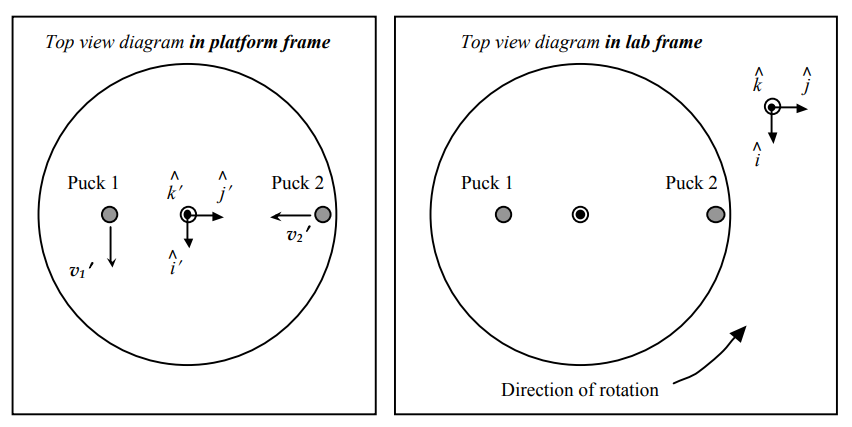
A rotating-frame setup with pucks shows how motion that is straight in an inertial (lab) frame can appear curved in the rotating frame. The page also lists the standard fictitious forces used in a rotating non-inertial frame (e.g., centrifugal and Coriolis terms) that account for these apparent deviations while keeping usable in the rotating coordinates. Source
For AP Physics C, the main point is recognition: if the observer's frame is accelerating or rotating, it is generally not inertial.
How to Recognize an Inertial Frame in Problems
In many mechanics problems, identifying the frame is straightforward.
A frame attached to the ground in a typical laboratory problem is often treated as approximately inertial.
A frame moving with constant velocity relative to the ground can also be treated as inertial.
A frame attached to an accelerating elevator, car, rocket, or rotating ride is non-inertial.
If Newton's first law works without adding extra “apparent” forces, the frame is inertial.
If free objects seem to accelerate for no physical reason, the frame is non-inertial.
The word approximately matters. No real frame is perfect in every situation. Earth rotates and revolves, so an Earth-based frame is not exactly inertial. However, for most AP Mechanics situations, those effects are small enough to ignore. The course usually treats the lab or ground frame as inertial unless the problem clearly describes noticeable acceleration or rotation of the frame itself.
Why This Matters in Mechanics
Choosing an inertial frame lets you apply Newton's laws directly and confidently. That matters because force reasoning depends on separating real interactions from motion caused by the observer's own acceleration.
If you misidentify the frame, you may:
draw forces that do not come from real objects,
misinterpret constant-velocity motion as requiring a force,
or fail to explain why an object appears to move strangely in an accelerating environment.
A major conceptual payoff is that two inertial observers moving at constant velocity relative to one another can both use Newton's first law successfully. They may disagree on measured velocity, but they agree on whether a free object has a changing velocity.
Common Misconceptions
Several mistakes occur repeatedly:
“A moving frame cannot be inertial.” False. Constant-velocity motion does not destroy inertial behavior.
“Rest means inertial.” False. A frame can be instantaneously at rest and still be accelerating, which makes it non-inertial.
“If an object looks like it drifts, there must be a real sideways force.” Not necessarily. In an accelerating frame, apparent motion can come from the frame, not a new interaction.
“Earth is never inertial, so Newton's laws cannot be used on Earth.” False. In most AP problems, Earth is a good enough inertial approximation.
This subtopic is fundamentally about where Newton's first law is valid in its standard form. Once that is clear, the rest of force analysis becomes much more reliable.
FAQ
A coordinate system is just a set of labels used to assign positions. A reference frame is broader: it includes the observer, the clock, and the state of motion of the observer.
You can redraw axes or shift an origin without changing whether the frame is inertial. But if the axes themselves rotate or accelerate with time, you have changed to a different frame, which may be non-inertial.
An accelerometer responds to forces on a small internal mass. If your frame is moving at constant velocity and no contact forces act on the device, it reads essentially zero.
If your car, lift, or spacecraft accelerates, the internal mass is forced away from its previous motion, and the device gives a non-zero reading. That is strong evidence that your local frame is not inertial.
For short laboratory experiments, the effect is usually tiny. For long times, large distances, or high precision, Earth’s rotation can become important.
Examples include:
Foucault pendulums
long-range artillery
weather systems
some aircraft and ocean-current motion
In those situations, a frame fixed to Earth behaves measurably as a rotating, non-inertial frame.
They are not additional physical interactions between objects. They appear when motion is described from a rotating frame and you want Newton-like equations to remain usable.
An observer in an inertial frame explains the same motion using only real forces such as gravity, tension, or contact forces. That is why centrifugal and Coriolis forces are called fictitious or inertial forces.
Often yes, but only approximately and only over limited distances and times. If the spacecraft is coasting, not rotating significantly, and far from strong gravitational gradients, objects inside can behave almost as they would in an inertial frame.
Over larger regions, gravity may vary slightly from one part of the cabin to another. Those tidal effects mean the cabin is never a perfect inertial frame everywhere at once.
Practice Questions
Two observers watch a hockey puck slide across nearly frictionless ice. Observer A stands on the ice. Observer B moves alongside the puck at constant velocity in a straight line. State whether each observer can use an inertial reference frame and justify your answer briefly.
1 mark: States that both A and B can be treated as inertial observers.
1 mark: Justifies that a frame moving at constant velocity relative to an inertial frame is also inertial, so Newton's first law is still verified.
A ball hangs from a string inside a train. The train accelerates forward, and the ball comes to rest at a constant backward angle relative to the train.
(a) State whether the train frame is inertial. (1 mark)
(b) Explain why Newton's first law does not apply in its simple form in the train frame. (2 marks)
(c) Describe the motion and force reasoning for the ball as seen from the ground frame, treated as inertial. (2 marks)
(a) 1 mark: States that the train frame is non-inertial because it is accelerating.
(b) 1 mark: Explains that the frame itself accelerates, so objects can appear to behave as though an extra force is present.
(b) 1 mark: States that Newton's first law is not verified directly in the train frame unless an apparent or fictitious force is introduced.
(c) 1 mark: States that in the ground frame the ball accelerates forward with the train.
(c) 1 mark: States that the horizontal component of the string tension provides the forward net force, while vertical forces balance.
