

AP Syllabus focus: 'The net force on a system is the vector sum of all forces. Translational equilibrium occurs when the net force on the system is zero.'
This subtopic establishes the exact force condition for translational equilibrium. Success in AP Physics C depends on treating forces as vectors and checking whether every component of the total force cancels.
Net Force as a Vector Quantity
The central idea is net force, the single force that represents the combined effect of all forces acting on a chosen object or system.
Net force: The vector sum of all forces acting on an object or system.
Because force is a vector, direction matters just as much as magnitude. Two large forces can cancel if they point in opposite directions, while two smaller forces can combine to produce a nonzero result if they point in different directions. For this reason, net force is never found by simply adding magnitudes unless all forces lie along the same line and a sign convention has already been chosen.
= net force on the chosen object or system, N
= vector sum of all forces acting on that object or system, N
This notation means that every force acting on the system must be included in a single vector sum. If the forces are collinear, the sum can be done algebraically with positive and negative signs. If the forces are angled or lie in more than one dimension, each force should be resolved into components before the final sum is found.
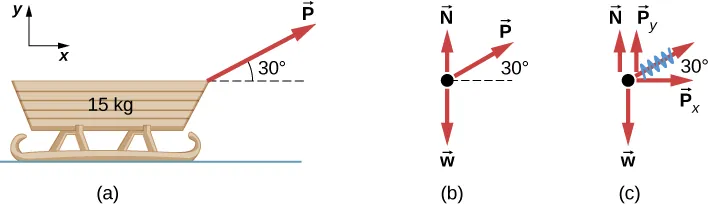
A sled example that transitions from the physical situation to a free-body diagram and then to a component-resolved force diagram. This is a compact visual of the workflow behind writing and and checking each for zero independently. Source
One-dimensional and multi-dimensional force sums
In one dimension, equilibrium questions often reduce to whether the positive and negative forces cancel exactly. In two dimensions, the analysis is stricter: the total horizontal force and the total vertical force must both vanish. A force that balances another in one direction may still leave an unbalanced component in a perpendicular direction, so visual cancellation alone is not enough.
Useful habits when assessing net force include:
Track direction with signs or vector components.
Combine only forces along the same axis when doing scalar sums.
Treat perpendicular directions separately before deciding whether the overall net force is zero.
Translational Equilibrium
A system is in translational equilibrium when there is no unbalanced net force acting on it.
Translational equilibrium: The condition in which the vector sum of all forces on a system equals zero.
This is a statement about the translation of the system as a whole. It does not mean that no forces are present, and it does not require the individual forces to be equal one-by-one. Instead, all of the forces together must cancel when added as vectors. A system can have several nonzero forces acting on it and still be in translational equilibrium if their total effect is zero.
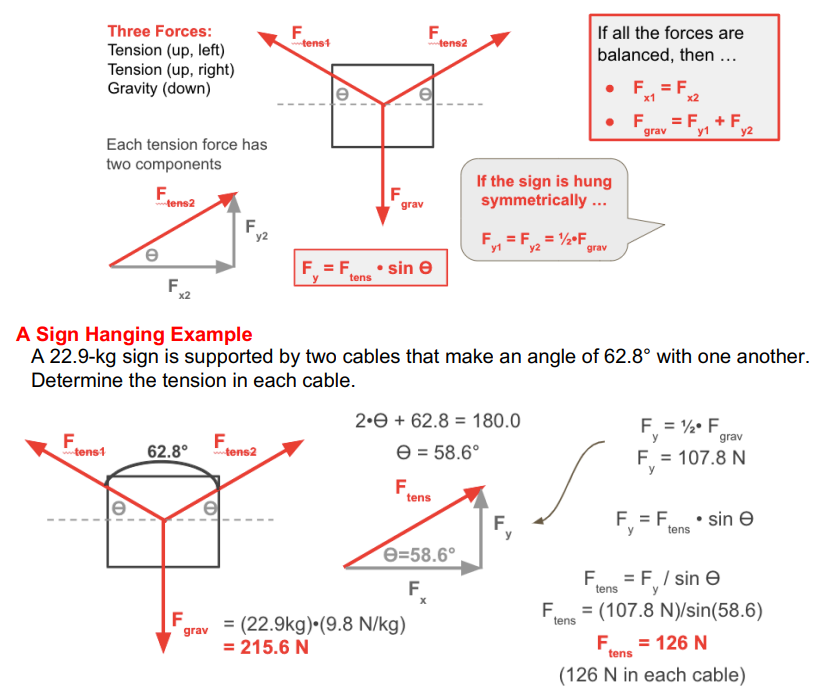
A hanging sign in equilibrium with two angled tension forces and a downward weight, accompanied by a component diagram that splits tension into - and -components. The figure emphasizes how equilibrium is verified by requiring the horizontal components to cancel and the vertical components to add to the weight. Source
= vector sum of all forces on the system, N
= zero vector, meaning no unbalanced force remains in any direction
The zero vector condition is the most compact and complete test for translational equilibrium. It is especially important in multi-force situations, because “balanced” means the full vector sum disappears, not merely that some forces point opposite one another.
For component-based analysis, the same condition can be written axis by axis.
= sum of force components along axis , N
= chosen coordinate direction such as , , or
In two dimensions, this means and .
In three dimensions, must also hold. If even one component sum is nonzero, the system is not in translational equilibrium.
What Balanced Forces Really Mean
The phrase balanced forces is often used informally, but in mechanics it has a precise meaning: the net force is zero. This is broader than saying “two forces cancel.” Three or more forces can be balanced, and the individual forces do not need to have the same magnitude.
Balanced-force situations can arise in several ways:
Two equal and opposite forces along one line
Several forces whose components cancel separately in each axis
One force balanced by the combined effect of multiple other forces
A common mistake is to look for matching pairs instead of evaluating the entire vector sum. AP Physics C problems reward a systematic approach: identify all forces, add them as vectors, and decide whether the result is zero.
Systematic Test for Equilibrium
When deciding whether a system is in translational equilibrium, it helps to follow the same sequence every time. First choose the object or system being analyzed. Next identify every force acting on it. Then express each force along the chosen axes and sum the components. Only after the full sums are written should you decide whether the net force is zero.
If every component sum is zero, the system satisfies translational equilibrium.
If any one component sum is nonzero, the system is not in translational equilibrium.
Changing the axes may change the algebra, but it cannot change the physical truth of whether the net force is zero.
Common Mistakes to Avoid
Errors in equilibrium problems usually come from weak vector reasoning rather than from difficult algebra.
Adding magnitudes without directions: force is a vector, so signs or components are essential.
Checking only one axis: zero net force vertically does not guarantee equilibrium overall.
Ignoring components of angled forces: an angled force usually contributes to more than one direction.
Assuming equilibrium means no forces act: equilibrium means cancellation, not absence of force.
Using incomplete force lists: the net force can be correct only if every relevant force on the chosen system is included.
The condition for translational equilibrium is therefore exact and testable: the vector sum of all forces on the system must equal zero.
FAQ
Yes. Translational equilibrium can be an instantaneous condition.
If the vector sum of forces is zero at one moment, the system is in translational equilibrium at that moment. If the forces later change so that the net force is no longer zero, the equilibrium no longer holds. This can happen in real systems with changing loads, moving supports, or time-dependent applied forces.
If you draw all force vectors head-to-tail and they form a closed shape, the net force is zero.
For two forces, this means they are equal in magnitude and opposite in direction. For three or more forces, the vectors may form a closed triangle or polygon. A closed force polygon is a geometric sign that the vector sum vanishes, so the system is in translational equilibrium.
In experiments, forces are measured with limited precision, so exact zero is rarely observed.
Instead, you compare the measured net force with the uncertainty of the apparatus. If the remaining force is small enough to fall within expected experimental error, it is reasonable to treat the system as being in translational equilibrium. This is why careful uncertainty analysis matters when testing balance conditions in the lab.
It can be very sensitive, especially when large forces are meant to cancel through their components.
A small angular error changes the horizontal and vertical components, which can leave a noticeable residual net force. This is one reason why setups involving cables or supports at shallow angles can be difficult to balance precisely. In practice, even slight misalignment may spoil equilibrium.
Sometimes, yes, but only when the symmetry is strong enough to guarantee cancellation.
For example:
equal forces placed symmetrically about a central line may have cancelling horizontal components
identical supports at mirrored angles may imply equal load sharing
However, symmetry arguments should be used carefully. If the geometry, masses, or force magnitudes are not truly symmetric, the conclusion may fail. A full vector check is always the safest test.
Practice Questions
A block has three horizontal forces acting on it: 12 N to the right, 5 N to the left, and 7 N to the left. Determine the net horizontal force and state whether the block is in translational equilibrium.
1 mark: Correctly finds the net force as N.
1 mark: Correctly states that the block is in translational equilibrium because the net force is zero.
A traffic light of mass is suspended at rest by two cables. The left cable makes an angle above the horizontal and has tension . The right cable makes an angle above the horizontal and has tension .
(a) Write the equilibrium equations for the horizontal and vertical directions.
(b) Solve for and in terms of , , , and .
1 mark: Correct horizontal equilibrium equation, such as .
1 mark: Correct vertical equilibrium equation, such as .
1 mark: Correct substitution or elimination using the two equilibrium equations.
1 mark: Correct expression for , .
1 mark: Correct expression for , .
