

AP Syllabus focus: 'Newton's law of universal gravitation says the gravitational force is proportional to both masses and inversely proportional to the square of the distance between their centers of mass.'
Gravity links all masses through a single mathematical rule. For AP Physics C, you need to understand how that rule depends on mass, separation, and the correct interpretation of distance.
Universal gravitation
Universal gravitation is the idea that any two masses interact through gravity, even when they are far apart. Newton expressed this interaction with a simple proportional law that applies broadly in classical mechanics.
Universal gravitation: The principle that every pair of masses exerts a gravitational force on each other, with magnitude determined by the masses and the distance between their centers of mass.
The key word universal matters. This law is not limited to planets, moons, or stars. It applies to any pair of objects with mass. In AP Physics C Mechanics, the main goal is to recognize the mathematical relationship: the gravitational force gets larger when either mass increases, and it gets smaller very quickly as the distance between the objects increases. In proportional form, this means and .
Newton’s law is usually written as a single equation for the magnitude of the gravitational force.
= magnitude of gravitational force, in newtons
= universal gravitational constant,
= the two interacting masses, in kilograms
= distance between the centers of mass, in meters
This equation combines two separate ideas into one compact statement. First, the force depends on the product of the masses, so both masses matter equally in setting the size of the interaction. Second, the force depends on the square of the separation distance, which makes distance especially important. The constant sets the overall scale of gravitational interactions in nature. Its very small value helps explain why gravitational forces between ordinary objects are usually much weaker than gravitational forces involving planets or stars.
Dependence on mass
If the distance stays fixed, changing either mass changes the force in direct proportion. This is often tested through ratio reasoning rather than full substitution.
If one mass doubles, the gravitational force doubles.
If one mass is cut in half, the gravitational force is cut in half.
If both masses double, the force becomes four times as large.
If one mass triples and the other stays the same, the force triples.
Because the masses appear multiplied together, it does not matter which one is labeled or . The expression is symmetric.
Dependence on distance
The distance dependence is an inverse-square relationship, and this is one of the most important features of the law. A modest increase in distance causes a large decrease in force. Students often underestimate how fast the force drops.
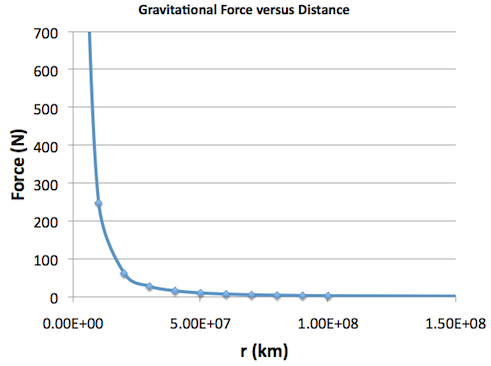
Plot of gravitational force (N) versus distance showing the characteristic inverse-square decay: large forces at small separations and rapidly diminishing force as increases. This visualization matches the scaling ideas in the notes (e.g., doubling reduces to one quarter). Source
If the distance doubles, the force becomes of the original value.
If the distance triples, the force becomes of the original value.
If the distance is cut in half, the force becomes four times as large.
This inverse-square form is why gravitational interactions are strong at relatively small separations between very massive bodies but become much weaker as separation grows.
Distance means center-to-center
In gravitational problems, is not usually the gap between surfaces.
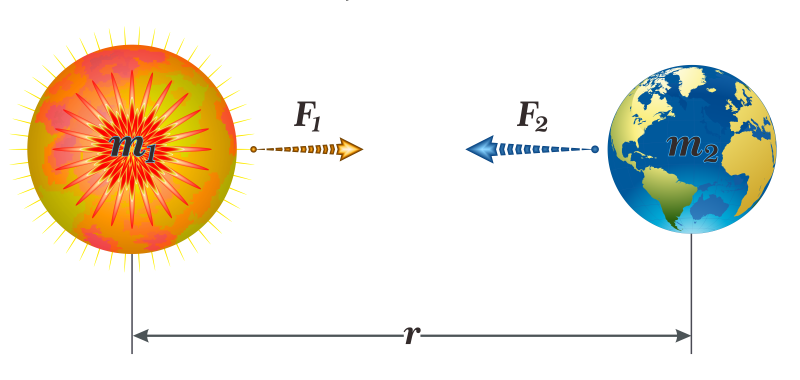
Diagram of two masses (shown as Sun and Earth) separated by the center-to-center distance , with forces and pointing along the line joining their centers. It highlights that the interaction is a mutual (pairwise) force and that the geometry uses centers of mass rather than surface distances. Source
It is the distance between the centers of mass of the two objects. This point is essential because the law is written in terms of the separation between the masses themselves as modeled in mechanics.
For many AP problems, each object can be treated as though its mass were concentrated at a single point for the purpose of calculating gravitational force magnitude. That means the correct distance is measured from the center of one object to the center of the other. A common mistake is to use an edge-to-edge distance instead. Unless the problem explicitly gives a center-to-center separation, you may need to infer it from the geometry.
Using the law effectively in AP Physics C
Newton’s law of gravitation often appears in problems that emphasize algebraic structure rather than difficult arithmetic. Strong setup matters more than memorizing special cases.
Useful habits include:
Identify the two interacting masses before writing the equation.
Make sure the distance used is the center-to-center distance.
Keep units in SI form: kilograms, meters, and newtons.
Use proportional reasoning when a problem asks how the force changes after one quantity is altered.
Check whether the problem is asking for the force itself or only how it compares with another force.
The equation is especially efficient when variables change by simple factors. For instance, if a mass becomes and the separation becomes , the new force can often be found immediately from scaling arguments without lengthy computation.
Common pitfalls
One frequent mistake is treating the distance dependence as instead of . Another is forgetting that both masses contribute to the force through multiplication. Students also sometimes mix up surface distance and center-to-center distance, which can significantly change the result.
A final point is that the law gives a pairwise interaction between two masses. When reading a problem, be clear about which two objects are being considered in the equation. Once that pair is identified correctly, Newton’s law of universal gravitation provides the exact mathematical relationship required by this subsubtopic.
FAQ
Gravity is extremely weak compared with other fundamental interactions, so the forces between laboratory-sized objects are tiny.
That means experiments must detect very small twists, displacements, or oscillations while reducing effects from:
vibrations
air currents
temperature changes
nearby masses
Because of this, $G$ is known much less precisely than many other physical constants.
It is called universal because the same mathematical form applies to all masses, not just objects near Earth.
The law was powerful historically because it used one rule to describe:
falling objects
planetary motion
moon–planet interactions
star–planet interactions
That unification was a major shift in physics: the heavens and Earth were described by the same mechanics.
Most everyday objects contain charged particles, but positive and negative charges usually balance almost exactly, so electric effects often cancel on large scales.
Gravity, however, only adds. Mass is always positive in ordinary mechanics, so gravitational effects accumulate.
Even so, the gravitational interaction between small objects is tiny, which is why you do not notice it unless at least one mass is enormous, such as a planet.
No. It works extremely well for many classical situations, especially where speeds are much smaller than the speed of light and gravitational fields are not extreme.
It begins to fail or need correction in cases such as:
very strong gravity near compact astronomical objects
very high precision orbital measurements
relativistic conditions
In those cases, general relativity gives a more complete description.
It could be tested through astronomical observations and laboratory experiments.
Astronomers checked whether planetary and lunar motions matched the predictions of an inverse-square force.
Later, laboratory measurements such as torsion-balance experiments allowed physicists to detect the attraction between known masses directly. That made it possible to estimate $G$ and confirm that the same law applied on both terrestrial and astronomical scales.
Practice Questions
Two objects have masses and and are separated by a distance . The gravitational force between them is . The distance is then doubled while the masses remain unchanged. What is the new gravitational force in terms of ?
1 mark for using the inverse-square dependence on distance,
1 mark for stating the new force is
A spacecraft of mass is a distance from the center of a small planet. The planet has mass .
(a) Write the equation needed to calculate the gravitational force between the planet and the spacecraft. (1 mark)
(b) Calculate the magnitude of the gravitational force on the spacecraft. Use . (3 marks)
(c) If the spacecraft moves to a distance from the planet’s center, state the new gravitational force as a fraction of the answer to part (b). (1 mark)
(a) 1 mark for
(b) 1 mark for correct substitution
(b) 1 mark for correct evaluation setup
(b) 1 mark for answer or
(c) 1 mark for stating the new force is of the part (b) value
